 COBOX
COBOX
How to Build a SaaS Product: From Idea to First Customer
How to Build a SaaS Product: From Idea to First Customer
Learn how to build a SaaS product from idea to first customer, including validation, MVP planning, technology, pricing, development, launch, and customer feedback.
Slug: how-to-build-a-saas-product
Category: SaaS & Product Development
Author: Himanshu Sharma
Publish Date:
Primary Keyword: how to build a SaaS product
Secondary Keywords: SaaS product development, build a SaaS application, SaaS MVP, SaaS development process, SaaS startup, SaaS product roadmap, SaaS software development
Excerpt: Learn how to build a SaaS product from idea to first customer, including validation, MVP planning, technology, pricing, development, launch, and customer feedback.
---
How to Build a SaaS Product: From Idea to First Customer
Building a SaaS product is not simply a matter of developing a web application and putting it online.
A SaaS business has to solve a real problem, attract the right customers, deliver recurring value, and operate reliably as the customer base grows.
That means there are several decisions to make before development starts:
- What problem are you solving?
- Who will pay for the solution?
- What should the first version include?
- How will customers discover the product?
- How will you price it?
- What technology should you use?
- How will you handle payments, security, support, and infrastructure?
- What will you measure after launch?
A practical SaaS development process can be summarized as:
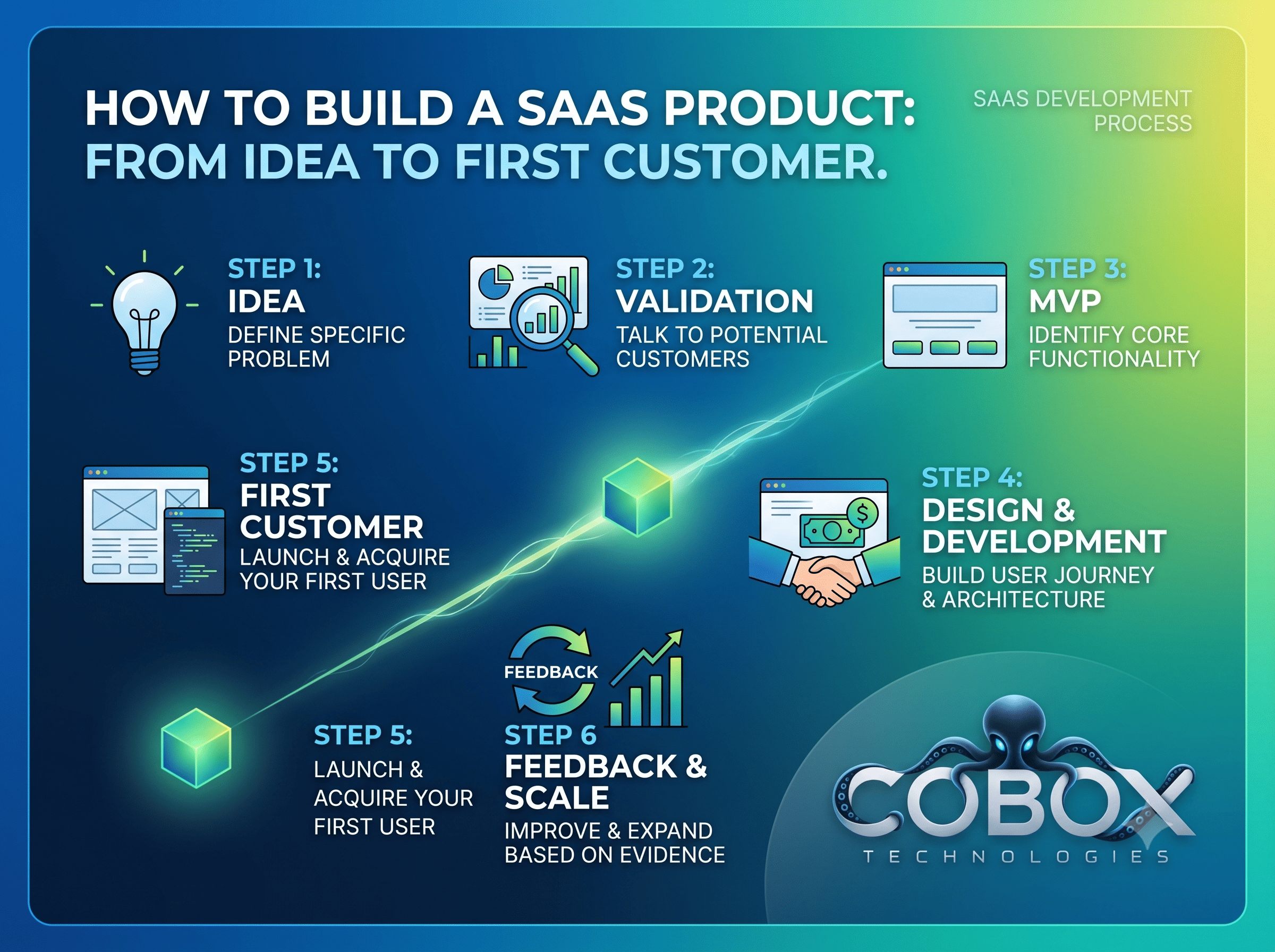
Problem → Validation → MVP → Development → First Customers → Feedback → Product Improvement → Scale
This guide explains each stage.
---
What Is a SaaS Product?
SaaS stands for Software as a Service.
Instead of purchasing software once and installing it locally, customers typically access a SaaS product through the internet and pay through a recurring subscription or usage-based model.
Examples of SaaS products include software for:
- Customer relationship management
- Accounting
- Project management
- Human resources
- Marketing
- Communication
- Analytics
- Customer support
- Document management
- Business automation
The SaaS model creates an important requirement:
The product must continue providing value after the initial purchase.
Getting the first customer is only the beginning.
---
Step 1: Start With a Specific Business Problem
Do not start with:
"I want to build a SaaS platform."
Start with:
"I want to solve this recurring problem for this specific type of customer."
For example:
Weak idea:
A platform for businesses to manage everything.
More specific idea:
A workflow platform that helps small accounting firms track client document collection and automatically remind customers about missing documents.
The second idea is easier to validate because the customer, problem, and workflow are clearer.
---
Step 2: Define Your Ideal Customer
Your first customer should not be "everyone."
Create an Ideal Customer Profile (ICP).
For example:
Industry: Accounting firms Company size: 5–50 employees Decision maker: Founder or operations manager Current process: Email + WhatsApp + spreadsheets Problem: Tracking client documents manually Business impact: Staff spend significant time following up Buying trigger: Increasing customer volume
This gives your sales and product teams a clear target.
---
Step 3: Validate the Problem
Before building the SaaS product, talk to potential customers.
Ask about their existing workflow.
For example:
- How do you handle this process today?
- What tools do you use?
- Where does the process usually fail?
- How much time does it take?
- How many people are involved?
- What happens when something is missed?
- Have you tried other software?
- What do you dislike about existing solutions?
- Would solving this problem save money or increase revenue?
The objective is to understand the customer's current behavior.
Do not rely entirely on hypothetical statements such as:
"Would you use this?"
Actual behavior is stronger evidence.
---
Step 4: Research Existing SaaS Products
There is a good chance that customers already use something to solve the problem.
That is useful information.
Research:
- Direct competitors
- Indirect competitors
- Free tools
- Spreadsheets
- Manual processes
- Internal software
Study their:
- Pricing
- Features
- Customer reviews
- Onboarding
- Integrations
- User experience
- Target market
Look for specific gaps.
For example:
Existing products provide the functionality, but they are designed for large enterprises and are difficult for small businesses to configure.
That can become part of your product positioning.
---
Step 5: Define Your SaaS Value Proposition
Your value proposition should explain three things:
Who is the product for?
What problem does it solve?
What result does the customer get?
For example:
"Help small accounting firms collect client documents faster by replacing manual WhatsApp and email follow-ups with one automated workflow."
This is more useful than:
"An innovative next-generation document management platform."
The first statement describes a business outcome.
---
Step 6: Decide Your SaaS Business Model
Your pricing model should match how customers receive value.
Common SaaS models include:
Per User
Customers pay based on the number of users.
Example:
₹999 per user/month
Useful for team-based software.
---
Tiered Pricing
Customers select different plans.
Example:
Starter — ₹999/month
Business — ₹2,999/month
Enterprise — Custom pricing
Different plans can provide different limits and features.
---
Usage-Based Pricing
Customers pay based on consumption.
Examples:
- API calls
- Transactions
- Messages
- Storage
- AI usage
This works well when product value increases with usage.
---
Flat Subscription
Everyone pays the same amount for the same product.
This is simple but may not work well when customers vary significantly in size.
---
Step 7: Define the MVP
Do not build the entire SaaS platform initially.
Identify the core workflow.
For example, for a customer support SaaS:
MVP
- User registration
- Team members
- Customer tickets
- Ticket assignment
- Status management
- Email notifications
- Basic dashboard
- Subscription management
Later
- AI ticket classification
- Advanced analytics
- WhatsApp integration
- Voice support
- Advanced automation
- Custom reporting
- Enterprise SSO
The MVP should solve the primary problem without carrying the entire future roadmap.
---
Step 8: Design the Core User Journey
Before development, map the customer's journey.
For example:
Landing Page
↓
Sign Up
↓
Create Workspace
↓
Configure Account
↓
Perform Core Workflow
↓
See Result
↓
Invite Team
↓
Upgrade Plan
This journey is more important than designing dozens of individual screens.
You need to understand what the customer must accomplish to receive value.
---
Step 9: Design the SaaS Architecture
Once the product scope is clear, technical architecture can be defined.
A typical SaaS application may contain:
Frontend
The user interface customers interact with.
Examples:
- React
- Next.js
- Vue
Backend
Handles:
- Business logic
- Authentication
- APIs
- Payments
- Background processing
Examples:
- Laravel
- Node.js
- NestJS
Database
Stores:
- Users
- Organizations
- Customers
- Transactions
- Product data
- Configuration
Common choices include:
- MySQL
- PostgreSQL
- MongoDB
The correct choice depends on the application's data model and requirements.
---
Step 10: Decide Whether You Need Multi-Tenancy
A SaaS product usually serves multiple customers from the same platform.
This introduces an important architectural concept:
Multi-tenancy.
For example:
Company A should only see Company A's data.
Company B should only see Company B's data.
The application must enforce this separation throughout the system.
A common early approach is to keep customers in the same database while associating records with an organization or tenant ID.
As requirements grow, other architectures can be considered.
The important point is to make the tenancy model explicit before development.
---
Step 11: Build Authentication and Permissions
SaaS applications frequently have different types of users.
For example:
- Owner
- Admin
- Manager
- Employee
- Viewer
You need to define what each role can:
- View
- Create
- Update
- Delete
- Approve
- Export
This is called authorization.
Authentication answers:
"Who are you?"
Authorization answers:
"What are you allowed to do?"
Both should be designed carefully from the beginning.
---
Step 12: Build the Billing System
If customers pay for your SaaS, billing becomes part of the core product.
Your system may need:
- Plans
- Subscriptions
- Trials
- Payment processing
- Invoices
- Renewals
- Failed payments
- Cancellations
- Upgrades
- Downgrades
- Usage limits
For example:
A customer starts a 14-day trial.
↓
Trial expires.
↓
Payment succeeds.
↓
Subscription becomes active.
↓
Monthly renewal occurs.
↓
Payment fails.
↓
Customer receives notification.
↓
Account enters a defined grace period.
This workflow should be designed before implementation.
---
Step 13: Build the MVP
Now development can begin.
A typical SaaS MVP team might include:
- Product manager
- UI/UX designer
- Frontend developer
- Backend developer
- QA engineer
- DevOps support
For smaller products, some roles can be combined.
The important thing is that product requirements, development, testing, and deployment are coordinated.
---
Step 14: Test With Real Users
Do not wait until the product feels "perfect."
Release the MVP to a small group of target customers.
You can use:
- Private beta
- Pilot customers
- Early-access program
- Paid trial
- Founder-led onboarding
Observe:
- Where users get confused
- Which features they use
- Where they stop
- What they ask support about
- Which workflows take too long
- Whether they return to the product
Real usage provides information that internal testing cannot provide.
---
Step 15: Get Your First Paying Customer
Getting the first customer is a major milestone because it tests more than product functionality.
It tests:
- Problem relevance
- Product value
- Pricing
- Sales process
- Customer trust
For early SaaS products, founders often need to participate directly in sales.
That can involve:
- Direct outreach
- Industry communities
- Existing network
- Partnerships
- Demonstrations
- Content marketing
- Search traffic
Do not assume that launching the product will automatically generate customers.
Distribution is part of the product strategy.
---
Step 16: Measure the Right SaaS Metrics
Once customers start using the product, track meaningful metrics.
MRR
Monthly Recurring Revenue
Shows the recurring revenue generated each month.
---
ARR
Annual Recurring Revenue
A common annualized view of recurring revenue.
---
Churn
Measures how many customers or revenue are lost over a period.
High churn can indicate problems with product value, customer fit, pricing, or onboarding.
---
Customer Acquisition Cost
Measures how much it costs to acquire a customer.
---
Customer Lifetime Value
Estimates the economic value of a customer over their relationship with the business.
---
Activation
Measures whether users reach the point where they experience the product's core value.
The exact activation event depends on the product.
For example:
Creating the first project and inviting a team member.
---
Step 17: Improve Onboarding
A customer should understand how to get value from the product quickly.
A good onboarding process can include:
- Welcome screen
- Guided setup
- Sample data
- Checklists
- Tooltips
- Setup progress
- Documentation
- Email guidance
Avoid asking users to configure twenty things before they can experience the core product.
Get them to the first useful result as quickly as possible.
---
Step 18: Improve Based on Evidence
After launch, your roadmap should change based on what you learn.
Suppose customers repeatedly ask for:
- WhatsApp integration
- Export functionality
- Better reporting
Those requests may become roadmap priorities.
But not every customer request should automatically become a feature.
Evaluate each request based on:
- Number of customers affected
- Business value
- Revenue impact
- Development effort
- Strategic importance
- Technical complexity
This keeps the roadmap focused.
---
Common SaaS Development Mistakes
Building Too Many Features
A large feature list does not guarantee product-market fit.
Start with the core customer problem.
---
Ignoring Distribution
A technically strong product can still fail without a customer acquisition strategy.
Think about distribution before development is complete.
---
Choosing Technology Before Defining Requirements
Do not start with:
"Should we use Laravel or Node.js?"
Start with:
"What does the product need to do?"
Then select technology based on those requirements.
---
Building Microservices Too Early
A new SaaS product may not need a distributed architecture.
A well-structured modular application can often be easier and cheaper to operate during the early stage.
Architecture should evolve with actual requirements.
---
Ignoring Operational Work
Customers do not only interact with the software.
Your team may need systems for:
- Support
- Billing
- Refunds
- Account management
- Monitoring
- Incident response
- Data backups
These operational requirements should be included in the product plan.
---
SaaS Product Development Roadmap
A practical roadmap can look like this:
Phase 1 — Discovery
- Define problem
- Identify target customer
- Research competitors
- Validate demand
Phase 2 — Product Definition
- Define value proposition
- Define MVP
- Map user journeys
- Create requirements
Phase 3 — Design
- Wireframes
- UI design
- Prototype
- Usability testing
Phase 4 — Development
- Frontend
- Backend
- Database
- Authentication
- Billing
- Admin
Phase 5 — Testing
- Functional testing
- Security testing
- Performance testing
- User acceptance testing
Phase 6 — Launch
- Production deployment
- Monitoring
- Documentation
- Customer onboarding
Phase 7 — Growth
- Customer feedback
- Product analytics
- Feature improvements
- Retention work
- Performance optimization
- Scaling
---
How Long Does It Take to Build a SaaS Product?
The timeline depends heavily on scope.
A focused SaaS MVP may take several weeks to a few months.
A more complex SaaS platform can take many months.
Factors that influence the timeline include:
- Number of workflows
- Number of user roles
- Integrations
- Billing complexity
- UI requirements
- Mobile requirements
- Security requirements
- Compliance
- Team size
- Requirement changes
A fixed timeline should therefore be based on a defined scope rather than a generic estimate.
---
How Much Does It Cost to Build a SaaS Product?
There is no universal SaaS development price.
The cost depends on:
- Product complexity
- Development team
- Geographic location
- Design requirements
- Technology
- Integrations
- Infrastructure
- Testing
- Security
- Ongoing maintenance
A simple SaaS MVP can require a relatively small initial investment, while a complex multi-tenant platform with billing, AI, integrations, mobile applications, and advanced security can require substantially more.
The best way to control the budget is to define the MVP before development begins.
---
Your First SaaS Customer Is a Learning Opportunity
Your first customer will probably reveal things you did not anticipate.
They may:
- Use a feature differently than expected.
- Ask for a workflow you did not consider.
- Struggle with onboarding.
- Want a different pricing model.
- Request an integration.
- Discover a process you misunderstood.
That is normal.
The objective of the first release is not to prove that you predicted everything correctly.
It is to create a working product that allows you to learn from real usage.
---
Final Thoughts
Building a SaaS product requires more than software development.
You need to understand the problem, identify the right customer, validate demand, define the MVP, choose an appropriate architecture, create a pricing model, build the core workflows, acquire early users, and continuously improve the product based on evidence.
A practical SaaS journey looks like:
Problem → Customer → Validation → MVP → First Customer → Feedback → Retention → Growth
Do not try to build the final version on day one.
Build enough to solve the core problem, get it into customers' hands, and use what you learn to decide what comes next.
The strongest SaaS products are rarely created in one development cycle.
They are built through repeated cycles of building, measuring, learning, and improving.
---
How COBOX Can Help
COBOX helps businesses and founders plan and develop SaaS products from the initial product concept through MVP development and future scaling.
The process can cover:
- Product discovery
- Business requirements
- MVP planning
- UI/UX design
- SaaS architecture
- Multi-tenant systems
- Web application development
- API development
- Subscription and payment integration
- Admin panels
- Cloud deployment
- Testing
- Product iteration
If you have a SaaS idea, the first step is not choosing a programming language.
It is defining the customer, the problem, and the smallest product that can solve it.
---