 COBOX
COBOX
How to Build a Two-Sided Marketplace That Actually Works
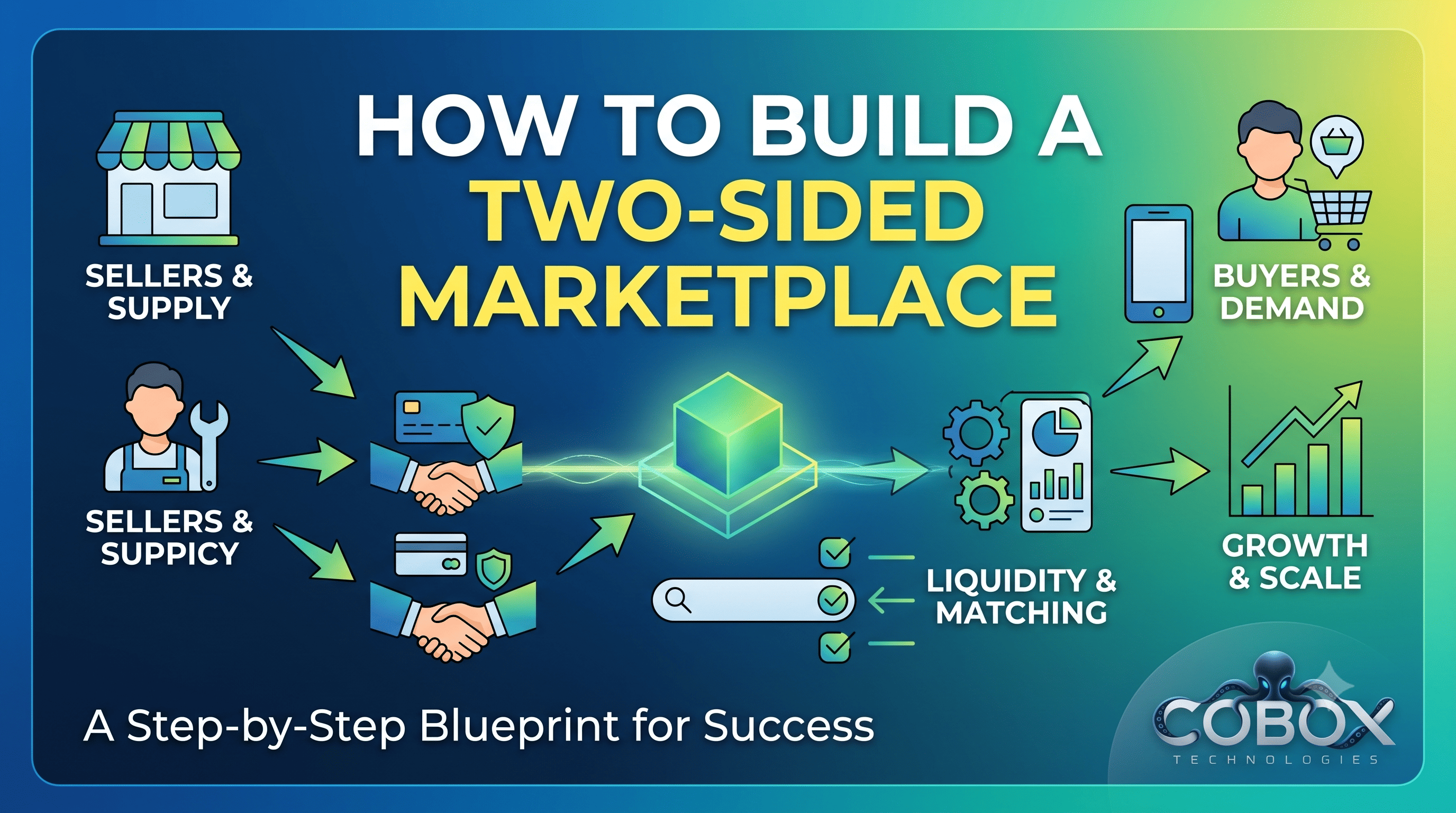
How to Build a Two-Sided Marketplace That Actually Works
Learn how to build a two-sided marketplace by solving supply and demand, designing the MVP, handling payments and trust, and creating enough liquidity for the marketplace to work.
Slug: how-to-build-two-sided-marketplace
Category: Startup & Product Development
Author: Himanshu Sharma
Publish Date:
Primary Keyword: build a two-sided marketplace
Secondary Keywords: two-sided marketplace, marketplace platform development, marketplace MVP, build an online marketplace, marketplace business model, marketplace app development, marketplace software
Excerpt: Learn how to build a two-sided marketplace by solving supply and demand, designing the MVP, handling payments and trust, and creating enough liquidity for the marketplace to work.
---
How to Build a Two-Sided Marketplace That Actually Works
Building a marketplace sounds straightforward.
Bring buyers and sellers together.
Let buyers find what they need, allow sellers to offer products or services, process the transaction, and take a commission.
The software itself may not be the hardest part.
The difficult part is creating a marketplace where both sides have enough reason to participate.
A marketplace with thousands of registered users can still fail if buyers cannot find the right sellers or sellers cannot generate enough business.
That is why marketplace development requires more than building an app.
You need to solve:
- Supply
- Demand
- Matching
- Trust
- Payments
- Pricing
- Operations
- Customer support
- Liquidity
This guide explains how to approach a two-sided marketplace from idea to MVP and beyond.
---
What Is a Two-Sided Marketplace?
A two-sided marketplace is a platform that connects two distinct groups of users who need each other.
For example:
| MarketplaceSide 1Side 2 | ||
|---|---|---|
| Airbnb | Guests | Hosts |
| Uber | Riders | Drivers |
| Upwork | Clients | Freelancers |
| Food delivery | Customers | Restaurants |
| Home services | Customers | Service providers |
The marketplace typically facilitates the interaction or transaction between the two groups.
The platform may earn revenue through:
- Commission
- Subscription
- Listing fees
- Transaction fees
- Lead fees
- Premium placement
- Advertising
The business model depends on how value is created.
---
The Core Marketplace Problem
A marketplace has a problem that a normal SaaS product does not have.
A SaaS application can provide value to one customer independently.
A marketplace depends on interaction between participants.
A buyer needs supply.
A seller needs demand.
This creates the classic chicken-and-egg problem.
Without buyers, sellers have little reason to join.
Without sellers, buyers have little reason to join.
Your initial marketplace strategy must therefore solve this imbalance.
---
Step 1: Choose a Narrow Marketplace
One of the biggest marketplace mistakes is trying to serve everyone.
Instead, start with a specific market.
For example:
Instead of:
Marketplace for freelancers.
Start with:
Marketplace connecting Indian businesses with freelance Laravel developers.
Or instead of:
Home services marketplace.
Start with:
Marketplace for verified home appliance technicians in Ahmedabad.
A narrower market makes it easier to:
- Find users
- Build supply
- Understand requirements
- Create trust
- Improve matching
- Market the platform
You can expand after proving the initial model.
---
Step 2: Identify Both Customer Groups
Define each side separately.
For example, consider a home-services marketplace.
Customer
- Needs a service
- Wants quick availability
- Wants transparent pricing
- Wants trusted professionals
Service Provider
- Wants new customers
- Wants predictable demand
- Wants easy booking management
- Wants timely payments
The platform must create value for both.
If only one side benefits, the marketplace will eventually struggle to retain the other.
---
Step 3: Understand the Existing Process
Before building software, understand how transactions happen today.
Ask customers:
- How do you currently find providers?
- How do you compare options?
- How do you verify quality?
- How do you negotiate pricing?
- How do you pay?
- What happens if something goes wrong?
Ask providers:
- How do customers currently find you?
- How much do you spend acquiring customers?
- How do you manage bookings?
- How do you collect payments?
- What causes cancellations?
- What type of customers do you want?
The goal is to understand the existing market behavior.
---
Step 4: Define Your Marketplace's Value Proposition
Your marketplace needs a clear reason for both sides to participate.
For buyers, it might be:
- More choice
- Better pricing
- Verified providers
- Faster discovery
- Convenient booking
- Secure payment
For sellers, it might be:
- More customers
- Lower acquisition cost
- Better utilization
- Faster payments
- Easier scheduling
- Business management tools
Your platform's value proposition should be specific.
For example:
"Find verified AC technicians near you, compare available time slots, and book a service online."
is more useful than:
"A next-generation home services ecosystem."
---
Step 5: Solve the Supply Side First
In many marketplaces, starting with supply is practical.
Imagine launching a marketplace with:
10,000 registered customers
but:
20 service providers.
Customers may search for a service and find no availability.
The result is a poor customer experience.
Instead, you may initially build a reliable supply base.
For example:
- Recruit 50 providers
- Verify their profiles
- Define service areas
- Collect pricing information
- Set availability
- Establish operating procedures
Then begin acquiring customers.
The exact strategy depends on the marketplace category.
---
Step 6: Create Marketplace Liquidity
Liquidity describes how easily users can successfully complete the transaction they came to the marketplace for.
For a service marketplace:
A customer searches → finds suitable providers → books one.
For a product marketplace:
A customer searches → finds the desired product → purchases it.
If users repeatedly search without finding a suitable match, the marketplace has a liquidity problem.
You can improve liquidity by controlling:
- Geographic coverage
- Categories
- Provider availability
- Pricing
- Search
- Matching
- Response times
This is why launching in one city or niche can be better than launching everywhere.
---
Step 7: Decide How Matching Works
Matching is one of the core marketplace functions.
A basic marketplace may allow users to search and filter manually.
For example:
- Location
- Price
- Rating
- Availability
- Category
A more advanced system may automatically match users.
For example:
Customer requirements
- AC repair
- Within 5 km
- Available today
- Budget under ₹1,000
Provider attributes
- AC repair specialist
- 3 km away
- Available today
- Pricing ₹800
The system can rank the provider as a potential match.
You do not necessarily need an AI matching engine for the first version.
Simple rules can often be sufficient for an MVP.
---
Step 8: Design the Marketplace MVP
A marketplace MVP usually needs functionality for both sides.
For example:
Buyer
- Registration
- Search
- Filters
- Provider/product profile
- Booking/order
- Payment
- Notifications
- Reviews
Seller
- Registration
- Profile
- Services/products
- Pricing
- Availability
- Order management
- Payment information
Admin
- User management
- Seller verification
- Listings
- Orders
- Payments
- Disputes
- Reports
- Configuration
This can already represent a significant product.
The key is to avoid adding features that do not help complete the core transaction.
---
Step 9: Build Trust Into the Product
Trust is one of the biggest challenges in marketplaces.
The customer may be dealing with someone they have never met.
Depending on the marketplace, trust mechanisms can include:
- Identity verification
- Business verification
- Reviews
- Ratings
- Profile information
- Certifications
- Transaction history
- Secure payments
- Refund policies
- Dispute management
Trust requirements differ by industry.
A freelance marketplace may emphasize portfolio and reviews.
A home-services marketplace may need identity verification and service guarantees.
---
Step 10: Design Payments Carefully
Payments become more complicated when money moves between multiple parties.
A marketplace may need to handle:
Customer → Platform → Seller
The platform may deduct:
- Commission
- Transaction fee
- Taxes
- Refund adjustments
The seller then receives the remaining amount.
You may also need to support:
- Refunds
- Partial refunds
- Failed payments
- Payment disputes
- Seller payouts
- Settlement reports
Payment architecture should therefore be considered early.
---
Step 11: Decide How the Marketplace Makes Money
Common marketplace revenue models include:
Commission
The platform takes a percentage of each transaction.
Example:
Customer pays ₹1,000
Marketplace commission: 10%
Seller receives: ₹900
---
Seller Subscription
Sellers pay a monthly fee for access to the platform.
This can work when sellers receive recurring value even without transactions.
---
Listing Fee
Sellers pay to publish listings.
This is more common in certain classified or specialized marketplaces.
---
Lead Fee
Businesses pay for customer leads.
For example:
Provider receives a customer enquiry and pays ₹50 for the lead.
---
Featured Placement
Sellers pay to appear more prominently in search results.
This should be designed carefully so it does not destroy user trust.
---
Step 12: Handle Cancellations and Disputes
Marketplace transactions can fail.
Examples:
- Customer cancels
- Seller cancels
- Provider does not arrive
- Product is damaged
- Payment succeeds but order fails
- Customer requests a refund
The platform needs clear rules.
For example:
Booking cancelled by customer
→ Refund based on cancellation policy.
Provider cancels
→ Customer receives refund.
Dispute
→ Admin reviews evidence.
These workflows should be part of the product requirements.
---
Step 13: Build the Admin Panel
Marketplace operations often depend heavily on the admin system.
The admin panel may need:
Users
- Customers
- Sellers
- Providers
Verification
- Documents
- Approval
- Rejection
- Re-verification
Transactions
- Orders
- Payments
- Refunds
- Payouts
Operations
- Bookings
- Availability
- Disputes
- Cancellations
Analytics
- GMV
- Orders
- Revenue
- Active users
- Seller performance
Without a strong operational system, marketplace growth can create significant manual work.
---
Step 14: Track Marketplace Metrics
Traditional website metrics are not enough.
You need marketplace-specific measurements.
GMV
Gross Merchandise Value
The total value of transactions processed through the marketplace.
---
Take Rate
The percentage of transaction value retained by the marketplace.
For example:
If GMV is ₹10 lakh and marketplace revenue is ₹1 lakh:
Take rate = 10%
---
Buyer Activation
Measures whether new buyers successfully complete a meaningful action.
---
Seller Activation
Measures whether new sellers actually become active on the platform.
---
Match Rate
The percentage of relevant buyer requests that successfully find suitable supply.
---
Conversion Rate
Measures how many users move from browsing to transaction.
---
Repeat Rate
Measures whether customers return for additional transactions.
Repeat usage can be particularly important for marketplaces with recurring demand.
---
Step 15: Launch in a Small Market
Do not assume that a nationwide marketplace needs nationwide supply on day one.
You can start with:
- One city
- One category
- One customer segment
- One transaction type
For example:
Home appliance repair marketplace in Ahmedabad.
This allows you to learn:
- Which providers perform well
- Which services are requested
- What customers are willing to pay
- How frequently transactions occur
- What operational problems appear
Once the model works, expansion becomes easier to plan.
---
Step 16: Consider Manual Operations During the MVP
Not every marketplace process needs to be automated immediately.
Suppose your marketplace needs provider verification.
Instead of building a sophisticated automated verification system, your admin team can initially review providers manually.
Suppose matching is complicated.
An operations manager can manually assign the first few hundred bookings.
This may seem inefficient, but it can be useful during validation.
You are learning how the process should work before turning it into software.
---
Marketplace MVP Example
Imagine you want to build a marketplace connecting businesses with freelance developers.
Client
- Registration
- Create project
- Browse developers
- View profiles
- Send requirement
- Hire developer
- Payment
Developer
- Registration
- Profile
- Skills
- Portfolio
- Availability
- Project requests
- Earnings
Admin
- Verify developers
- Manage projects
- Manage payments
- Handle disputes
- Manage users
You might initially avoid:
- AI matching
- Video interviews
- Complex project management
- Time tracking
- Mobile applications
- Advanced analytics
Those can be introduced after validating the core transaction.
---
Common Two-Sided Marketplace Mistakes
Trying to Launch Everywhere
A marketplace with low density can provide a poor experience.
Start where you can create sufficient liquidity.
---
Focusing Only on Customers
A marketplace cannot function without quality supply.
Seller or provider acquisition is equally important.
---
Adding Too Many Features
The goal is to facilitate the transaction.
Do not build an entire ecosystem before proving the basic marketplace model.
---
Ignoring Trust
Users need confidence before transacting with unknown participants.
Trust should be part of the product design.
---
Automating Too Early
Manual operations can help you understand the process before investing in complex automation.
---
Ignoring Unit Economics
Revenue does not automatically mean profitability.
Consider:
- Customer acquisition cost
- Seller acquisition cost
- Payment fees
- Support costs
- Refunds
- Discounts
- Operations
- Infrastructure
A marketplace needs sustainable economics on both sides.
---
How to Know If Your Marketplace Is Working
Look for evidence such as:
- Buyers successfully find relevant supply.
- Sellers receive meaningful demand.
- Transactions are completed.
- Customers return.
- Sellers remain active.
- Cancellations are manageable.
- Support requirements decrease as processes improve.
- Revenue grows with transaction volume.
- The economics improve as the marketplace scales.
Registration numbers alone do not tell you whether a marketplace is working.
A marketplace becomes valuable when users can repeatedly complete successful transactions.
---
A Practical Marketplace Development Roadmap
Phase 1 — Research
- Identify the market
- Define both customer groups
- Research competitors
- Understand existing workflows
Phase 2 — Validation
- Interview buyers
- Interview sellers
- Test pricing
- Build initial supply
- Test demand
Phase 3 — MVP
- Buyer experience
- Seller experience
- Admin panel
- Matching
- Payments
- Notifications
Phase 4 — Pilot
- Launch in a narrow market
- Manually support transactions
- Measure liquidity
- Collect feedback
Phase 5 — Improve
- Fix operational problems
- Improve matching
- Improve onboarding
- Improve conversion
Phase 6 — Scale
- Expand geography
- Add categories
- Automate operations
- Improve infrastructure
- Expand acquisition channels
---
Final Thoughts
Building a two-sided marketplace is fundamentally different from building a normal SaaS application.
The software matters, but the marketplace only works when buyers and sellers can reliably find value in each other.
That requires more than registration and listings.
You need to solve:
Supply → Demand → Discovery → Matching → Trust → Transaction → Fulfillment → Repeat Usage
Start with a narrow market.
Build enough supply.
Find the first customers.
Support transactions manually where necessary.
Measure whether buyers and sellers are successfully connecting.
Then automate and scale the parts of the business that have already been proven.
The goal of the first marketplace version is not to create the biggest platform.
It is to create a working market.
---
How COBOX Can Help
COBOX helps businesses build marketplace platforms around real operational requirements rather than starting with a generic feature list.
A marketplace project can include:
- Product discovery
- Marketplace business analysis
- Buyer and seller workflows
- MVP planning
- UI/UX design
- Web and mobile applications
- Seller/provider management
- Search and matching
- Payment integration
- Commission and payout logic
- Reviews and ratings
- Admin operations
- Notifications
- Analytics
- Cloud deployment
If you are planning a marketplace, the first question should not be "How much will the app cost?"
Start with:
Who are the two sides, what transaction connects them, and why will both sides use your platform?
---