 COBOX
COBOX
How Much Does It Cost to Build an MVP in 2026?
How Much Does It Cost to Build an MVP in 2026?
One of the first questions founders ask after coming up with a product idea is:
"How much will it cost to build an MVP?"
There is no single price because an MVP can mean very different things depending on the product, target users, features, technology, integrations, design requirements, and development team.
A simple internal business tool might cost significantly less than a SaaS platform with payments, subscriptions, AI, third-party integrations, and multiple user roles.
In 2026, the better question is not simply:
"What is the average MVP development cost?"
Instead, ask:
"What is the smallest product I can build to validate my business idea with real customers?"
That distinction can make a significant difference to your budget.
---
What Is an MVP?
MVP stands for Minimum Viable Product.
An MVP is the smallest practical version of a product that can deliver its core value to a defined group of users and generate meaningful feedback.
It does not mean building a poor-quality product.
It means avoiding unnecessary features until you have evidence that customers actually need them.
For example, imagine you want to build a food delivery platform.
A complete platform could eventually include:
- Customer mobile application
- Restaurant dashboard
- Delivery partner application
- Admin panel
- Real-time tracking
- Online payments
- Coupons
- Loyalty programs
- Reviews
- Notifications
- Analytics
- AI recommendations
An MVP might initially focus on:
- Customer registration
- Restaurant listing
- Menu browsing
- Order placement
- Payment
- Basic order tracking
- Admin order management
The goal is to test whether customers actually want the service before investing in the complete platform.
---
How Much Does an MVP Cost in 2026?
As a broad planning range, software MVP development can fall into several categories.
| MVP TypeTypical ScopeApproximate Cost | ||
|---|---|---|
| Simple MVP | Basic workflow or business tool | $5,000–$15,000 |
| Standard MVP | Web application with backend and admin | $15,000–$40,000 |
| Advanced MVP | SaaS, marketplace, integrations | $40,000–$80,000+ |
| Complex MVP | AI, real-time systems, multiple platforms | $80,000+ |
These are planning ranges, not fixed market prices.
The actual cost depends on the product requirements, development location, team composition, technology, design complexity, integrations, testing requirements, and expected quality level.
For an India-based development team, the same product can have a different cost structure than one developed primarily by teams in North America or Western Europe.
---
What Determines MVP Development Cost?
Several factors influence the final budget.
1. Product Complexity
Complexity is usually the biggest cost driver.
A simple CRUD application may require:
- Authentication
- Forms
- Database
- Dashboard
- Basic reporting
A more complex application may require:
- Real-time communication
- Payment processing
- Subscription management
- AI APIs
- Recommendation engines
- Geolocation
- Multi-tenant architecture
- Advanced permissions
- Third-party integrations
Every additional system increases development and testing effort.
---
2. Number of Features
More features generally mean more development time.
For example:
Basic MVP
- Login
- User profile
- Dashboard
- Core workflow
- Admin panel
Medium MVP
- Everything above
- Payments
- Notifications
- Search
- Filters
- Reports
- File uploads
- Multiple user roles
Advanced MVP
- Everything above
- AI features
- Real-time communication
- Advanced analytics
- Multiple integrations
- Mobile applications
- Complex workflows
The difference between these scopes can be substantial.
---
3. Web App vs Mobile App
Platform choice also affects cost.
A responsive web application can often be a practical starting point for an MVP.
If you build separate native applications for iOS and Android, you may need additional development resources.
Another option is cross-platform mobile development.
The right approach depends on how customers interact with the product.
For example, a B2B workflow application may be perfectly suitable as a web application.
A location-dependent consumer product may require mobile capabilities much earlier.
---
4. UI/UX Design
Design requirements can significantly affect the budget.
A basic business dashboard may need:
- Simple navigation
- Forms
- Tables
- Basic dashboards
A consumer-facing application may require:
- Custom design system
- Animations
- Interactive components
- Advanced onboarding
- Responsive layouts
- Extensive usability testing
Good design does not necessarily mean expensive visual effects.
For an MVP, the priority should be clarity and usability.
---
5. Backend Architecture
The backend is often more than a simple API.
Depending on the product, you may need:
- Authentication
- Authorization
- Database architecture
- API development
- Background jobs
- Queues
- Caching
- File storage
- Notifications
- Payment processing
- Logging
- Monitoring
- Audit trails
A small MVP might work perfectly well with a straightforward monolithic architecture.
You do not necessarily need microservices on day one.
---
6. Third-Party Integrations
Integrations can increase both development effort and ongoing operating costs.
Examples include:
- Stripe or Razorpay
- Twilio or SMS gateways
- WhatsApp APIs
- Google Maps
- Google OAuth
- AWS services
- Azure services
- OpenAI or other AI APIs
- Email services
- Accounting software
- CRM systems
Before estimating the development budget, create an integration list.
---
7. Admin Panel
Founders sometimes focus entirely on the customer-facing application and underestimate the admin system.
Many products need an administrative interface for:
- User management
- Orders
- Payments
- Content
- Reports
- Customer support
- Configuration
- Permissions
- Analytics
A basic admin panel may be relatively simple.
A sophisticated operational dashboard can become a significant part of the MVP.
---
8. Security Requirements
Security should not be treated as a feature that gets added after launch.
Depending on the product, you may need:
- Secure authentication
- Role-based access control
- Input validation
- API security
- Rate limiting
- Encryption
- Secure file handling
- Audit logging
- Backup strategy
- Vulnerability testing
Products dealing with financial, medical, legal, or sensitive customer information may require additional security and compliance work.
---
9. Testing and Quality Assurance
Development is only part of the project.
You also need to test:
- Functional workflows
- APIs
- Authentication
- Payments
- Mobile responsiveness
- Browser compatibility
- Error handling
- Performance
- Security
A product that technically works but fails during checkout or loses customer data is not a successful MVP.
---
MVP Cost Breakdown
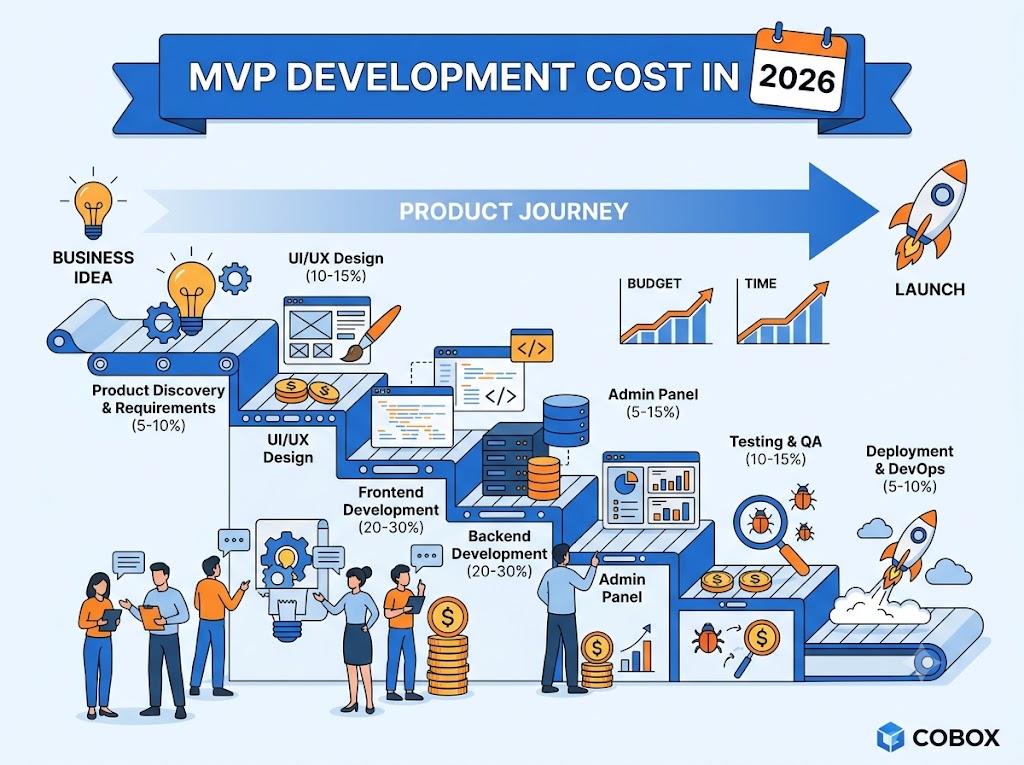
A typical MVP budget can be divided into several areas.
| ComponentApprox. Share | |
|---|---|
| Product discovery & requirements | 5–10% |
| UI/UX design | 10–15% |
| Frontend development | 20–30% |
| Backend development | 20–30% |
| Admin panel | 5–15% |
| Testing & QA | 10–15% |
| Deployment & DevOps | 5–10% |
These percentages are useful for planning but should not be treated as a universal pricing formula.
The actual distribution depends heavily on the product.
---
Development Team Options
Your choice of development team also affects cost.
Freelancer
A freelancer can be suitable for:
- Small MVPs
- Proof-of-concepts
- Simple applications
- Early experiments
However, one person may not cover product management, UX, backend, frontend, QA, and DevOps equally well.
---
Development Agency
An agency can provide a broader team covering:
- Product management
- UI/UX
- Frontend
- Backend
- QA
- DevOps
This can be useful when the founder does not have an internal technical team.
The trade-off is typically a higher project cost compared with hiring a single freelancer.
---
In-House Team
An in-house team provides greater control and long-term ownership.
But hiring developers, designers, QA engineers, product managers, and DevOps specialists creates ongoing costs such as:
- Salaries
- Benefits
- Recruitment
- Equipment
- Management
- Office or remote-work infrastructure
For an idea that has not yet been validated, building a large internal team may be premature.
---
Technology Partner
A technology partner can operate between traditional outsourcing and an internal team.
The partner may help with:
- Product discovery
- Architecture
- Development
- Hiring support
- MVP delivery
- Scaling
- Long-term technical strategy
This model can be useful when the founder wants technical ownership without immediately building an entire engineering organization.
---
How Long Does It Take to Build an MVP?
The timeline depends on scope.
A rough planning range could look like:
| MVP ComplexityTypical Timeline | |
|---|---|
| Simple | 4–8 weeks |
| Medium | 8–16 weeks |
| Advanced | 4–6+ months |
| Complex | 6+ months |
These timelines assume that requirements are reasonably clear and the team is available consistently.
Delays often come from scope changes rather than coding itself.
---
Why MVP Projects Go Over Budget
Many MVP projects become expensive because the scope keeps expanding.
It often starts like this:
"We only need five features."
Then:
"Let's also add subscriptions."
Then:
"Can we add WhatsApp?"
Then:
"Let's add an AI chatbot."
Then:
"We also need mobile apps."
Eventually, the MVP becomes a complete product.
This is commonly called scope creep.
---
How to Control Your MVP Budget
1. Define the Core User Journey
Identify the single workflow that creates the primary value.
For example:
Customer → Select Service → Pay → Receive Confirmation
Build this workflow first.
---
2. Separate Must-Have and Nice-to-Have Features
Create three categories:
Must Have
Required for the product to work.
Should Have
Useful but not essential for the first release.
Later
Features that can wait until you have customer feedback.
This simple classification can significantly reduce unnecessary development.
---
3. Avoid Overengineering
An MVP usually does not need:
- Microservices everywhere
- Complex event-driven architecture
- Multiple databases without a clear reason
- Kubernetes
- Advanced AI infrastructure
- Multiple mobile applications
Start with an architecture that is appropriate for your current scale.
You can introduce additional infrastructure when the business requires it.
---
4. Use Existing Services
You do not need to build everything yourself.
For example:
Instead of building a payment system from scratch, use a payment gateway.
Instead of creating your own email infrastructure, use an email provider.
Instead of implementing complex authentication infrastructure unnecessarily, use established authentication mechanisms.
This can reduce development time and initial cost.
---
5. Build a Modular MVP
Even when starting small, keep the codebase maintainable.
A well-structured application should make it possible to add future features without rewriting the entire system.
The goal is:
Small initial scope + scalable foundation.
Not:
Small initial scope + disposable code.
---
Example: MVP Cost for a SaaS Product
Suppose you want to build a simple SaaS platform for small businesses.
The first version requires:
- User registration
- Login
- Subscription
- Dashboard
- Customer management
- Basic reports
- Admin panel
- Email notifications
A possible scope could be:
| AreaEstimated Effort | |
|---|---|
| Discovery | 3–5 days |
| UI/UX | 5–10 days |
| Frontend | 15–25 days |
| Backend | 20–30 days |
| Admin | 5–10 days |
| Integrations | 5–10 days |
| QA | 7–12 days |
| Deployment | 2–5 days |
The exact cost depends on team composition and hourly or project rates.
This is why giving a single number before understanding the product can be misleading.
---
Should You Spend More on Your MVP?
Not necessarily.
A larger budget does not automatically produce a better MVP.
The objective is to maximize learning per unit of investment.
For example:
Spending $50,000 to discover that customers do not want the product is worse than spending $10,000 to discover the same thing early.
At the same time, spending too little can create an unusable product and produce misleading feedback.
The right target is:
The minimum investment required to create a credible test of the business idea.
---
What Should You Include in an MVP?
Before starting development, answer these questions:
Product
- What problem are we solving?
- Who has the problem?
- What is the primary user journey?
Features
- What is absolutely required?
- What can wait?
- What can be handled manually?
Technology
- Which platform should we build first?
- Which integrations are required?
- What architecture is appropriate for the current scale?
Business
- How will we acquire customers?
- How will we charge?
- What is our expected customer value?
Validation
- What assumption are we testing?
- What metric will determine success?
- What will we do if customers reject the product?
These questions should be answered before development begins.
---
A Better Way to Think About MVP Cost
Instead of calculating:
Features × Development Hours = Cost
think about:
Business Risk × Required Learning × Product Complexity = Investment Required
The purpose of an MVP is to reduce uncertainty.
Your first release should therefore answer the most important business questions.
For example:
- Will customers use it?
- Will customers pay?
- Can we acquire customers?
- Can we deliver the service profitably?
- Which features matter most?
- What should we build next?
---
Final Thoughts
The cost to build an MVP in 2026 can range from a relatively small investment for a simple product to a substantial budget for a complex SaaS, marketplace, AI application, or multi-platform system.
There is no universal MVP price.
The most effective way to control cost is to control scope.
Start with the core customer problem, validate the market, define the smallest useful product, prioritize essential features, choose an appropriate technology architecture, and build only what you need to test your assumptions.
A successful MVP is not the product with the most features.
It is the product that helps you learn the most about your business with the least unnecessary investment.
---
How COBOX Can Help
At COBOX, we help businesses and founders move from product idea to a practical MVP by combining product discovery, technical planning, UI/UX, software development, integrations, and deployment.
Instead of estimating development cost from a feature list alone, the process can start with understanding the business objective, defining the MVP scope, and identifying what needs to be built first.
If you have an idea and want to understand what your MVP should include, how long it could take, and what factors will influence its development cost, start with a structured product discovery process.
---