 COBOX
COBOX
MVP vs Full Product: What Should You Build First?
MVP vs Full Product: What Should You Build First?
Should you build an MVP or a complete product first? Learn how to choose the right development approach, control costs, validate demand, and plan your product roadmap.
Slug: mvp-vs-full-product-what-to-build-first
Category: Startup & Product Development
Author: Himanshu Sharma
Publish Date:
Primary Keyword: MVP vs full product
Secondary Keywords: MVP vs product, MVP development, full product development, startup MVP, minimum viable product, product development strategy, MVP features
Excerpt: Should you build an MVP or a complete product first? Learn how to choose the right development approach, control costs, validate demand, and plan your product roadmap.
---
MVP vs Full Product: What Should You Build First?
You have a business idea.
You have identified the target customers.
You may even have a detailed feature list and a development budget.
Now comes one of the most important decisions:
Should you build an MVP first or develop the complete product from the beginning?
For many startups, building everything at once sounds attractive.
You want the product to look complete when customers see it. You want all the features available from day one. You may also believe that building everything together will save time later.
But there is a problem.
You are making many assumptions before you have enough evidence.
An MVP takes a different approach.
Instead of building the entire product immediately, you build the smallest version capable of delivering the core value and learning from real customers.
The right choice depends on your product, market, customers, risks, and business model.
Let's examine both approaches.
---
What Is an MVP?
An MVP, or Minimum Viable Product, is an initial version of a product containing the essential functionality required to solve a specific customer problem and validate important business assumptions.
The goal is not to build a cheap or unfinished product.
The goal is to build the minimum useful product required to learn.
For example, suppose you want to build a platform connecting customers with home-service professionals.
A complete product might eventually include:
- Customer application
- Provider application
- Admin panel
- Online payments
- Ratings and reviews
- Live tracking
- Subscription plans
- Coupons
- Loyalty program
- Chat
- Notifications
- Analytics
- AI recommendations
An MVP could initially focus on:
- Customer registration
- Service selection
- Provider assignment
- Booking
- Payment
- Basic notifications
- Admin management
Once customers start using the system, you can determine which additional features actually matter.
---
What Is a Full Product?
A full product is a more mature version of the software designed to support broader customer requirements, operational needs, and business growth.
It may include:
- Advanced workflows
- Multiple user types
- Complex permissions
- Integrations
- Analytics
- Automation
- Mobile applications
- Advanced reporting
- Performance optimization
- Scalability
- Customer support tools
A full product does not necessarily mean that every imaginable feature has been built.
It means the product has moved beyond the initial validation stage and is being developed to support a more established business.
---
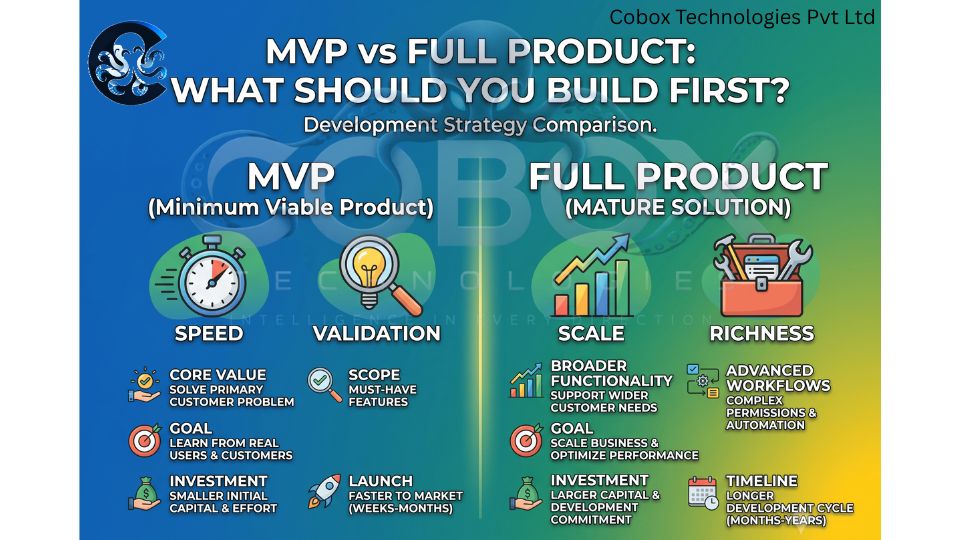
MVP vs Full Product: The Key Difference
The fundamental difference is the objective.
| MVPFull Product | |
|---|---|
| Validate assumptions | Scale the business |
| Learn from customers | Serve established demand |
| Limited feature set | Broader functionality |
| Smaller initial investment | Larger investment |
| Faster launch | Longer development cycle |
| Focused customer segment | Wider customer requirements |
| Frequent iteration | More predictable roadmap |
An MVP asks:
"Does this solution work for our target customer?"
A mature product asks:
"How do we make this solution reliable, scalable, and valuable for a growing customer base?"
---
Why Founders Often Want to Build the Full Product
There are understandable reasons.
You may want:
- A polished first impression
- Complete functionality
- Strong branding
- Better investor demonstrations
- Fewer future rewrites
- A competitive feature set
But building a complete product before validation introduces a significant risk:
You may optimize a product nobody wants.
The issue is not that a full product is bad.
The issue is building it before you have enough evidence to justify the investment.
---
When Should You Build an MVP?
An MVP is usually appropriate when:
1. The market is uncertain
You don't know how customers will respond.
2. The problem has not been validated
You have a hypothesis rather than strong evidence.
3. The product is new
There is limited historical data to guide feature decisions.
4. You need customer feedback
You want real-world usage before expanding the product.
5. You have a limited initial budget
You want to reduce the amount of capital committed before validation.
6. You want to test pricing
You need to understand whether customers will actually pay.
7. You need to test product-market fit
You want to determine whether users repeatedly receive meaningful value.
In these situations, an MVP can reduce unnecessary investment.
---
When Should You Consider Building More Upfront?
There are situations where a more complete initial product may make sense.
Regulated or High-Risk Products
Some products require significant infrastructure before they can be meaningfully tested.
Examples can include systems involving:
- Financial transactions
- Healthcare workflows
- Security
- Compliance
- Government requirements
The minimum usable version may already require substantial functionality.
---
Enterprise Products
Enterprise customers may expect:
- Role-based access
- Security controls
- Audit logs
- Reporting
- Integrations
- Data management
- Administrative controls
A very small MVP may not be sufficient for enterprise adoption.
---
Products With Complex Network Effects
Some products only provide value when enough participants are available.
For example:
- Marketplaces
- Social networks
- Two-sided platforms
A minimal product may need enough functionality on multiple sides of the network to create a usable experience.
---
Existing Demand
If you already have:
- Paying customers
- Signed contracts
- Strong customer commitments
- An established distribution channel
- Proven demand
you may have less need for an exploratory MVP.
The product may instead need a production-ready first version.
---
The Biggest Mistake: Confusing MVP With Poor Quality
An MVP should have a small scope, not poor execution.
There is an important difference.
Small scope
You support five important workflows instead of thirty.
Poor quality
Those five workflows are unreliable or difficult to use.
The first can be good MVP strategy.
The second can damage customer trust.
Your MVP should still have:
- Secure authentication
- Reliable core workflows
- Proper error handling
- Basic testing
- Reasonable UI/UX
- Data protection
- Production monitoring
- Reliable deployment
You can reduce features without reducing basic quality.
---
What Should Be Included in an MVP?
Start by identifying the core customer outcome.
Ask:
What is the primary reason someone would use this product?
Then work backward.
For example:
Product idea
Online appointment platform.
Core customer outcome
A customer can quickly book an appointment with the right service provider.
MVP functionality
Customer
- Registration
- Search providers
- View availability
- Book appointment
- Payment
- Confirmation
Provider
- Login
- Manage availability
- View bookings
- Update appointment status
Admin
- Manage customers
- Manage providers
- Manage bookings
- View payments
Everything else can initially be evaluated as a later feature.
---
Use the Must-Have / Should-Have / Later Framework
A simple prioritization framework can help.
Must Have
Without these features, the core product does not work.
Examples:
- Authentication
- Core workflow
- Database
- Payment
- Required notifications
Should Have
These improve the experience but are not essential for initial validation.
Examples:
- Advanced reports
- Additional filters
- Custom dashboards
- Advanced notifications
Later
These can wait until you have real usage data.
Examples:
- AI recommendations
- Loyalty programs
- Advanced analytics
- Multiple mobile applications
- Complex automation
This framework prevents your MVP from becoming a full product before launch.
---
Don't Build Features Because Competitors Have Them
A common founder question is:
"Our competitor has this feature. Should we build it too?"
Not necessarily.
Ask instead:
"Does this feature solve an important problem for our target customer?"
A competitor may have 100 features because they have spent years developing their platform.
Your objective is not to reproduce their entire product.
Your objective is to establish your own value proposition.
---
MVP vs Full Product: Cost Difference
The difference in scope can create a significant difference in investment.
For example:
MVP
- 1 platform
- 5–8 core workflows
- Basic admin panel
- Essential integrations
- Basic analytics
Full Product
- Web application
- iOS application
- Android application
- Advanced admin
- Multiple user roles
- Subscription system
- Advanced analytics
- Multiple integrations
- Automation
- AI features
- Reporting
- Customer support tools
The second version may require several times the development effort.
This is why defining the MVP correctly matters.
---
MVP vs Full Product: Timeline Difference
The same principle applies to development time.
A focused MVP may potentially be delivered within a few weeks or several months, depending on complexity.
A complete product can take considerably longer.
The problem with a long initial development cycle is that the market may change while you are still building.
Customer expectations can change.
Competitors can launch.
Technology can change.
Your own assumptions can change.
An MVP gives you an opportunity to learn earlier.
---
What About Investors?
Some founders believe they need a complete product before approaching investors.
That is not always the case.
Depending on the stage of the company, investors may evaluate:
- Market opportunity
- Problem
- Solution
- Founding team
- Traction
- Customer validation
- Revenue
- Growth
- Product
- Technology
- Business model
An early-stage company may use customer interviews, prototypes, pilots, waitlists, or an MVP as evidence.
For later-stage fundraising, stronger product and business metrics may become more important.
The right product stage depends on what you are trying to prove.
---
What About Customer Expectations?
If you are selling the MVP to customers, you need to communicate the product scope clearly.
Do not promise features that do not exist.
Instead, position the product around the specific problem it solves.
For example:
Instead of:
"Our platform does everything your business needs."
Say:
"Our platform helps your sales team capture, assign, and follow up on leads from one dashboard."
The second statement is narrower but easier to deliver and validate.
---
A Better Product Development Roadmap
Instead of:
Idea → Full Product → Launch
consider:
Idea → Research → Validation → MVP → Customer Feedback → Product-Market Fit → Scale
Each stage answers different questions.
Stage 1: Idea
What do we think customers need?
Stage 2: Validation
Do customers actually have this problem?
Stage 3: MVP
Can we solve the problem with a focused product?
Stage 4: Feedback
What do customers actually use?
Stage 5: Product-Market Fit
Are customers repeatedly getting enough value?
Stage 6: Scale
How do we support more customers efficiently?
---
When Should You Add More Features?
Use evidence.
A feature becomes more important when you see signals such as:
- Customers repeatedly request it.
- Customers cannot complete important workflows without it.
- The feature improves conversion.
- The feature improves retention.
- The feature reduces operational cost.
- The feature increases revenue.
- Competitor analysis shows a meaningful market requirement.
- Data demonstrates a clear product opportunity.
This is better than adding features simply because they sound impressive.
---
Example: From MVP to Full Product
Imagine a company building an employee management platform.
Version 1 — MVP
- Employee registration
- Employee profiles
- Leave requests
- Manager approval
- Basic admin panel
Version 2
- Attendance
- Payroll integration
- Notifications
- Reports
- Employee documents
Version 3
- Mobile app
- Advanced analytics
- Automated workflows
- Performance management
- Multiple integrations
Version 4
- AI-assisted HR workflows
- Advanced workforce analytics
- Enterprise controls
- Multi-region capabilities
This incremental approach allows the company to learn at every stage.
---
Questions to Ask Before Choosing
Before deciding between an MVP and a full product, answer these questions:
Market
- How well do we understand our target customer?
- How strong is existing demand?
Product
- What is the single most important customer outcome?
- Which features are absolutely necessary?
Business
- Do we already have paying customers?
- How will we monetize?
Budget
- How much capital can we responsibly allocate?
- What happens if the first version does not gain traction?
Technology
- Are there compliance or security requirements?
- Does the product require complex infrastructure from day one?
Timeline
- How quickly do we need market feedback?
- How quickly is the market changing?
The answers should guide your development strategy.
---
A Simple Decision Framework
Use this as a starting point:
Build an MVP first when:
- The idea is unvalidated.
- Customer demand is uncertain.
- You need market feedback.
- Budget is limited.
- The product can be simplified.
- You want to test pricing or adoption.
Consider a more complete initial product when:
- You already have strong demand.
- Customers have committed to the solution.
- Regulatory requirements require substantial functionality.
- Enterprise customers require production-grade capabilities.
- The business model has already been validated.
- The product requires multiple components to create meaningful value.
This is not a rigid rule. Product context matters.
---
Final Thoughts
The MVP vs full-product decision is ultimately a question of risk, evidence, and investment.
If you have an unvalidated idea, building everything at once can expose you to unnecessary development cost and long feedback cycles.
An MVP allows you to test the most important assumptions with a focused product.
But an MVP should not be an excuse for poor quality.
The right approach is:
Reduce scope, not reliability.
Build the smallest product that can deliver meaningful customer value, measure what happens, learn from real users, and expand based on evidence.
Instead of asking:
"How can we build the entire product?"
start with:
"What is the smallest product that can prove this business can work?"
That question can fundamentally change your development strategy.
---
How COBOX Can Help
At COBOX, we help founders and businesses turn product ideas into structured MVPs and scalable digital products.
Our approach can include:
- Product discovery
- Requirement analysis
- MVP definition
- UI/UX design
- Technical architecture
- Web application development
- Mobile application development
- API development
- Admin panels
- Third-party integrations
- Cloud deployment
- Product iteration
The objective is not simply to build more software.
It is to build the right software for the current stage of the business.
---