 COBOX
COBOX
How to Turn an Idea Into a Business: A Step-by-Step Guide
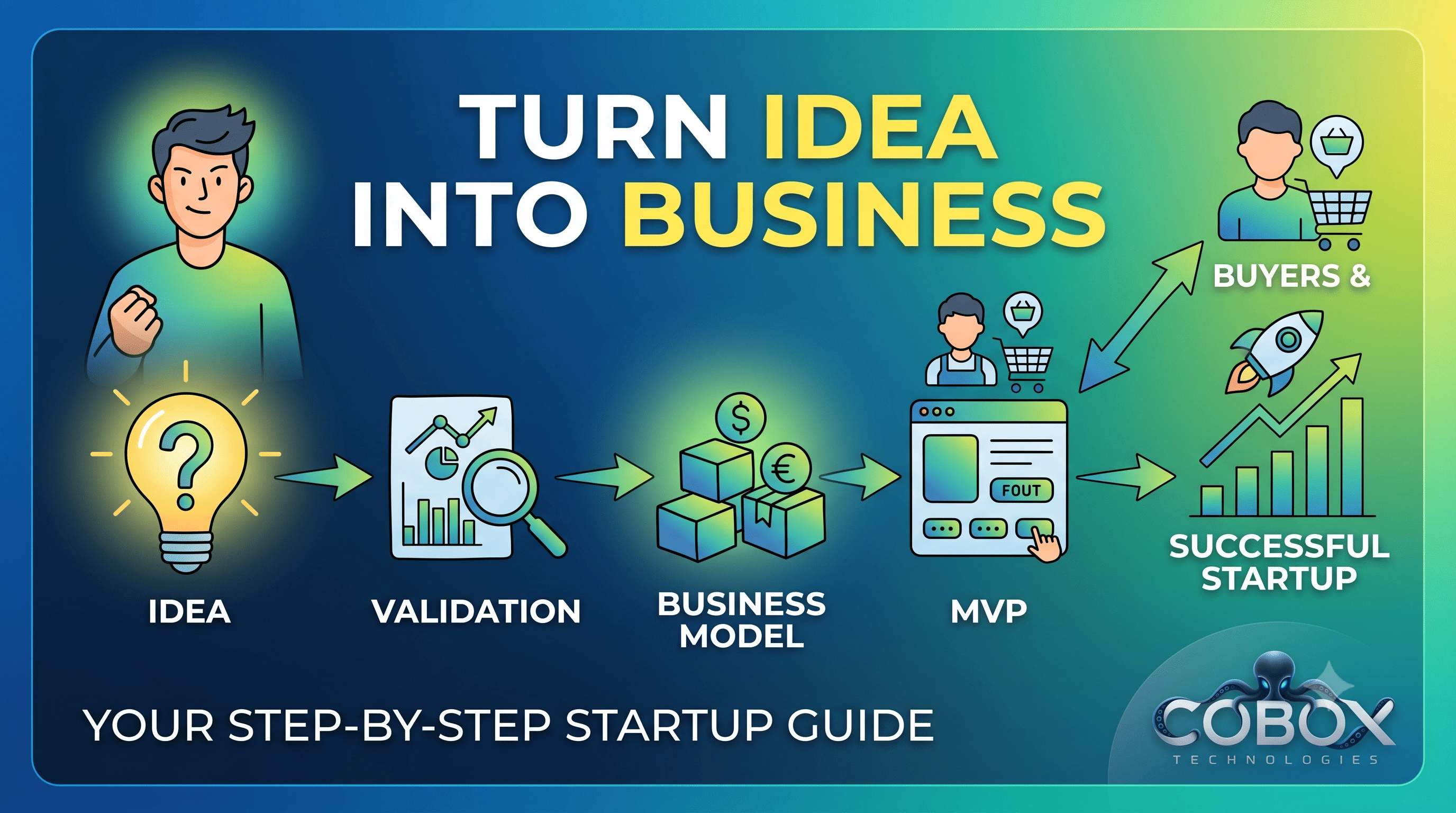
How to Turn an Idea Into a Business: A Step-by-Step Guide
Have a business idea but don't know where to start? Follow this practical guide to validate the problem, find customers, define your business model, build an MVP, and get your first customers.
Slug: turn-idea-into-business
Category: Startup & Product Development
Author: Himanshu Sharma
Publish Date:
Primary Keyword: turn an idea into a business
Secondary Keywords:
business idea to startup, turn an idea into a business, startup idea validation, how to start a business, business idea development, build a startup, validate business idea
Excerpt:
Have a business idea but don't know where to start? Follow this practical guide to validate the problem, find customers, define your business model, build an MVP, and get your first customers.
---
Almost every business starts with an idea.
You may notice a problem in your industry.
You may see an inefficient process at work.
You may have an idea for an application.
You may discover a gap in an existing market.
The idea itself is only the starting point.
Turning it into a business requires answering a series of practical questions:
- Is the problem real?
- Who has the problem?
- How are they solving it today?
- Will they pay for a better solution?
- How will you reach them?
- What should you build first?
- How much will it cost?
- How will the business make money?
A practical path looks like:
Idea → Problem → Customer → Validation → Business Model → MVP → First Customer → Improvement → Growth
This guide explains how to move through each stage.
---
1. Start With the Problem, Not the Product
One of the most common mistakes is starting with a product idea.
For example:
"I want to build an AI application for small businesses."
That describes technology, but not the business problem.
A better starting point is:
"Small businesses spend several hours every week manually responding to repetitive customer questions."
Now there is a specific problem to investigate.
A strong problem statement should explain:
- Who experiences the problem?
- What happens?
- How frequently does it happen?
- Why is it a problem?
- What does it cost the customer?
The more specific the problem, the easier it becomes to validate.
---
2. Identify the Customer
Your idea needs a specific customer.
Avoid descriptions such as:
Everyone who owns a business.
Instead, define an initial customer segment.
For example:
Small Indian e-commerce businesses with 5–20 employees that receive more than 100 customer enquiries per day.
Now you can research that group.
You can understand:
- Their workflow
- Their software
- Their budget
- Their decision-making process
- Their pain points
- Their purchasing behavior
A focused customer segment is usually easier to reach than a broad market.
---
3. Understand How Customers Solve the Problem Today
Your potential customer is already doing something.
They may be using:
- Excel
- Paper
- Existing software
- Internal processes
- Outsourced services
- Manual work
Your product needs to provide a meaningful improvement over the current solution.
Ask:
"What happens today if your product does not exist?"
The answer can reveal your real competitors.
Sometimes the biggest competitor is not another software company.
It is a spreadsheet.
---
4. Talk to Potential Customers
Before investing in development, speak to people who match your target customer profile.
Aim to understand their actual experience.
Useful questions include:
- How do you currently handle this?
- What takes the most time?
- What usually goes wrong?
- How often does this happen?
- Who handles the process?
- What does it cost you?
- What tools have you tried?
- What do you dislike about those tools?
- What would make you change your current process?
Avoid spending the entire conversation explaining your product.
You are trying to learn first.
---
5. Validate the Business Problem
After customer interviews, look for patterns.
Suppose you speak with ten potential customers.
If seven or eight describe the same problem independently, that is useful evidence.
You should also look for evidence that the problem matters.
A problem is generally more commercially relevant when it affects:
- Revenue
- Cost
- Time
- Customer satisfaction
- Compliance
- Productivity
- Operational risk
A problem that is merely inconvenient may be harder to monetize.
---
6. Research the Market
Market research helps you understand whether your idea exists within a viable market.
Research:
- Competitors
- Market size
- Pricing
- Customer reviews
- Industry trends
- Search demand
- Alternative solutions
- Buying behavior
Read competitor reviews carefully.
Customers often explain exactly what they dislike.
For example:
"The software is powerful but too complicated for our team."
That may reveal a positioning opportunity.
---
7. Define Your Unique Value Proposition
Once you understand the problem and alternatives, define why someone should choose your product.
A useful value proposition answers:
Who is it for?
What problem does it solve?
What outcome does it provide?
For example:
"Help small logistics companies reduce manual shipment follow-ups by automatically notifying customers about delivery status."
This is much more useful than:
"An innovative logistics management platform."
Be specific about the result.
---
8. Decide How the Business Will Make Money
A business idea needs an economic model.
Possible models include:
Subscription
Customers pay monthly or annually.
Common for SaaS products.
Transaction Fee
The business earns a percentage of each transaction.
Common for marketplaces and payment platforms.
One-Time Purchase
Customers pay once for a product or service.
Service + Software
The company combines software with professional services.
Usage-Based
Customers pay according to consumption.
For example:
- API calls
- Messages
- Storage
- Transactions
- AI usage
The model should match how customers receive value.
---
9. Estimate Your Potential Revenue
You do not need a perfect financial model at the idea stage.
Start with simple assumptions.
For example:
Target customers: 1,000
Expected customers in Year 1: 50
Average monthly revenue per customer: ₹5,000
Potential monthly recurring revenue:
50 × ₹5,000 = ₹2,50,000
This is only a scenario, not a forecast.
Then consider:
- Customer acquisition cost
- Churn
- Payment fees
- Support
- Infrastructure
- Employee costs
- Marketing
The objective is to understand whether the economics could work.
---
10. Decide What to Build First
Do not immediately create a 50-feature product.
Identify the core customer outcome.
Ask:
"What must the customer be able to do for this product to be useful?"
For example:
If the product helps businesses manage customer enquiries, the MVP may need:
- Customer registration
- Lead capture
- Lead assignment
- Lead status
- Follow-up
- Basic notifications
It may not initially need:
- AI forecasting
- Advanced analytics
- Ten integrations
- Mobile applications
- Complex automation
Those can be evaluated later.
---
11. Create an MVP
The MVP should test your most important assumptions.
Suppose your business idea is:
Software that helps clinics reduce appointment no-shows.
Your MVP might include:
- Appointment management
- Customer details
- Automated reminders
- Confirmation links
- Basic reporting
- Admin dashboard
You can then measure:
- Confirmation rate
- No-show rate
- Customer adoption
- Staff usage
- Willingness to pay
The MVP is not the final product.
It is a practical test of the business.
---
12. Build a Prototype Before Development
A prototype can help test the product experience before you invest in engineering.
You can design:
- Landing page
- Login
- Dashboard
- Main workflow
- Settings
- Reports
Then ask potential customers to complete tasks.
For example:
"You have received a new customer enquiry. Show me what you would do."
If they cannot understand the workflow, change the design before writing production code.
---
13. Choose the Technology Carefully
Once the product requirements are clear, select the technology.
Possible considerations include:
- Web or mobile
- Backend framework
- Frontend framework
- Database
- Cloud platform
- APIs
- Authentication
- Payments
- Notifications
Do not choose technology simply because it is popular.
Choose it based on:
- Product requirements
- Team skills
- Development speed
- Maintenance
- Scalability needs
- Integration requirements
- Budget
For an early-stage product, simplicity is often valuable.
---
14. Build the First Version
Development should follow a clearly defined scope.
A typical process may include:
Product Requirements
Define what the system needs to do.
UI/UX
Design the important workflows.
Backend
Build business logic, APIs, authentication, and database functionality.
Frontend
Build the customer-facing interface.
Admin
Create operational tools required to manage the product.
Testing
Verify workflows and edge cases.
Deployment
Move the product to a production environment.
Avoid changing the product definition every few days.
Requirement changes are sometimes necessary, but uncontrolled changes can quickly increase cost and timeline.
---
15. Get Your First Customers
A product is not a business until people are willing to pay for the value it provides.
Your first customers may come from:
- Personal network
- Existing professional relationships
- Direct outreach
- Industry communities
- Partnerships
- Search traffic
- Content marketing
- Referrals
For an early-stage business, direct customer conversations can be particularly valuable.
You learn why customers buy, why they hesitate, and what they actually care about.
---
16. Don't Wait for a Perfect Product
Your first customers do not need every feature.
They need the problem solved.
Suppose your software automates a process that currently takes a customer four hours every week.
If your first version reduces that to one hour, you may already have meaningful value.
You can improve the product later.
Waiting until everything is perfect can delay the feedback you need to improve it.
---
17. Measure What Happens After Launch
Once the product is live, measure actual behavior.
Depending on your business, useful metrics may include:
- Website conversion
- Sign-ups
- Activation
- Trial-to-paid conversion
- Monthly recurring revenue
- Customer acquisition cost
- Churn
- Retention
- Average order value
- Repeat purchases
- Support requests
Choose metrics that relate directly to your business model.
Do not track dozens of numbers simply because analytics software makes them available.
---
18. Improve the Product Based on Evidence
Your first version will almost certainly need changes.
Customers may:
- Ignore features you expected them to use.
- Request features you did not plan.
- Use workflows differently.
- Need better onboarding.
- Find pricing confusing.
- Encounter operational problems.
That is normal.
Prioritize changes based on evidence.
A useful framework is:
Customer impact × Business impact ÷ Development effort
A feature requested by one customer that requires months of development may not be the right next priority.
---
19. Build a Repeatable Sales Process
After getting your first customers, document how you acquired them.
For example:
LinkedIn outreach
↓
Discovery call
↓
Product demonstration
↓
Pilot
↓
Proposal
↓
Payment
↓
Onboarding
Now you can measure each stage.
If 100 prospects produce:
- 30 replies
- 15 calls
- 8 demos
- 4 pilots
- 2 customers
you have a starting sales funnel.
The objective is to understand where prospects drop off and improve each stage.
---
20. Decide When to Scale
Do not scale everything immediately.
First identify what is working.
For example:
- A specific customer segment converts well.
- A specific acquisition channel produces customers.
- A specific feature drives retention.
- A specific pricing plan performs well.
Then invest more heavily in those areas.
Scaling a business model that has not been validated can simply increase the speed at which money is spent.
---
Common Mistakes When Turning an Idea Into a Business
Building Before Validation
Spending months developing an untested idea creates unnecessary risk.
Targeting Everyone
A broad market makes customer acquisition and positioning harder.
Copying Competitors
Competitor features do not automatically represent customer priorities.
Ignoring Pricing
If you do not test willingness to pay, you may validate interest but not the business model.
Overbuilding the MVP
Too many features increase cost and delay learning.
Ignoring Distribution
A good product still needs a reliable way to reach customers.
Scaling Too Early
Hiring, infrastructure, and marketing should generally grow with evidence of demand.
---
A Practical 30-Day Plan
You can structure the first month around learning rather than immediately building.
Week 1 — Problem
- Define the problem
- Identify the customer
- Research alternatives
- Study competitors
Week 2 — Validation
- Conduct customer interviews
- Test the problem
- Test the value proposition
- Investigate willingness to pay
Week 3 — Product
- Define MVP
- Map user journeys
- Create prototype
- Estimate development cost
Week 4 — Decision
At the end of the month, decide whether to:
Build
Change the idea
Narrow the market
Change the business model
or
Stop
Stopping or changing direction after four weeks of research can be far better than discovering the same problem after six months of development.
---
Idea vs Business
There is an important distinction.
An idea is a hypothesis.
A business has evidence.
An idea says:
"People will pay for this."
A business starts to demonstrate:
"These customers have this problem, they use our solution, and they are willing to pay for it."
That transition is what validation, MVP development, sales, and customer feedback are designed to create.
---
Final Thoughts
Turning an idea into a business is not one large development project.
It is a sequence of decisions.
Start by understanding the problem.
Identify the customer.
Research existing alternatives.
Validate demand.
Define the business model.
Build the smallest useful product.
Get it in front of real customers.
Measure what happens.
Then improve and scale based on evidence.
The most important shift is to stop thinking:
"How do I build my idea?"
and start thinking:
"How do I prove that this idea deserves to be built?"
Once you have that evidence, development becomes much easier to plan because you know what you are building, who it is for, and why it should exist.
---
How COBOX Can Help
COBOX works with founders and businesses at the stage where an idea needs to become a practical digital product.
The process can include:
- Business and product discovery
- Requirement analysis
- Market and competitor research
- MVP definition
- UI/UX design
- Technical architecture
- Web and mobile development
- API development
- Admin systems
- Third-party integrations
- Testing and deployment
- Product improvement
If you have an idea but are unsure what to build first, the right starting point is usually not development.
It is defining the problem, customer, business model, and MVP.
---