 COBOX
COBOX
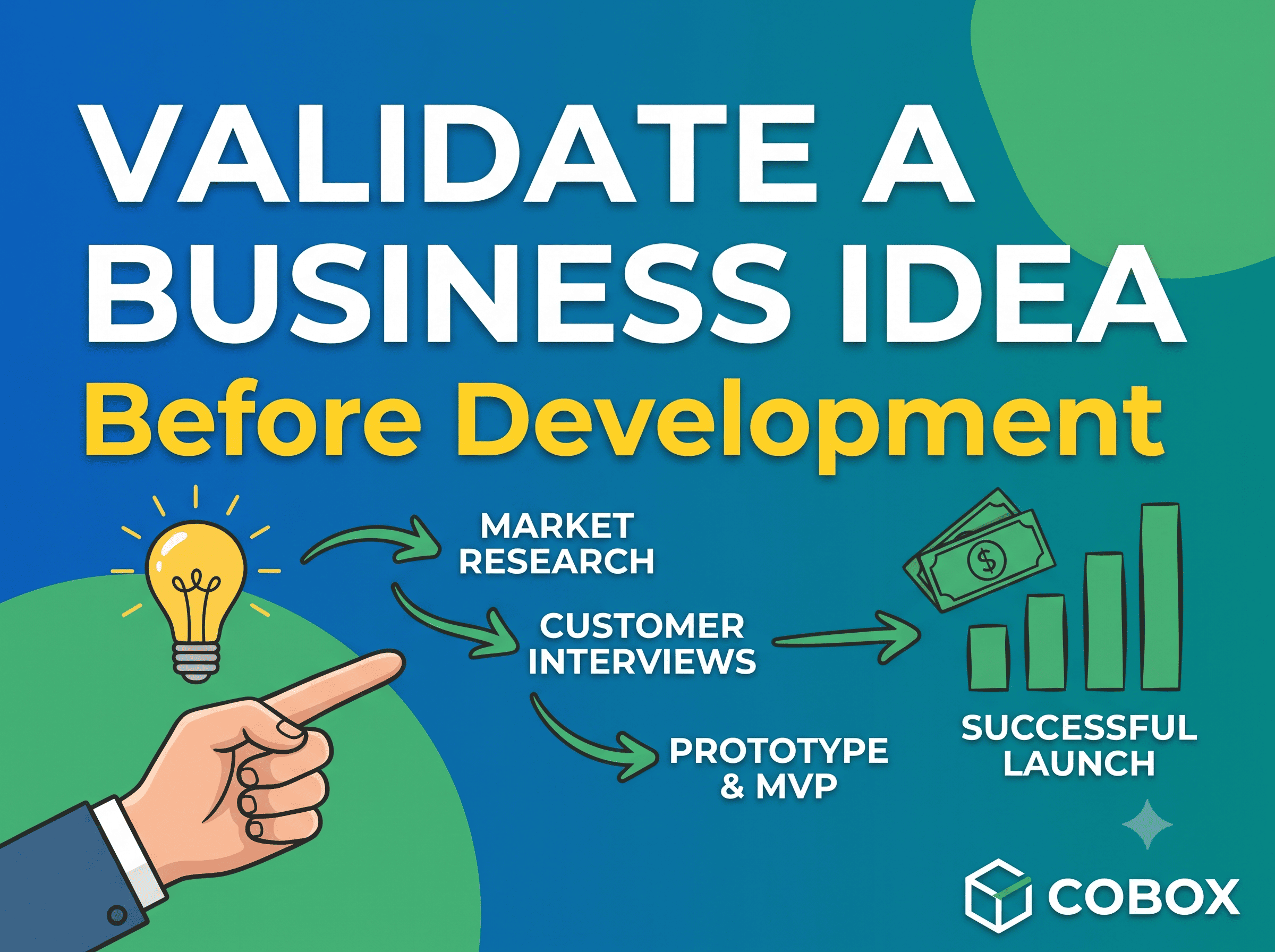
Having a great business idea is exciting. You may already be thinking about the website, mobile app, features, technology stack, branding, and launch strategy.
But there is an important question to answer before writing a single line of code:
Does anyone actually want this product?
Many startups spend thousands of dollars and months of development time building products before discovering that customers do not have a strong enough reason to use or pay for them.
The good news is that you do not always need a large development budget to test an idea.
You can validate a business idea using customer conversations, competitor research, landing pages, prototypes, manual processes, and even a simple MVP.
This guide explains a practical process for validating your business idea before spending heavily on software development.
---
What Does Business Idea Validation Mean?
Business idea validation is the process of testing whether there is a real market for your proposed product or service.
The goal is not to prove that your idea is perfect.
Instead, you want to answer a few fundamental questions:
- Does the problem actually exist?
- Who experiences this problem?
- How frequently does it happen?
- How are people solving it today?
- Are existing solutions good enough?
- Would customers pay for a better solution?
- Can you reach these customers profitably?
- Is the potential market large enough?
- Can the product be built within a realistic budget?
If the answers are positive, you have stronger evidence to move toward an MVP or full product.
If the answers are negative, you can change your idea before committing significant money and resources.
---
Why You Should Validate an Idea Before Development
Software development can become expensive very quickly.
A seemingly simple application can eventually require:
- UI/UX design
- Frontend development
- Backend development
- Database architecture
- Authentication
- Payment integration
- Third-party APIs
- Admin panels
- Cloud infrastructure
- Testing
- Security
- Deployment
- Maintenance
- Customer support
The bigger problem is that development creates a psychological commitment.
Once a company has invested months of development and significant money into a product, it becomes difficult to accept that the original idea may not work.
Validation moves much of that learning before the expensive part.
Think of validation as risk reduction
Instead of asking:
"Can we build this?"
Ask:
"Should we build this?"
That change in thinking can save a startup significant time and money.
---
Step 1: Clearly Define the Problem
Start with the problem rather than the product.
For example, saying:
"I want to build an AI-powered CRM."
does not clearly define a business problem.
Instead, you might discover:
"Small sales teams spend several hours every week manually updating customer information across WhatsApp, spreadsheets, and email."
Now you have a specific problem to investigate.
A strong problem statement should identify:
Who → What problem → When it happens → Why it matters
For example:
Small service businesses lose potential customers because leads received through WhatsApp are not consistently recorded, assigned, or followed up.
This gives you something that can actually be tested.
---
Step 2: Identify Your Target Customer
One of the biggest mistakes founders make is defining their target market too broadly.
"Small businesses" is not a useful customer segment.
Try to become more specific.
For example:
- Indian accounting firms with 5–20 employees
- Local real estate agencies with multiple sales agents
- D2C brands processing 500+ orders per month
- Clinics managing appointments through WhatsApp
- Small manufacturers managing orders through spreadsheets
The more specific your initial customer profile, the easier it becomes to validate the problem.
Create a basic Ideal Customer Profile (ICP).
Example ICP
Industry: Professional services Company size: 5–50 employees Location: India Decision maker: Founder or operations manager Problem: Manual lead and customer management Current tools: WhatsApp + Excel + email Buying trigger: Increasing lead volume
You can refine this profile as you conduct interviews.
---
Step 3: Talk to Potential Customers
Customer conversations are one of the most valuable validation methods.
Do not start by pitching your product.
Instead, talk about the problem.
Ask questions such as:
- How do you currently handle this process?
- What is the most frustrating part?
- How frequently does this happen?
- How much time does it take?
- What happens when the process fails?
- What tools are you currently using?
- Have you tried solving this problem before?
- How much does the problem cost your business?
- Who is responsible for solving it?
- What would an ideal solution look like?
Avoid asking:
"Would you use my application?"
People often say yes because they want to be helpful.
Their current behavior is usually more valuable than their hypothetical answer.
---
Step 4: Find Out How People Solve the Problem Today
Your competitors are not limited to companies selling similar software.
Your biggest competitor may be:
Excel.
Or:
WhatsApp.
Or:
Email.
Or:
Manual work.
Or:
Doing nothing.
Suppose you want to build software for appointment management.
Your competition might include:
- Existing appointment software
- Google Calendar
- Phone calls
- Paper registers
- Excel spreadsheets
- Receptionist-managed scheduling
Understanding these alternatives helps you determine whether your product provides meaningful improvement.
---
Step 5: Research Existing Competitors
Competitor research can reveal whether there is already demand in the market.
Create a simple comparison table.
| CompetitorTarget CustomerMain FeaturesPricingStrengthWeakness | |||||
|---|---|---|---|---|---|
| Competitor A | Small businesses | CRM | ₹X/month | Easy to use | Limited customization |
| Competitor B | Enterprises | CRM + ERP | ₹X/month | Powerful | Expensive |
| Competitor C | Agencies | Lead management | ₹X/month | Specialized | Limited integrations |
You are not looking only for competitors to copy.
You are looking for gaps.
For example:
- Poor user experience
- High pricing
- Missing integrations
- Complicated setup
- Weak customer support
- Lack of industry-specific features
- Poor mobile experience
- Limited automation
These gaps can help shape your product positioning.
---
Step 6: Use Search Data to Understand Demand
Search behavior can provide another signal.
Look for keywords people use when trying to solve the problem.
For example, if your product is designed to automate business processes, potential searches might include:
- business process automation
- automate business processes
- business automation software
- workflow automation
- automate repetitive tasks
- CRM automation
Tools such as Google Trends, Google Search, keyword research platforms, Reddit, forums, and industry communities can help you understand what people are searching for and discussing.
However, search volume alone does not prove that people will pay for your product.
It is only one validation signal.
---
Step 7: Build a Simple Landing Page
You do not necessarily need a working application to test interest.
Create a simple landing page explaining:
- The problem
- Your proposed solution
- Who it is for
- Key benefits
- How it works
- Pricing or expected pricing
- Call to action
Your CTA could be:
Join the Waitlist
or:
Book a Demo
or:
Request Early Access
or, for a B2B product:
Talk to an Expert
Then drive a small amount of relevant traffic to the page.
Track what visitors actually do.
---
Step 8: Create a Prototype Before Building the Product
A prototype can help you test the user experience before development.
You can create screens for:
- Login
- Dashboard
- Main workflow
- Customer management
- Payments
- Reports
- Notifications
The prototype does not need to work.
Its purpose is to answer:
"Does this workflow make sense to the customer?"
You can show the prototype to potential users and ask them to perform realistic tasks.
For example:
"Imagine you received a new customer enquiry. Show me how you would use this system to assign the enquiry to your sales team."
Watch what they do.
Do not immediately explain the interface.
Their confusion can reveal usability problems before development begins.
---
Step 9: Test Willingness to Pay
Interest is not the same as purchasing intent.
Someone saying:
"This is a great idea."
is not necessarily a customer.
A stronger validation signal is:
"How much does it cost?"
An even stronger signal is:
"Send me the proposal."
And stronger still:
"Here is the payment."
Depending on your product, you can test willingness to pay through:
- Pre-orders
- Paid pilots
- Deposits
- Consulting engagements
- Letters of intent
- Paid discovery
- Early-access subscriptions
For B2B software, a paid pilot can be particularly useful because it tests both the problem and the customer's purchasing behavior.
---
Step 10: Consider a Concierge MVP
You do not always need to automate the entire process initially.
A Concierge MVP delivers the desired outcome manually while customers believe they are receiving the intended service.
For example, imagine you want to build an AI system that automatically generates business reports.
Instead of building the entire AI platform, you could:
- Collect customer data manually.
- Process it yourself.
- Generate the report.
- Deliver the report to the customer.
- Ask for feedback.
- Charge for the service.
If customers repeatedly pay for the result, you have evidence that automation may be worth building.
This approach helps validate the business value before the technology.
---
Step 11: Define Your MVP
Once you have evidence that the problem is real, define the smallest product that can deliver meaningful value.
Your MVP should not mean:
"Build the cheapest version possible."
Instead, think:
"What is the smallest version that can solve the core problem for the first group of customers?"
For example, if you are building a customer management platform, your first version may only need:
- User login
- Customer records
- Lead management
- Task assignment
- Basic notifications
- Simple dashboard
You may not need:
- Advanced analytics
- AI recommendations
- Mobile applications
- 50 integrations
- Complex reporting
- Multi-region infrastructure
Those features can come later.
---
Step 12: Calculate the Cost of Building the MVP
After validation, you can estimate development costs more intelligently.
Your estimate should consider:
Product design
- UX research
- Wireframes
- UI design
- Prototype
Development
- Frontend
- Backend
- Database
- APIs
- Admin panel
Infrastructure
- Hosting
- Database
- Storage
- CDN
- Monitoring
Third-party services
- Payment gateway
- SMS
- Maps
- Authentication
- AI APIs
Quality and security
- Testing
- Security
- Performance optimization
- Deployment
Ongoing costs
- Maintenance
- Bug fixes
- Infrastructure
- Support
- New features
This gives you a much more realistic picture than simply asking:
"How much does an app cost?"
---
A Practical Business Idea Validation Framework
You can evaluate your idea using five validation areas.
| AreaQuestion | |
|---|---|
| Problem | Does a real problem exist? |
| Customer | Can you clearly identify who has it? |
| Demand | Are people actively looking for solutions? |
| Payment | Will customers pay to solve it? |
| Delivery | Can you deliver the solution profitably? |
Your goal is not to achieve a perfect score.
Your goal is to collect enough evidence to make a rational development decision.
---
When Should You Start Development?
Consider moving toward development when you have evidence such as:
- Customers consistently describe the same problem.
- The problem has a measurable business impact.
- Existing solutions have identifiable gaps.
- Customers understand your proposed solution.
- Potential customers agree to pilots or demos.
- You have evidence of willingness to pay.
- You understand your initial customer segment.
- You can define a focused MVP.
- You have a realistic development budget.
At this point, development becomes an investment based on evidence rather than an assumption.
---
Common Validation Mistakes
1. Asking friends and family
Friends and family may give supportive feedback that does not represent your actual market.
2. Building too much too early
Developing dozens of features before validating the core problem increases both cost and risk.
3. Confusing compliments with demand
"Great idea" is not the same as "I will pay for this."
4. Ignoring existing solutions
If customers already have a solution, you need to understand why they would switch.
5. Targeting everyone
A product designed for everyone often has weak positioning.
6. Validating technology instead of the business
A technically impressive product can still fail if customers do not need it.
7. Ignoring pricing
Pricing should be part of validation, particularly for B2B products.
---
A Simple 7-Day Business Idea Validation Plan
If you want to validate an idea quickly, you can start with this process.
Day 1: Define the problem
Write down the problem, target customer, and expected outcome.
Day 2: Research the market
Study competitors, alternatives, reviews, forums, and search behavior.
Day 3: Talk to customers
Interview at least several people who fit your target customer profile.
Day 4: Analyze the problem
Look for repeated pain points and common workflows.
Day 5: Create a prototype
Design the core user journey without developing the complete product.
Day 6: Test the concept
Show the prototype to potential customers and collect feedback.
Day 7: Test commercial interest
Ask about pricing, pilots, early access, or purchasing.
At the end of the week, you should have significantly more information than you had when you started.
---
Final Thoughts
Building software is easier than ever.
That makes validation more important, not less important.
The biggest risk for a startup is not always that the technology will fail. It can be that the team successfully builds something customers do not need badly enough to buy.
Before spending months and significant money on development, validate the problem, understand the customer, research existing alternatives, test the proposed solution, and look for evidence that people are willing to pay.
Once the evidence is strong enough, you can move from:
Idea → Validation → MVP → First Customers → Product → Scale
That approach gives you a much better foundation for building software that solves a real business problem.
---
How COBOX Can Help
At COBOX, we work with businesses and founders to turn ideas into practical digital products.
Instead of starting with technology and immediately building a large application, the process can begin with understanding the business problem, defining requirements, identifying the MVP, designing the product architecture, and then developing the solution.
Whether you need an MVP, custom business software, automation platform, SaaS product, API integration, or a complete digital product, the first step is understanding what should actually be built.
Have a business idea you want to validate? Start with the problem, not the code.
---