 COBOX
10 Mistakes Founders Make Before Building Their First Product
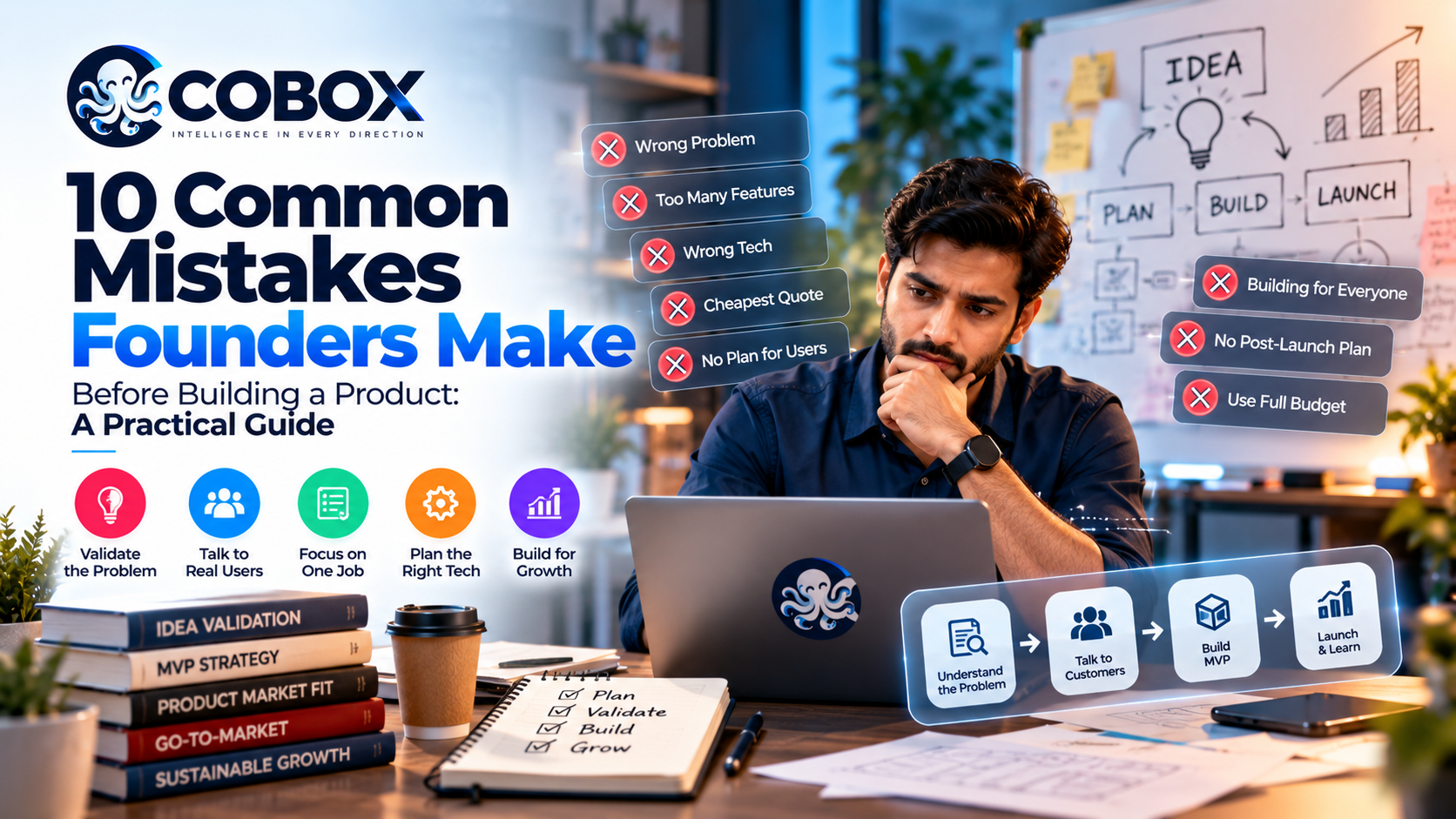
Most first products don't fail because the code was bad. They fail earlier, in the weeks before anyone opens an editor, when the founder makes a handful of decisions that quietly set the whole project up to disappoint. We see the same ten again and again. None of them is dramatic. That's exactly why they get through.
The examples below are composites of patterns we've run into, not stories about any one client. If one of them makes you wince, good. It's much cheaper to wince now.
1. Falling in love with the solution before understanding the problem
"I want to build an app that does X" is a solution. Somewhere behind it there should be a sentence like "dispatchers at small transport firms lose an hour every morning re-typing orders from WhatsApp." If you can't write that second sentence, you don't have a problem yet. You have a feature in search of a reason.
Try this instead: describe the problem without using the word "app", "platform" or "AI". If the description falls apart, go back and talk to more people before spending anything.
2. Asking friends and family if it's a good idea
They love you. They will say it's great. Their answer tells you almost nothing, because they aren't the buyer and nothing is at stake for them. We've watched founders collect a dozen enthusiastic reactions and then discover that not one of those people would have paid.
Ask people who have the problem and who spend money or time on it today. Ask what they do right now, what it costs them, and what they've already tried. If someone has built their own spreadsheet to cope, that's a better sign than ten compliments.
Try this instead: book five conversations with strangers who match your target customer, and ask about their last experience of the problem rather than about your idea.
3. Writing a feature list instead of choosing one job
Founders often arrive with forty features and no ranking. Everything feels essential because everything came from the same excited brainstorm. The result is a first version that tries to do twelve things moderately well and none of them memorably.
Pick the one thing a user must be able to do for the product to be worth opening. Build the path to that, and be honest about what else is just decoration. Our guide to MVP features goes through how to draw that line.
Try this instead: finish the sentence "A user can ___ in under two minutes." Whatever fills the blank is your first version.
4. Choosing the technology before the product
React or Flutter, Laravel or Node, monolith or microservices. These debates feel productive and they're almost never the thing that decides whether you succeed. For a first version, the right stack is usually the one your team already knows well and that is easy to hire for later.
If a vendor opens the first conversation with their favourite framework rather than your customer, treat that as information about how they'll run the project.
Try this instead: ask any team you're considering to explain their technology choice in terms of your business. If they can't, they probably chose it for themselves.
5. Hiring on the lowest quote
Two quotes for "the same app" can differ by a factor of three, and the cheap one is rarely cheap in the end. Usually it means someone has assumed less: fewer screens, no admin panel, no testing, nothing about hosting. The gaps show up as change requests in month two, when you have no leverage.
Compare quotes line by line, not by total. Ask each firm to list what is not included. We've put together ten questions worth asking before you sign anything.
Try this instead: build a simple table with one column per vendor and one row per deliverable. Empty cells are where the extra costs hide.
6. Ignoring who will own what
It sounds boring until it isn't. Who owns the source code? Whose name is on the domain, the hosting account and the app store listing? What happens if you and your developer part ways? Founders who never asked have, more than once, discovered that their product lived in someone else's account.
Try this instead: settle it in writing at the start, and set up every account in your company's name. There is a plain-language walkthrough in who owns your software.
7. Building for everyone
"Small businesses" is not a customer. A bakery with two shops, a clinic with six doctors and a freight forwarder share almost nothing in how they work. A product aimed at all of them ends up fitting none, and your marketing has nothing specific to say.
Choose a narrow first group, maybe one trade in one city, and make something they'd miss if it disappeared. Widening later is far easier than narrowing.
Try this instead: write a one-line description of your first customer that a stranger could use to find them. If it needs the word "and" more than once, narrow it further.
8. Having no plan for the first ten customers
"We'll do marketing after launch" is how products sit unused for months. The first ten users almost never come from advertising. They come from conversations: people you already spoke to during research, a community you belong to, a few warm introductions.
Try this instead: before you build, write down the names of ten people or businesses who might use the first version, and how you'll reach each. If you can't fill the list, that's worth knowing now rather than after the final invoice.
9. Treating launch as the finish line
Launch day feels like an ending. It's closer to the point where the real information starts arriving. Real users click in unexpected places, abandon the form on step three, and ask for things you hadn't considered. Teams that planned nothing beyond launch tend to go quiet for a month, exactly when attention matters most.
There's also a plain cost question: someone has to keep the thing running. We explain that in what software maintenance costs after launch.
Try this instead: keep some budget and calendar time after launch, and decide in advance which numbers you'll look at. We cover those in what to measure in the first 90 days.
10. Spending the whole budget on version one
If every rupee goes into the first release, you have nothing left to respond with when the market teaches you something. And it always does. The product that people ask for in month two is rarely the one you specified in month zero.
A healthier split is to hold back a meaningful share, many teams aim for a quarter to a third, for changes after real usage begins. A slightly smaller first version with room to adapt beats a bigger one you can't afford to touch.
Try this instead: ask for a quote for the smallest useful version, and treat everything beyond it as a second phase you'll price once you've seen real behaviour. Our comparison of MVP and full product helps with that decision.
Which ones are you most likely to make?
Most founders hit two or three of these, and that's survivable if you notice early. A good habit is to read this list before every large spending decision and ask honestly which of the ten you're about to do. It takes two minutes and can save a budget.
A sensible next step
If you'd like a second pair of eyes on your plan before you commit money, a short idea validation exercise is a low-cost way to find the weak spots. If you'd rather start on your own, our free Business Blueprint turns a rough idea into a structured plan in a few minutes and shows you where the gaps are. And if you simply want to talk it through, get in touch. We're happy to tell you when something doesn't need to be built at all.