 COBOX
COBOX
How to Build a Restaurant Ordering and Delivery Business Without Relying Only on Aggregators
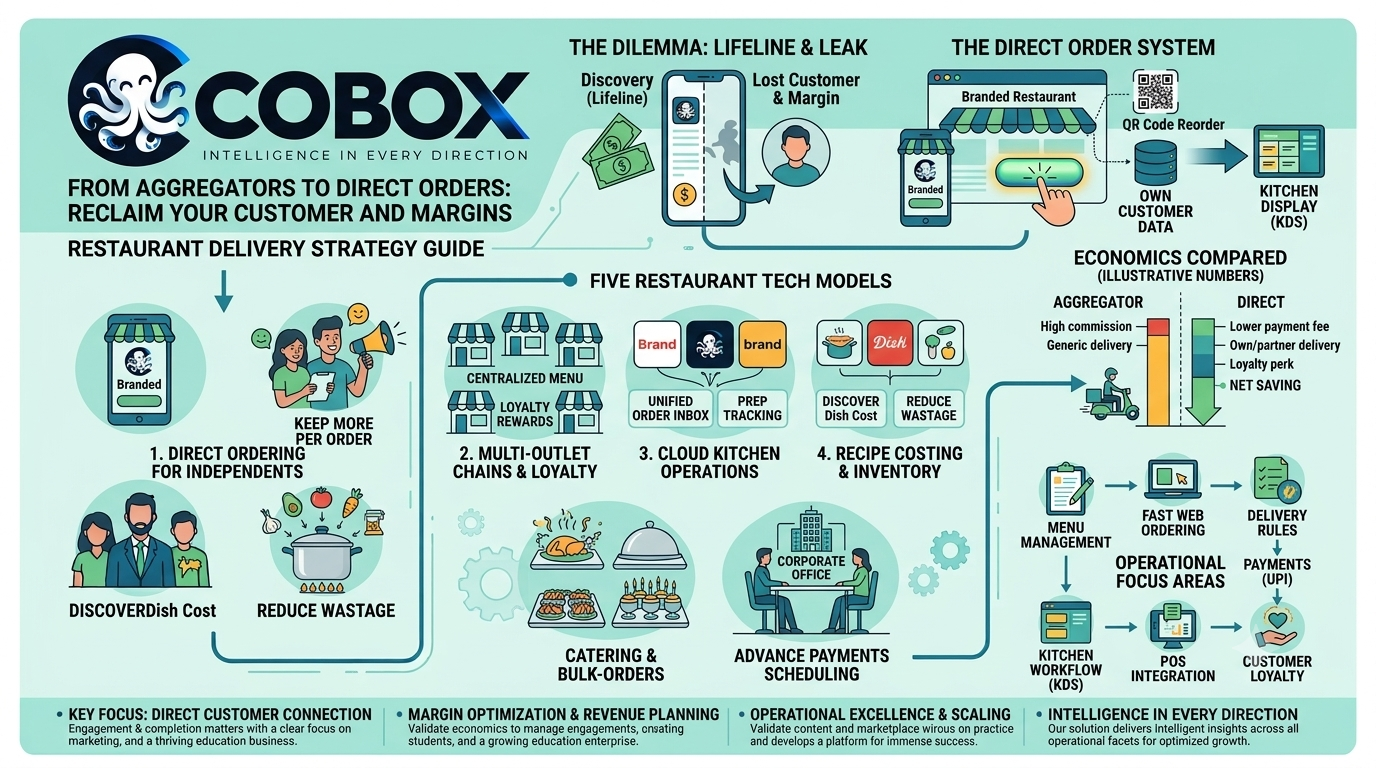
For many restaurants, delivery apps are both a lifeline and a leak. They bring orders from people who would never have found the restaurant. They also take a large share of each order and keep the customer relationship for themselves: the restaurant often never learns who ordered, cannot message them, and watches the same customer return through an app that now offers a competitor's discount.
This guide is for restaurant, cafe and cloud kitchen owners who want to take more orders directly, and for entrepreneurs considering restaurant technology as a business. It covers five business ideas, the features a restaurant ordering system actually needs (which are different from a generic online store), a worked comparison of aggregator and direct orders, costs and risks. All figures are illustrative; commission rates and costs vary by city, contract and cuisine.
How restaurant ordering businesses work
A restaurant earns on food margin, with costs spread across ingredients, staff, rent and delivery. Orders arrive through dine-in, phone, walk-in, its own channels, and aggregators. Each channel has a different cost to serve:
- Dine-in: highest service cost, no commission.
- Aggregator orders: discovery and delivery logistics, paid for with commission and sometimes promotion fees.
- Direct orders: no commission, but you must acquire customers and handle delivery yourself or through a delivery partner.
Restaurants face problems that generic e-commerce does not:
- Menus change daily, and items go out of stock mid-service.
- Modifiers and combos (no onion, extra cheese, meal deals) must reach the kitchen correctly.
- Time matters: food orders have minutes, not days, and peak hours swamp kitchens.
- Delivery radius and charges depend on distance and kitchen load.
- Customer data is lost when orders come through someone else's app.
Five restaurant technology business ideas
1. Direct ordering for independent restaurants
Concept: a branded ordering page and app-like experience for one restaurant, with menu, payments and kitchen alerts. Customer: single-outlet restaurant owners. Value: keep more of each order and own the customer list. Revenue: monthly subscription, sometimes plus a small per-order fee. Product: menu management, ordering, payment and order notifications. Risks: many existing tools, and customers who default to aggregator apps. Validate by: setting up five restaurants on a basic version and measuring how many orders shift.
2. Ordering and loyalty for multi-outlet chains
Concept: ordering, loyalty points and campaigns across several outlets with centralised menus. Customer: chains with 3 to 30 outlets. Revenue: implementation plus subscription per outlet. Product: central menu with outlet overrides, delivery zones, loyalty and reports. Risks: integration with existing billing (POS) systems. Validate by: running a pilot with two outlets of one brand.
3. Cloud kitchen operations software
Concept: a system for kitchens that run several delivery-only brands from one location: combined order intake from channels, kitchen display and prep tracking. Customer: cloud kitchen operators. Revenue: subscription per kitchen. Product: unified order inbox, kitchen display, inventory deduction and performance by brand. Risks: dependence on aggregators' integration access. Validate by: manually merging one operator's orders for a month to see where time is lost.
4. Recipe costing and inventory control for restaurants
Concept: link recipes to purchasing so owners know each dish's true cost, wastage and theoretical versus actual stock. Customer: owners whose margins vanish in the kitchen. Revenue: subscription. Product: recipe costing, stock counts, purchase orders and variance reports. Risks: staff discipline in entering data. Validate by: costing the ten best-selling dishes for three restaurants.
5. Catering and bulk-order portal
Concept: online quotes and ordering for corporate lunches, events and parties. Customer: restaurants and caterers; offices as buyers. Revenue: per-order fee or subscription. Product: quote builder, advance payments, scheduling and invoicing. Risks: lumpy demand and capacity planning. Validate by: handling corporate orders for one restaurant through a simple form.
Revenue models
| Model | How it earns | Fits |
|---|---|---|
| Monthly subscription | Per outlet or per kitchen | Ordering and operations software |
| Per-order fee | Small fixed fee per order, far below aggregator commissions | Direct ordering |
| Implementation fee | Menu setup, integrations, training | Chains |
| Add-on modules | Loyalty, campaigns, analytics | All products |
| Delivery margin | Markup on third-party delivery | Platforms offering logistics |
For a restaurant itself, the "revenue model" is the channel mix: how many orders move from commissioned channels to direct ones.
A hypothetical restaurant group, end to end
Imagine a six-outlet regional biryani brand that currently takes most delivery orders through aggregators. This is a composite, not a real client.
- Problem: commissions consume a large share of delivery revenue and the brand knows nothing about its delivery customers.
- Customers: repeat local customers who already like the food.
- Opportunity: shift a portion of repeat orders to the brand's own ordering with a loyalty reward.
- Acquisition: QR codes on packaging, receipts and WhatsApp messages inviting reorder with a small perk.
- A transaction: the customer opens the ordering page, picks an outlet by location, customises items, pays by UPI and gets a tracking message.
- Delivery: the nearest outlet's kitchen display receives the order; the outlet's riders or a delivery partner completes it.
- Revenue: food sales without aggregator commission, with loyalty points to drive repeat orders.
- Software: ordering page, central menu, delivery zones, kitchen display and loyalty.
- Validate first: whether repeat customers will switch a meaningful share of orders for a modest incentive.
- Expand: campaigns, catering orders and a branded app.
What the platform needs
- Menu management: categories, items, variants, modifiers, combos, taxes, availability by time and by outlet, and a one-tap "sold out".
- Ordering experience: fast mobile ordering with address autofill, outlet selection by location and saved past orders for one-tap reorder.
- Delivery rules: delivery zones, minimum order, distance-based fees, pickup option and estimated time that reacts to kitchen load.
- Payments: UPI, cards, wallets and cash on delivery, with refund handling for cancelled orders.
- Kitchen workflow: a kitchen display or printer integration, accept/reject, prep time and status updates.
- Billing integration: pushing orders into the restaurant's POS or accounting so sales and tax records are one set. See how to connect order and accounting systems.
- Customer data and loyalty: consented contact details, points, offers, birthday and win-back messages.
- Notifications: order confirmation and tracking by WhatsApp or SMS.
- Roles: owner, outlet manager, kitchen staff and delivery staff.
- Reports: orders by channel, average order value, repeat rate, peak hours and item popularity.
- Integrations: payments, delivery partners and messaging; see API integrations.
MVP versus later phases
| Capability | MVP | Later phase |
|---|---|---|
| Menu | Items, modifiers, availability | Combos, scheduled menus, upsell suggestions |
| Ordering | Mobile web, one or two outlets | Branded app, group ordering |
| Delivery | Fixed zones and fees | Dynamic fees, rider tracking |
| Kitchen | Order alert and printed ticket | Kitchen display with prep timing |
| Loyalty | Points on repeat orders | Tiers, campaigns, referral rewards |
| Billing | Daily sales export | Live POS integration |
Whether to build an app is a real question; mobile app vs web app explains why web ordering usually comes first, supported by QR codes and WhatsApp.
Technology approach
A fast mobile-first web front end (Next.js or similar) so orders can start from a QR code with no app install, a Laravel or Node.js back end, MySQL or PostgreSQL, and real-time channels (websockets or push) for kitchen alerts. Use queues for notifications and printing. Keep the menu service resilient: a restaurant at peak cannot wait for a slow page. Offer a fallback such as order alerts by WhatsApp if a kitchen tablet goes offline. Avoid building your own mapping or delivery tracking; use established providers.
Cost and timeline (illustrative)
Assumptions: India-based team, mobile web ordering for a multi-outlet brand, central menu, payments, kitchen alerts, loyalty basics, one POS integration, no native app. Planning ranges, not a COBOX quotation. A single restaurant is usually better served by a hosted ordering tool.
| Item | Illustrative range |
|---|---|
| Discovery and Blueprint | 1 to 2 weeks |
| Chain ordering platform MVP | Roughly ₹6 to 14 lakh (about US$7,000 to 16,500 at around ₹85 per US$), 8 to 12 weeks |
| POS integration | Depends on the POS vendor's API access and fees |
| Messaging and maps | Usage-based monthly cost |
| Hosting | Modest monthly cost |
| Maintenance | Ongoing; peak-time reliability matters |
The economics, with numbers
Compare one aggregator order with one direct order for an outlet with an average order value of ₹450. The commission rate is an assumption; real contracts vary.
| Per order | Aggregator | Direct |
|---|---|---|
| Commission at 25% | ₹112.50 | 0 |
| Payment fee at 2% | included | ₹9.00 |
| Delivery cost | included in commission | ₹40.00 |
| Loyalty perk or discount | 0 | ₹30.00 |
| Total cost to fulfil channel | ₹112.50 | ₹79.00 |
Saving per direct order: 112.50 − 79 = ₹33.50. For a six-outlet brand that moves 500 orders per outlet per month from aggregators to direct, that is 6 × 500 × ₹33.50 = ₹1,00,500 a month. If the ordering platform costs ₹15,000 a month to run, the net monthly benefit is ₹85,500. On a ₹9 lakh build, payback is 9,00,000 ÷ 85,500 ≈ 10.5 months.
Now the honest part. This depends on shifting 500 orders per outlet, which means winning customers who already like you, not stealing from aggregators' discovery. If only 150 orders per outlet shift, the saving is 6 × 150 × 33.50 = ₹30,150, less ₹15,000 running cost, leaving ₹15,150 a month, and payback stretches to about 59 months. Also, aggregators bring new customers you may never reach otherwise; the aim is to convert repeat customers, not to leave the platforms. These figures are invented, not forecasts.
A launch plan in seven phases
- Research and validation: analyse current orders by channel, commission paid and repeat customers. Find out how many customers would switch.
- Blueprint and requirements: a Business Blueprint sets channel targets, menu structure and scope.
- MVP build: ordering page, menu, payments, kitchen alerts.
- Pilot: one or two outlets for a month. Success: a measurable share of repeat customers ordering directly with no service failures.
- Customer acquisition: QR codes on packaging, receipts and WhatsApp reorder nudges.
- Operational improvement: faster prep estimates, better stock-outs and loyalty tuning.
- Expansion: all outlets, catering orders, campaigns, and an app if repeat usage justifies it.
Risks and compliance
- Food licensing: food businesses in India generally need FSSAI registration or licensing, and display requirements apply to online food orders. Confirm yours.
- Tax: GST on restaurant services and invoicing treatment differ by structure; use an accountant.
- Delivery quality: late or cold food damages the brand more than missing discounts.
- Peak-hour reliability: downtime at dinner rush is costly. Test under load and keep a fallback.
- Payments and refunds: clear cancellation rules for prepared food.
- Customer data: collect consent for marketing messages and follow India's Digital Personal Data Protection Act, 2023. Our security checklist is a useful baseline.
- Channel conflict: aggregator contracts may restrict how you promote direct ordering. Read them.
These are pointers for your advisers, not legal advice.
How COBOX can help
COBOX starts by understanding your order mix and margins, then recommends whether a hosted tool is enough or a custom platform pays back. We build the ordering, menu, kitchen and loyalty systems, integrate them with your POS, payments and messaging, and improve them as real order data comes in. Our retail work covers related ordering and inventory systems, and marketing automation helps with reorder campaigns.
Frequently asked questions
Can I start with a website instead of a mobile app?
Yes. A mobile web ordering page opened from a QR code needs no download and suits most first customers.
Should I leave the aggregators?
Usually not. Use them for discovery and steer repeat customers to direct ordering.
Do I need my own delivery riders?
Not necessarily. You can start with pickup and a delivery partner, or use your own riders in a small radius.
What should the first release include?
Menu with modifiers, mobile ordering, UPI payments and a reliable kitchen alert. Add loyalty after orders flow.
Will it integrate with my billing system?
Often, depending on your POS vendor's API. Check this early in the Blueprint because it affects scope.
How do I get customers to order direct?
QR codes with perks, reorder links by WhatsApp, and loyalty rewards that aggregator orders do not receive.
What costs should I expect?
Software subscription or build cost, payment fees, delivery, and the perks you offer. Compare them with the commission you pay today.
Is a cloud kitchen different?
Yes. It needs unified order intake from several channels and brand-level reporting, which is a different product from single-restaurant ordering.
Turn your restaurant idea into a plan
Want to take more orders directly instead of depending only on aggregators? Start with a Business Blueprint covering your channel mix, ordering features, costs and rollout. Paste something like this into the Blueprint tool:
I run [number] restaurants / cloud kitchens in [city] with about [number] delivery orders a month, mostly through [aggregators]. I want a direct ordering and loyalty system, an estimate of savings, an MVP scope and whether to buy a tool or build custom.
Or talk to us.