 COBOX
COBOX
How to Manage Rental Properties with Software: Rent, Maintenance and Tenant Experience

The business of renting property looks passive from outside. From inside it is a stream of small, time-sensitive tasks: reminding tenants of rent, chasing partial payments, arranging a plumber, renewing agreements, settling deposits, dealing with society rules and answering the same questions every month. One owner with three flats can do this with a phone and a notebook. A manager with 80 units, or a co-living operator with 400 beds, cannot, and the leaks add up fast.
This guide is for property managers, landlords with growing portfolios, PG and co-living operators, housing societies, and founders who want to build property-management software. It is different from our guide on building a real estate platform, which covers listings and lead generation; this one covers operating properties after a tenant moves in. We cover business models, features, worked economics, risks and a rollout plan. Scenarios are hypothetical and figures illustrative.
Why operations software pays back quickly
Rental income is predictable, which makes small improvements visible. Three levers dominate:
- Vacancy: every empty day on a unit is lost rent that cannot be recovered. Faster turnover and renewals matter.
- Collection: late and partial payments create hidden financing costs and awkward conversations.
- Maintenance: slow repairs drive tenants away, while uncontrolled spending erodes margins.
Business models you can adopt or build
1. Software for your own portfolio
A landlord or manager adopts a tool to track units, tenants, rent and expenses. For small portfolios, an existing app or well-structured spreadsheet is enough; for larger or unusual operations, custom software can be justified. The trade-offs appear in custom software vs ready-made tools.
2. Property management service company
You manage properties for owners, charging a percentage of rent (commonly a single-digit percentage) and fees for leasing and maintenance. Software lets you handle more units per employee and report transparently to owners.
3. PG, hostel and co-living operator
You lease buildings and rent beds or rooms. Revenue is the room rent plus services such as food, laundry and housekeeping. Occupancy, churn and daily operations dominate; the technology is a core part of the business.
4. Society and apartment management platform
Resident associations need maintenance billing, visitor management, complaints, notices and amenity bookings. Revenue is a subscription per flat or per society. Selling to committees takes patience.
5. Property management SaaS for professionals
You sell to many managers and landlords. Revenue is a monthly fee per unit. Choose a niche such as student housing, commercial leases or short-stay rentals. See how to build a SaaS product.
| Model | Revenue | Capital need | Main challenge |
|---|---|---|---|
| Own portfolio software | Saves time, raises collection | Low | Discipline in recording data |
| Management company | Percentage of rent plus fees | Low to medium | Owner trust, scaling people |
| PG and co-living | Rent and services | High (leases, fit-out) | Occupancy, daily operations |
| Society platform | Subscription per flat | Low | Committee decisions, adoption |
| Property SaaS | Subscription per unit | Low | Competition, support load |
A hypothetical scenario: a 60-bed PG
Consider a fictional operator, NestStay, running three PG buildings with 60 beds. Rent is due on the 5th. Each month the manager messages every tenant, collects UPI screenshots, matches them to a sheet and chases about a quarter of tenants who pay late. A tenant leaving gives two weeks' notice by phone; the manager forgets to list the bed, so it stays empty for 18 days. Maintenance requests arrive on WhatsApp and get lost.
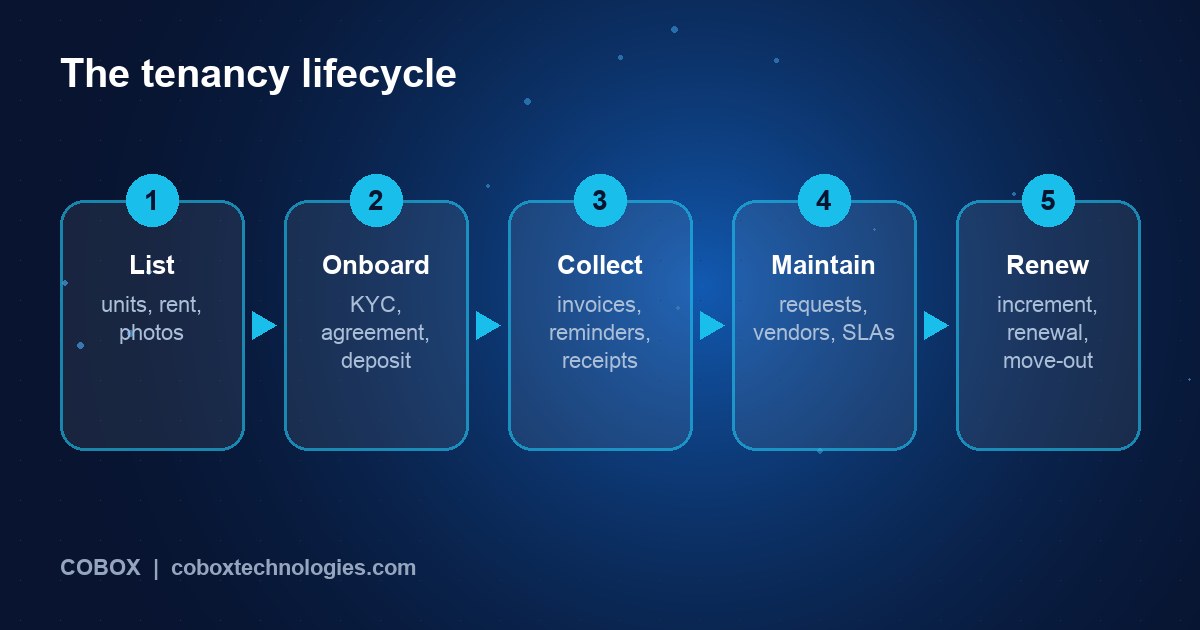
With software, each tenant has a profile, a rent plan and a payment link. Invoices and reminders go out automatically before the due date; payments reconcile themselves; part-payments are recorded and reminders continue for the balance. A tenant's notice triggers a vacancy listing on the same day, a move-out checklist and a deposit settlement worksheet. Maintenance requests are logged with photos, assigned to a vendor and tracked until closed, and tenants rate the fix. The manager's day shifts from chasing to deciding.
Features that matter
| Area | MVP | Later |
|---|---|---|
| Units and tenants | Property, unit and bed records, tenant profiles, KYC documents, agreement storage | E-signature, police verification workflow where required, tenant scoring |
| Rent and billing | Invoices, payment links, auto-reminders, part-payments, receipts, late fees | Auto-debit, utility sub-metering, owner payouts |
| Deposits | Deposit ledger, move-in and move-out checklists with photos | Deduction workflows, dispute records |
| Maintenance | Request logging, assignment, status, vendor records, cost tracking | Preventive schedules, vendor performance, inventory |
| Communication | Notices, WhatsApp and SMS, tenant app or portal | Community features, amenity booking, visitor management |
| Owner reporting | Rent collected, expenses, net income statements | Tax-ready reports, yield analysis |
| Leasing | Vacancy tracking, enquiries, simple listing | Syndication to portals, virtual tours |
For scoping help see what to include in an MVP.
Money handling needs transparency
When you collect rent on behalf of owners, record exactly what came in, what fees you deducted and what you paid out. Owners will leave a manager they do not trust. Whether you may hold money in a pooled account depends on your structure and payment provider, so confirm it before designing payouts. Related questions appear in building a financial services platform.
Architecture in plain language
- Manager web dashboard: portfolio, collections, maintenance, reports.
- Tenant portal or app: pay rent, raise requests, view documents. A mobile web page with WhatsApp prompts often beats an app; see mobile app vs web app.
- Owner portal: statements and documents.
- Backend: tenancies, ledgers, schedules, notifications.
- Integrations: payment gateway or UPI collection, WhatsApp, accounting, e-signature, maybe smart locks or meters. See API integrations and CRM and customer portals.
Costs and timeline (illustrative)
| Build | Scope | Indicative cost | Indicative time |
|---|---|---|---|
| Portfolio management MVP | Units, tenants, rent, reminders, maintenance, owner statements | ₹6-15 lakh | 10-14 weeks |
| PG and co-living system | Beds, occupancy, meals, attendance, tenant app, billing | ₹12-28 lakh | 4-6 months |
| Property SaaS v1 | Multi-company accounts, roles, billing, integrations, support tools | ₹25-50 lakh | 6-9 months |
Add 15-20 percent of build cost per year for maintenance; see software maintenance costs.
Worked economics: vacancy and collection
Assume NestStay (hypothetical) has 60 beds at ₹9,000 a month.
- Potential monthly rent at full occupancy: 60 x ₹9,000 = ₹5,40,000
- Average vacancy of 14 percent: ₹75,600 lost a month
- Late and uncollected rent equal to 3 percent of potential: ₹16,200 a month
Suppose software helps in two ways. Faster re-listing and renewal reminders cut vacancy from 14 to 10 percent, recovering 4 percent of potential, which is ₹21,600 a month. Automated reminders and payment links cut uncollected rent from 3 to 1 percent, recovering ₹10,800. Total recovery is ₹32,400 a month, or about ₹3.9 lakh a year. If a custom system costs ₹14 lakh and ₹2.1 lakh a year to maintain, the net gain is ₹1.8 lakh a year, which is a poor return. A ready-made tool at ₹30,000 a year would net ₹3.6 lakh and pay back immediately. For one 60-bed operator, buying beats building; at 600 beds across multiple cities the same improvements are worth ten times as much and a custom system can make sense.
This kind of arithmetic is the right way to decide between buying and building. For a SaaS product, compute lifetime value: at ₹40 per unit per month and 200 units per customer, monthly revenue is ₹8,000 per customer; with 4 percent monthly churn, expected lifetime is 25 months, so lifetime revenue is ₹2,00,000 before support costs. Keep revenue, margin and cash separate in reports; see weekly dashboard numbers, and test demand with the validation guide.
Growth and retention levers
- Renewal workflow: start renewal conversations 60 days ahead with a clear increment policy.
- Fast maintenance: closing requests quickly is the strongest driver of renewals.
- Owner transparency: monthly statements and photos win referrals.
- Digital marketing for vacancies: listings with accurate availability and virtual tours.
- Community and services: food, laundry and events in co-living raise retention.
Measure occupancy, days vacant between tenants, on-time collection rate, maintenance resolution time and renewal rate. See what to measure in the first 90 days.
Seven-phase rollout plan
- Build the data baseline: units, tenants, rents, deposits and agreement dates in one clean sheet.
- Measure current vacancy, collection delays and repair times.
- Choose to buy or build using arithmetic like the example above.
- Pilot one building for 6-8 weeks.
- Roll out collections first, then maintenance, then owner reporting.
- Train staff and onboard tenants with simple WhatsApp-first steps.
- Review quarterly against the baseline.
If you are still on spreadsheets, our guide on Excel and WhatsApp: when to upgrade helps you pick the moment.
Risks and compliance
- Tenancy law: rent control, registration of rent agreements, notice periods and deposit rules vary by state. Confirm local requirements; software should enforce your policy, not invent one.
- Personal data and KYC: ID documents are sensitive under India's Digital Personal Data Protection Act, 2023. Collect only what you need, restrict access and set retention periods. See our security page.
- Police and local verification: some localities require tenant verification; follow local rules.
- Money handling: collecting rent on behalf of owners needs a clear and compliant structure.
- Safety and licensing for PGs: fire, building and local licensing rules apply to hostels and co-living.
- Taxes: GST on rent, TDS and income tax treatment vary by case; confirm with an accountant.
These are pointers for your advisers, not legal advice.
How COBOX can help
COBOX helps you decide honestly whether to buy or build, and delivers the custom pieces that give you an edge. We map your operations, produce a Blueprint, build tenant, owner and manager experiences, and integrate payments and messaging. See business process automation, MVP development and marketplace development for related offers.
Frequently asked questions
Do I need custom software to manage rentals?
Usually not for a small portfolio. Existing tools are cheaper. Build when you operate at scale, have unusual workflows, or are creating a product to sell.
How much does property management software cost to build?
A focused MVP is typically ₹6-15 lakh in India. PG, co-living and SaaS products cost more.
Can tenants pay by UPI through the system?
Yes, through a payment provider that supports UPI collection and reconciliation. Confirm fees and settlement timelines.
How do I reduce late payments?
Send reminders before the due date, provide one-tap payment links, and apply clear late-fee rules that you actually enforce.
Is a tenant app necessary?
No. A mobile web portal plus WhatsApp reminders works for most operators.
How should I store agreements and IDs?
In encrypted storage with role-based access and a defined retention period, and only with tenant consent where required.
Can this work for commercial leases?
Yes, but with additional features such as escalation clauses, CAM charges and longer lease terms.
What should I track first?
Occupancy, on-time collection and maintenance resolution time.
Turn your idea into a plan
Planning to run properties on software or build a property product? Start with a Business Blueprint covering users, workflows, MVP features, technology and rollout roadmap. Paste something like this into the Blueprint tool:
I manage [number] units/beds across [number] properties in [city]. My problems are [vacancy / late rent / maintenance]. I need to decide whether to buy or build, an MVP plan and a rollout plan.
Or talk to us first, and read about the Business Blueprint.