 COBOX
COBOX
How to Build a Creator Economy Platform: Memberships, Content, Commerce and Payouts
A creator with 20,000 followers on a social platform often earns almost nothing from them. The platform owns the audience, the algorithm decides who sees what, and a sponsor deal may arrive twice a year. Meanwhile a creator with 800 paying members can earn a stable living. That gap is the opportunity behind the creator economy: tools that help creators turn attention into income they own.
This guide is for founders who want to build a creator platform, and for creators, media houses and communities who want their own membership or digital-products business instead of renting audience from social networks. We cover five business models, features, payouts, worked economics, risks and a launch plan. Scenarios are hypothetical and figures illustrative.
What creators actually need
Most creators are small businesses of one. Ask what they want and the answers are consistent:
- Predictable income: memberships and recurring revenue instead of sporadic sponsorships.
- Direct audience relationship: email, phone numbers and community they control.
- Simple tools: publish, sell, get paid, with no engineering.
- Fair fees: they notice every percentage point.
- Reliable payouts and tax paperwork: clear statements and timely settlements.
Five business models
1. Membership and fan subscription platform
Fans pay a monthly fee for exclusive posts, lives or community. The platform earns a percentage. Retention and content cadence decide success, and a few top creators produce most of the revenue.
2. Digital products and courses marketplace
Creators sell templates, presets, e-books, courses and downloads. Compare with launching an online education business for the learning side. Earnings are one-time sales with a long tail, and discovery is the hard problem.
3. Tipping and micro-support
Small one-off payments during live streams or posts. Volume is high and value per transaction low, so payment cost and fraud control matter a lot.
4. Brand collaboration marketplace
Brands post campaigns and creators apply; the platform handles briefs, content approval, payment protection and reporting. Revenue is a commission on deals. Quality control of both sides and measurable outcomes are essential.
5. Creator business tools (SaaS)
Link-in-bio pages, storefronts, email tools, analytics and invoicing. Revenue is subscription. This is a lower-risk entry into the ecosystem, then expand into payments and commerce. See how to build a SaaS product.
| Model | Revenue | Key dependency | Main challenge |
|---|---|---|---|
| Membership platform | Percentage of subscriptions | Top creators bringing audiences | Creator acquisition, churn |
| Digital products | Commission on sales | Discovery and trust | Low differentiation, refunds |
| Tipping | Percentage of tips | Live or social traffic | Low ticket size, payment costs |
| Brand marketplace | Commission on deals | Brand budgets | Quality, disputes, measurement |
| Creator SaaS | Subscription | Creator adoption | Competition from free tools |
A hypothetical scenario: a cooking creator
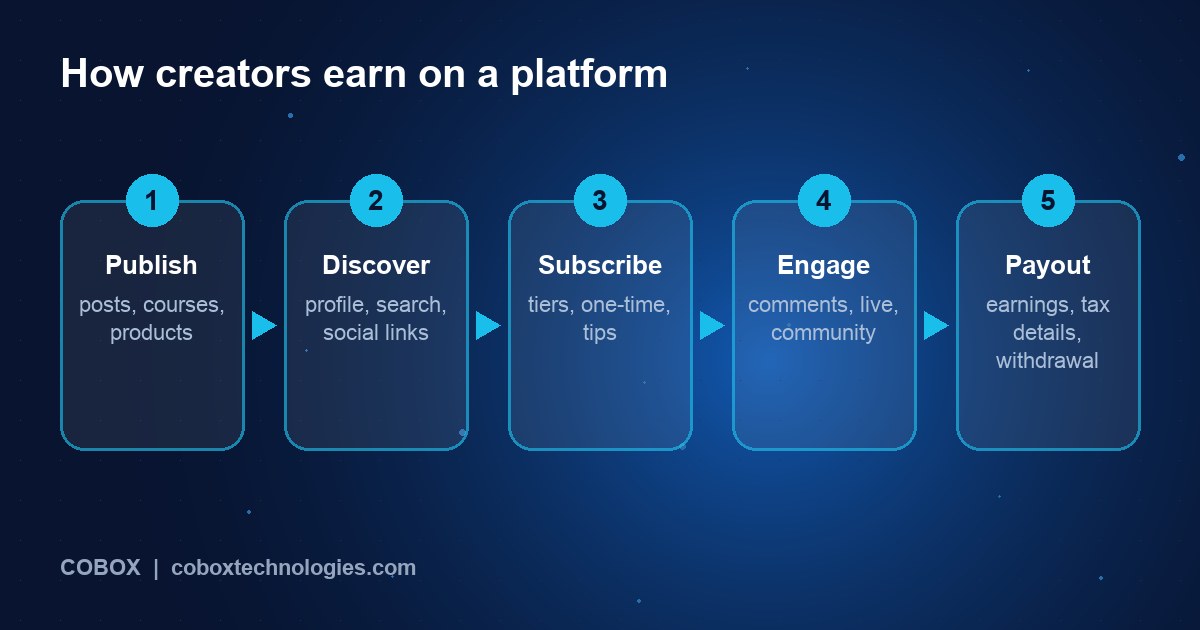
Consider a fictional platform, Gather, and a creator, Nisha, who teaches regional recipes to 60,000 followers. She creates a page, offers three tiers (₹99 for recipes, ₹299 for weekly live cooking, ₹999 for a monthly small-group masterclass), and also sells a ₹499 recipe e-book. She shares the link in her bio. A follower subscribes to the ₹299 tier by UPI, which sets up a recurring mandate. They receive instant access to previous posts, a reminder before each live session, and a community space. Nisha sees her earnings dashboard, churn and which posts drive sign-ups. At the end of the month, Gather settles her balance minus a platform fee and payment charges, along with a statement for her accountant.
Features that matter
| Area | MVP | Later |
|---|---|---|
| Creator pages | Profile, tiers, posts (text, image, video), custom link | Custom domains, themes, storefront |
| Monetisation | Subscriptions, one-time products, tips, coupons | Bundles, gifting, affiliates, brand deals |
| Content delivery | Gated posts, secure video, downloads, notifications | Live streaming, courses, audio, offline access |
| Community | Comments, polls, direct messages with limits | Groups, events, leaderboards |
| Payments and payouts | UPI and cards, recurring billing, creator balance, payout requests, statements | International payments, multi-currency, instant payouts |
| Analytics | Subscribers, revenue, churn, top posts | Cohorts, audience insights, experiments |
| Safety and trust | Reporting, moderation tools, content rules, age gates | Automated moderation, creator verification |
For scoping see what to include in an MVP.
Recurring payments need careful design
Recurring billing in India has specific rules for mandates, notices and limits set by the RBI and payment networks, and not every method supports every amount. Plan for failed payments, grace periods, reminders and easy cancellation. Make cancellation as easy as sign-up; it reduces chargebacks and complaints. Related design issues are discussed in building a financial services platform.
Moderation is a feature, not an afterthought
User-generated content brings legal and reputational risk. Provide a way to report content, a clear policy, and tools to remove it. Decide your stance on adult content, minors, hate speech and impersonation before launch, since payment partners will have their own restrictions.
Architecture in plain language
- Fan-facing web and mobile web: discovery, subscribe, consume. Many fans arrive from links in social posts. Decide when an app is worth it using mobile app vs web app.
- Creator dashboard: publish, manage tiers, view earnings.
- Admin console: moderation, payouts, disputes, finance.
- Backend: subscriptions, content access control, ledger, notifications.
- Media pipeline: upload, transcoding, secure delivery through a CDN.
- Integrations: payment gateway with recurring support, email and WhatsApp, analytics, tax and invoicing. See API integrations and cloud infrastructure.
Video is the biggest cost driver. Storage and bandwidth grow with success, so plan for them in pricing and design.
Costs and timeline (illustrative)
| Build | Scope | Indicative cost | Indicative time |
|---|---|---|---|
| Creator tools MVP | Pages, storefront, payments, basic analytics | ₹8-18 lakh | 3-4 months |
| Membership platform v1 | Tiers, recurring billing, gated content, payouts, moderation, admin | ₹20-40 lakh | 5-7 months |
| Full platform with apps and live | Native apps, live streaming, community, brand marketplace | ₹50-100 lakh | 8-12 months |
Running costs for media, payments and moderation grow with usage. Maintenance of 15-20 percent of build cost a year is a starting assumption; see software maintenance costs.
Worked economics: take rate and retention
Suppose Gather (hypothetical) takes a 10 percent platform fee on subscriptions, and payment processing costs about 2 percent.
- One subscriber at ₹299 a month: platform fee ₹29.90
- Payment cost: about ₹6 (2 percent of ₹299), which may be recovered from the creator or fan depending on your policy; here we assume the platform bears it
- Media delivery and storage allocation: about ₹4 per subscriber per month
- Contribution per subscriber per month: ₹29.90 - ₹6 - ₹4 = about ₹20
Now scale. A creator with 800 subscribers across tiers averaging ₹299 earns ₹2,39,200 a month gross; the platform's contribution from that creator is 800 x ₹20 = ₹16,000 a month. To cover ₹10 lakh a month of platform costs (team, tools, rent, support) you need about 62 such creators, or about 50,000 paid subscriptions. A 10 percent take rate is thin, which is why successful platforms add services: payments in several currencies, product sales, live commerce and brand deals.
Retention matters: with 6 percent monthly churn a subscriber stays about 17 months on average (1 / 0.06), so lifetime fee per subscriber is about ₹29.90 x 17 = ₹508, and lifetime contribution about ₹20 x 17 = ₹340. If it costs ₹500 in marketing to bring a creator's fans over, the cost per subscriber has to be far lower, which is why platforms depend on creators bringing their own audience. Keep gross merchandise value, platform revenue and contribution distinct in reports; see weekly dashboard numbers, and test creator demand with the validation guide.
Growth levers
- Creator-led acquisition: help creators move fans with templates, pre-launch pages and migration tools.
- Niche focus: regional-language creators, educators or musicians have different needs; specialise.
- Creator success team: training, content calendars and feedback matter more than features.
- Referral and bundles: cross-promotion between complementary creators.
- Transparent economics: clear fees and fast payouts attract creators from rivals.
Measure creator activation, subscriber churn, revenue per creator, payout failure rate and content-report resolution time. See what to measure in the first 90 days and tracking marketing leads to revenue.
Seven-phase launch plan
- Pick a niche and recruit 10-20 creators personally.
- Concierge test: run their memberships on existing tools and payment links to learn what they actually need.
- Define the MVP: pages, subscriptions, payouts.
- Build and pilot with those creators, adjusting weekly.
- Launch with creator-led campaigns and early-adopter fee discounts.
- Add products, live sessions and community.
- Open applications gradually while maintaining content quality.
Risks and compliance
- Content liability: India's IT rules require platforms to handle certain content complaints and takedowns; take advice on intermediary obligations and grievance processes.
- Payments and payouts: holding funds for creators and paying them out is regulated; use a licensed payment provider and confirm the structure.
- Taxes: creators have income tax and possibly GST obligations; platforms may have TDS or collection duties. Confirm with an accountant and provide statements.
- Personal data and minors: India's Digital Personal Data Protection Act, 2023 sets stricter rules for children's data. See our security page.
- Intellectual property: take-down processes for copyright claims and clear terms on ownership of uploaded content.
- Creator concentration: a few creators can account for most revenue; losing one hurts. Diversify.
- Advertising disclosure: influencer promotions must follow advertising disclosure guidelines; help creators comply.
These are pointers for your advisers, not legal advice.
How COBOX can help
COBOX helps you pick a niche, validate creator demand, and build a platform with strong payments and content controls. We produce a Blueprint, build creator, fan and admin experiences, set up media delivery and integrate payments and messaging. See product discovery, MVP development and SaaS work.
Frequently asked questions
Why would creators use my platform instead of existing ones?
Because you serve a niche better: lower fees, local payments, regional languages or specific tools. General competition is hard.
How much does a creator platform cost to build?
A creator-tools MVP often costs ₹8-18 lakh in India, and a full membership platform ₹20-40 lakh or more.
What take rate is reasonable?
It varies by service level. Many platforms charge a single-digit to low-double-digit percentage; creators compare it with total value, not only the number.
Do I need an app?
Start with the web. Consider an app when daily engagement and notifications justify it.
How do I handle video costs?
Transcode efficiently, use a CDN, limit upload sizes and price plans so heavy video users cover their costs.
How do I moderate content at scale?
Combine clear policies, user reporting, a review queue and automated checks for obvious violations.
Can fans pay internationally?
Yes with a payment provider that supports international cards; fees and compliance are higher.
What should I measure first?
Creator activation, subscriber churn and revenue per creator.
Turn your creator idea into a plan
Planning a creator platform? Start with a Business Blueprint covering creators, fans, revenue model, MVP features, technology and launch roadmap. Paste something like this into the Blueprint tool:
I want to build a [membership / digital products / brand deals] platform for [niche or language] creators. I expect [number] creators with [number] paying fans at about ₹[price] a month. I need an MVP plan, a payout design and a validation plan.
Or talk to us first, and read about the Business Blueprint.