 COBOX
COBOX
How to Build an Insurance Distribution Platform: Comparison, Policy Servicing and Claims Support

Insurance is sold, not bought. Most people do not wake up wanting a policy; they buy after an agent calls, a loan officer bundles it, or a family event reminds them of risk. This is why distribution, the work of reaching customers, explaining products and servicing policies, is where much of the value in insurance sits, and why technology businesses are drawn to it. It is also why this is the most regulated category in this series: selling insurance without the right authorisation is not a grey area.
This guide is for founders, agencies and financial-services firms considering an insurance distribution platform in India. We cover five models and the licence route each tends to need, the features that matter, worked commission economics, the risks, and a launch plan. It is a product and business guide, not legal advice. Regulation changes quickly, so every regulatory statement below should be confirmed with a qualified adviser and the current IRDAI texts before you build or launch.
A note on regulation first
As of October 2026, our research from public secondary sources indicates the following, and you should verify each point against official IRDAI notifications:
- In India, soliciting or selling insurance is regulated by the Insurance Regulatory and Development Authority of India (IRDAI). Distribution is usually through licensed intermediaries such as individual agents, corporate agents, brokers, insurance marketing firms and web aggregators.
- Parliament has passed the Sabka Bima Sabki Raksha (Amendment of Insurance Laws) Act, 2025, which among other things raises the foreign investment limit in insurers to 100 percent and amends the Insurance Act, 1938. Reports differ on whether it creates composite licences; see the Saraf and Partners analysis and confirm in the official text.
- PwC reports that IRDAI notified amendments to the Insurance Intermediaries regulations in July 2026 covering corporate agents, brokers, insurance marketing firms and web aggregators, to align with the amended Act (see the PwC summary). A law-firm overview of distribution channels, compliance and data governance is available from Cyril Amarchand Mangaldas.
- Under the earlier 2017 web aggregator regulations, a web aggregator needed IRDAI approval, had to meet eligibility conditions including minimum paid-up capital and net worth, and was restricted from other business. The 2026 changes may have altered details such as registration validity and fees.
The practical conclusion: decide your licence route before you design the product, because the licence defines what you may show, recommend and earn.
Five distribution models
1. Web aggregator or comparison platform
Customers compare quotes from several insurers. Revenue is commission or lead fees from insurers. The licence is a web aggregator authorisation. Traffic is expensive, so the business lives or dies on acquisition cost and conversion.
2. Broker or corporate agent platform
A licensed broker advises customers and places business with insurers, earning commission and sometimes a fee. This model suits complex products such as group health, commercial insurance and employee benefits, where advice and servicing matter.
3. Agent and POSP enablement platform
Software for a distributor's network of agents or point-of-sales persons: lead management, quotes, onboarding, training, commission tracking and servicing. Revenue is a subscription or a share of the distributor's margin. You serve a licensed entity, which is simpler than becoming one.
4. Embedded insurance
Insurance sold inside another journey: a phone purchase, a travel booking, a loan, a vehicle sale. You partner with a licensed distributor or insurer and handle the user experience and integration. Conversion is high because the customer is already in a buying moment.
5. Servicing and claims-assistance platform
Tools that help policyholders store policies, receive renewal reminders and get claim guidance. Revenue comes from distributor subscriptions or referral arrangements, subject to rules on what you may recommend. Trust and neutrality are your product.
| Model | Revenue | Typical licence position | Main challenge |
|---|---|---|---|
| Web aggregator | Commission, lead fees | Needs its own authorisation | Acquisition cost, compliance |
| Broker platform | Commission, fees | Needs broker licence | Advice quality, servicing load |
| Agent enablement | Subscription or margin share | Works through a licensed distributor | Winning distributors |
| Embedded insurance | Commission via partner | Through licensed partner | Integrations, partner dependence |
| Servicing and claims help | Subscription, referrals | Depends on what you do; confirm | Trust, neutrality |
A hypothetical scenario: a two-wheeler renewal
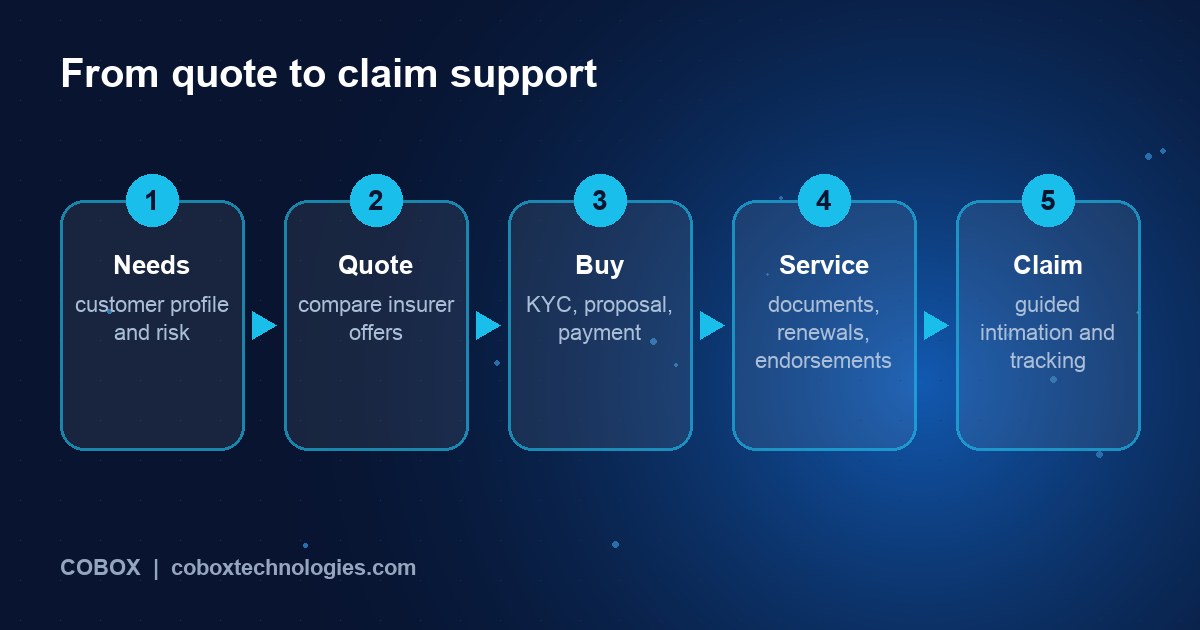
Consider a fictional agent-enablement platform, CoverDesk, used by a licensed corporate agent. A customer's two-wheeler policy is due in 30 days. CoverDesk sends a renewal reminder on WhatsApp with a link. The customer sees the current policy, three renewal quotes returned live from the insurers the distributor is authorised to sell, the premium, and a plain-language comparison of what each covers. They choose one, confirm KYC details already on file, pay, and receive the policy document. CoverDesk records the commission earned for the agent, stores the policy and schedules next year's reminder. If the customer later has an accident, the platform offers a guided claim-intimation form and a checklist of documents, and tracks status with the insurer.
The platform did not give advice beyond what the licensed distributor is permitted to provide; it removed friction around a purchase the customer already needed.
Features that matter
| Area | MVP | Later |
|---|---|---|
| Quotes | Insurer integrations for one or two products, comparison view, plain-language benefits | More products, rule-based recommendations, group quoting |
| Onboarding | Proposal forms, KYC capture, consent, document upload | Video KYC, auto-fetch from registries where permitted |
| Payments | Payment gateway, receipts, refunds handling | Instalment collection, auto-renew mandates |
| Policy servicing | Policy vault, renewal reminders, endorsements requests | Self-service changes, family dashboards |
| Claims support | Claim intimation form, document checklist, status tracking | Cashless network search, claim assistance workflows |
| Distributor tools | Leads, pipeline, commission statements, agent onboarding and training | Gamification, hierarchy management, performance analytics |
| Compliance | Disclosures, consent logs, audit trail, record retention | Automated regulatory reports, sales-quality reviews |
For scope discipline see what to include in an MVP.
Design for fair selling
Customers must understand what they are buying. Show exclusions, waiting periods and claim processes as clearly as price. Avoid dark patterns that hide the costlier plan or pre-select add-ons. Record what was shown and what the customer agreed to. Regulators and courts look closely at mis-selling, and clear journeys also reduce complaints and cancellations.
Architecture in plain language
- Customer web and mobile web: quotes, purchase, policy vault.
- Distributor and agent dashboard: leads, quotes, commission, servicing queue.
- Admin and compliance console: approvals, audit logs, reports.
- Backend: product rules, quotes, proposals, policy records, notifications.
- Integrations: insurer APIs (each has its own format), payment gateway, KYC providers, WhatsApp and SMS, accounting. See API integrations and connecting CRM, accounting and order systems.
- Security: very high; see below.
Insurer integrations are the long pole. Every insurer exposes quotes and issuance differently, with different error handling and approval times, so budget more time for them than for screens. The design thinking is similar to building a financial services platform.
Costs and timeline (illustrative)
| Build | Scope | Indicative cost | Indicative time |
|---|---|---|---|
| Agent enablement MVP | Leads, quotes for 1-2 insurers, policy vault, commissions, reminders | ₹15-35 lakh | 4-6 months |
| Broker or aggregator v1 | Multi-insurer quotes, KYC, payments, servicing, compliance logs | ₹35-80 lakh | 7-10 months |
| Embedded insurance integration | Quote and issuance inside a partner journey | ₹10-25 lakh | 2-4 months |
Licence, capital, compliance staff, security audits and insurer onboarding sit outside these figures and can exceed software costs. Plan 15-20 percent of build cost per year for maintenance (see the breakdown).
Worked economics: commission and acquisition cost
Suppose CoverDesk's distributor (hypothetical) sells a motor policy with a ₹6,000 premium. Commission rates are set by insurers within regulatory limits and vary by product, so use your own agreement; here we assume 15 percent for illustration.
- Premium: ₹6,000 (this is not your revenue)
- Commission revenue: ₹900
- Payment cost at about 1.5 percent of premium: ₹90 (often paid by the insurer or customer depending on setup)
- Agent share of commission (for a network model) at 60 percent: ₹540
- Servicing and support allocation: ₹60
- Contribution to the platform and distributor before marketing: ₹900 - ₹90 - ₹540 - ₹60 = ₹210
If a customer is acquired by paid advertising at ₹700, the first policy loses ₹490. The business works only through renewals: if 70 percent renew each year, the expected number of policies per customer over five years is 1 + 0.7 + 0.49 + 0.34 + 0.24 = about 2.77. Expected five-year contribution is 2.77 x ₹210 = about ₹582, which is below the ₹700 acquisition cost, so the business loses money. Cut acquisition cost to ₹200 through embedded or referral channels and the same customer leaves about ₹382 of contribution; lift renewals or add a second product and it improves further.
The lesson is the same across distribution businesses: first-year commission rarely covers paid acquisition, renewals and cross-selling decide profitability, and channel cost matters more than interface polish. Always keep premium, commission revenue and contribution separate in reports; see weekly dashboard numbers. Test the assumptions with the validation guide before building integrations.
Growth levers
- Embedded channels with lenders, automobile dealers, travel and e-commerce partners, where intent is high and acquisition is cheap.
- Renewal engine: timely reminders and easy payment protect lifetime value.
- Education content that explains products plainly, for organic reach and trust.
- Agent productivity tools that help distributors sell more with less effort.
Measure quote-to-purchase conversion, renewal rate, claim satisfaction, complaints per 1,000 policies and cost per acquired policy. Learn attribution in tracking marketing leads to revenue.
Seven-phase launch plan
- Decide the licence route with a regulatory adviser before building anything customer-facing.
- Choose one product line, such as two-wheeler, term life or health top-ups.
- Secure insurer partnerships and understand their integration capabilities.
- Design the journey with disclosures and consent first.
- Build and test in the insurers' sandboxes.
- Pilot with a small distributor network and review every complaint.
- Scale channels and products after renewal and complaint metrics are healthy.
Risks and compliance
- Authorisation: acting as an unlicensed intermediary is a serious violation. Confirm your position with a qualified adviser.
- Mis-selling: unclear disclosures, pressure tactics and wrong product recommendations lead to complaints and penalties.
- Personal and sensitive data: health, vehicle and identity data demand strict protection; India's Digital Personal Data Protection Act, 2023 and IRDAI information and cybersecurity expectations apply. See our security approach and security checklist.
- Insurer dependence: API changes or terminated partnerships can break journeys; design for multiple insurers.
- Record keeping: store proposals, consents and communications for the required periods.
- Commission and disclosure rules: what you may earn and must disclose can change; track IRDAI updates.
- Taxes: GST on commission and services follows specific rules; confirm with an accountant.
These are pointers for your advisers, not legal advice.
How COBOX can help
COBOX builds the technology, not the licence. We help you map the journey, produce a Blueprint, design disclosure-first user experiences, and build distributor, customer and admin tools with careful integration and security. See product discovery, MVP development and CRM and customer portals.
Frequently asked questions
Can I sell insurance online without a licence?
Generally no. Selling or soliciting insurance requires an authorised route, such as working through a licensed distributor or obtaining the right intermediary licence. Take specialist advice.
Do I need to become a web aggregator?
Only if you compare and sell across insurers under that model. Software vendors serving licensed distributors usually do not need it, but confirm your exact role.
How much does an insurance platform cost to build?
An agent-enablement MVP is often ₹15-35 lakh, and an aggregator or broker platform costs more. Licensing and compliance add to that.
Why are insurer integrations difficult?
Each insurer has different APIs, data requirements and approval processes, so integration and testing take longer than interface work.
Is embedded insurance easier?
Often, because the customer is already in a purchase journey and a licensed partner handles regulated parts. You still need contracts and careful integration.
How do I keep customer data safe?
Use encryption, strict access controls, audit logs, vendor reviews and regular security testing, and collect only the data you need.
Can AI recommend policies?
It can assist, but recommendations are regulated in many contexts. Keep a licensed human accountable and log the basis for suggestions.
What should I measure first?
Quote-to-purchase conversion, renewal rate, complaints, and acquisition cost per policy.
Turn your insurance idea into a plan
Planning an insurance distribution product? Start with a Business Blueprint covering users, model, MVP features, technology and launch roadmap, then take it to your regulatory adviser. Paste something like this into the Blueprint tool:
I want to build an [agent enablement / embedded insurance / comparison] platform for [product line] working with [licensed distributor or partner]. I expect [number] policies a month with an average premium of ₹[amount]. I need an MVP plan, insurer integration approach and compliance questions to ask.
Or talk to us first, and read about the Business Blueprint.