 COBOX
COBOX
How to Build a Financial Services Platform: Customer Onboarding, Payments and Compliance
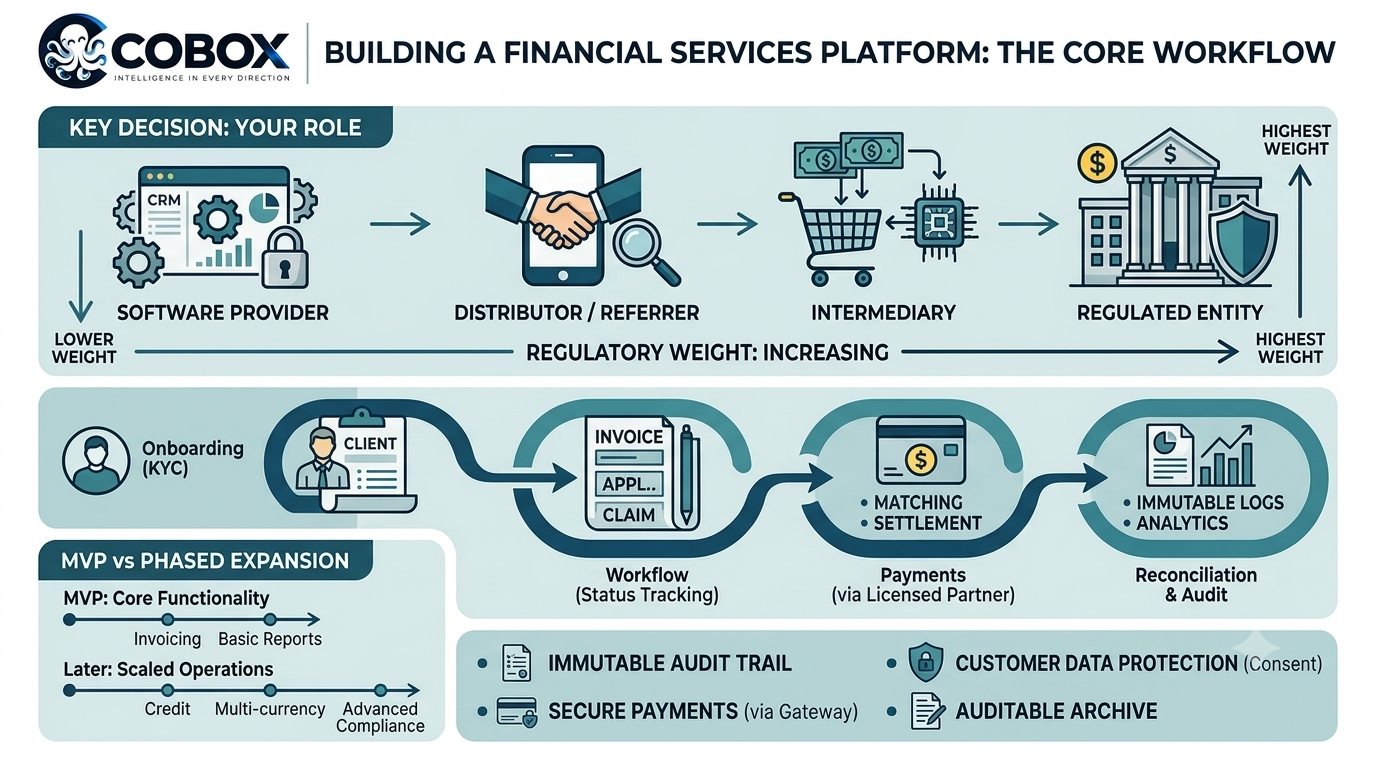
Financial services attract founders because money moves through almost every business. They also punish casual planning more than most industries. In most markets a company that holds customers' money, lends, insures or gives investment advice needs a licence or a licensed partner, and software that touches those activities inherits the compliance obligations of what it does. The founders who succeed usually begin by choosing exactly which part of the chain they will own, and which parts they will leave to regulated institutions.
This guide is for entrepreneurs planning a financial services product and for finance businesses that want to digitise customer onboarding, billing or collections. It does not tell you how to become a regulated entity. It shows five business ideas that mostly sit around regulated activity rather than inside it, the platform each needs, a worked example of the economics, and where legal and compliance advice is not optional. Figures are illustrative.
How financial services businesses work
Financial businesses make money from interest (lending), fees (payments, advice, account services), spreads and commissions (distribution of loans, insurance or investments) and software subscriptions sold to those who do. Customers range from consumers to small businesses to institutions. Operations revolve around three recurring jobs: identify the customer (KYC), move or record money safely, and prove everything to a regulator or auditor.
Frequent operational problems, especially for small firms:
- Paper-heavy onboarding: documents collected over WhatsApp, re-keyed into systems.
- Delayed collections and reconciliation between bank statements and invoices.
- Poor visibility into where each application or invoice stands.
- Audit trails that exist in people's memories rather than in systems.
- Fraud and error risk from manual handling.
The key decision: which part of the chain will you own?
Before any features, answer this question, because it determines licences, cost and risk.
| Role | Example | Regulatory weight |
|---|---|---|
| Software provider to regulated firms | CRM or workflow tool for loan agents or advisers | Lower; mainly data protection and security |
| Distributor or referrer | Connects customers to a lender or insurer | Medium; depends on registration rules for agents and referrals |
| Intermediary in money flows | Collects payments for merchants | High; payment rules, usually via a licensed partner |
| Lender, insurer, adviser, investment platform | Provides the regulated service itself | Highest; licence and capital requirements |
A first product is usually safest in the first two rows, or in the third through a licensed partner.
Five financial services business ideas
1. Invoicing and payment collection for small businesses
Concept: invoices, payment links, reminders and reconciliation for small merchants and service firms. Customer: small businesses chasing late payments. Value: faster collection and clean records. Revenue: subscription plus a revenue share from a licensed payment partner. Product: invoice builder, payment links, automated reminders and bank reconciliation. Risks: competition from accounting suites and dependence on the payment partner. Validate by: chasing invoices manually for ten businesses and measuring days saved.
2. Loan lead and document management for agents
Concept: a CRM for loan distribution agents that collects documents, tracks applications across lenders and reminds customers. Customer: independent loan agents and small distribution firms. Revenue: subscription. Product: lead inbox, document checklist, application status and commission tracking. Risks: digital lending rules affect how data flows between lenders and intermediaries. Validate by: shadowing five agents for a week to map their paperwork.
3. Client portal for investment and insurance distributors
Concept: a branded portal where clients of a registered distributor or adviser see portfolios, documents and service requests, with transactions executed through regulated platforms. Customer: distributors and small advisory firms. Revenue: subscription per adviser. Product: client dashboards, document vault, reminders and reporting. Risks: advice and distribution are regulated; the software must not blur who is giving advice. Validate by: prototype with two advisers and review with their compliance contact.
4. Expense and reimbursement management for SMEs
Concept: employees submit expenses with receipts, managers approve, finance reimburses and books entries. Customer: companies with 20 to 500 employees. Revenue: subscription per user. Product: mobile receipt capture, policy rules, approvals and accounting export. Risks: a crowded space. Validate by: processing one company's expenses via forms for a month.
5. Collections management for lenders' field teams
Concept: assign overdue accounts to field agents, record visits and promises to pay, and report recovery. Customer: small lenders and finance companies. Revenue: subscription per agent. Product: mobile app, assignments, visit logs, call notes and dashboards. Risks: conduct rules for collection practices and sensitive customer data. Validate by: running a month of collections for one branch.
Revenue models
| Model | How it earns | Fits |
|---|---|---|
| SaaS subscription | Per user, per business or per account | CRMs, invoicing, portals |
| Payment revenue share | Share of fees via a licensed payment partner | Collections tools |
| Referral or distribution fee | Paid by a regulated provider for completed customers | Agent tools and referral platforms (check registration rules) |
| Implementation fees | Set-up and integrations | Enterprise customers |
| Premium features | Reconciliation, analytics, API access | All SaaS products |
Interest income, insurance premiums and advisory fees belong to regulated entities and are outside this guide's scope.
A hypothetical business, end to end
Imagine a founder building invoicing and collections software for small service businesses. This is a composite, not a real client.
- Problem: small firms send invoices over WhatsApp, forget to follow up, and cannot match payments.
- Customers: consultants, agencies and small contractors.
- Opportunity: automatic reminders and one-click payment links reduce the days it takes to get paid.
- Acquisition: accountants as referrers, content on late payments, free tier for solo users.
- A transaction: the business creates an invoice; the customer receives a payment link by WhatsApp or email and pays via a licensed gateway.
- Delivery: money settles to the merchant through the gateway partner; the platform marks the invoice paid and reconciles.
- Revenue: subscription plus a revenue share on payments.
- Software: invoicing, payment links, reminders, reconciliation and reports.
- Validate first: whether merchants actually get paid faster and keep paying the subscription.
- Expand: accounting exports, recurring billing, credit offers through licensed partners.
What the platform needs
- Onboarding and identity: secure sign-up, business verification and, where required, KYC through a licensed verification provider rather than hand-built checks.
- Core workflow: invoices, applications, claims or tasks with clear states and an immutable history.
- Payments: use a licensed payment gateway or aggregator. The platform should never hold customer funds itself unless it is authorised to.
- Reconciliation: match payments to invoices automatically and flag exceptions.
- Documents: secure upload, versioning, expiry reminders and access logs.
- Roles and approvals: maker-checker patterns for sensitive actions.
- Audit trail: who did what and when, retained as required.
- Security: encryption, strong authentication, least privilege, secrets management, monitoring and tested backups. See our security page.
- Notifications: reminders by WhatsApp, SMS and email with consent.
- Reports: ageing, collections, conversion and exports for accountants.
- Integrations: payment gateway, accounting, KYC and bank data providers. See API integrations.
MVP versus later phases
| Capability | MVP | Later phase |
|---|---|---|
| Core workflow | One workflow done well (for example invoicing) | Recurring billing, credit notes, multi-entity |
| Payments | Payment links through one licensed gateway | Multiple gateways, bank transfers, payouts |
| Reconciliation | Match by reference, manual exceptions | Bank feed matching, rules engine |
| Compliance | Audit log, role-based access, consent records | Automated reporting, advanced monitoring |
| Reminders | Scheduled messages | Smart timing and escalation |
| Integrations | Accounting export | Two-way accounting sync, bank APIs |
Resist features that make you handle money or advice directly. Every such feature adds licensing work. Business automation tools such as process automation help with reminders and workflows without crossing that line.
Technology approach
Choose conservative, auditable technology: a Laravel or Node.js back end with strong transaction handling, PostgreSQL or MySQL with row-level audit tables, a Next.js front end, and encrypted object storage. Run in a cloud region that meets data-location expectations, with separate environments, infrastructure as code and a tested restore process. Keep payment data out of your systems by using hosted checkout from a certified provider, which narrows PCI DSS obligations. Use queues for retries and idempotent payment callbacks so duplicate notifications never create duplicate payments. Avoid microservices for the MVP, but design clear module boundaries so compliance-critical parts can be reviewed independently.
Cost and timeline (illustrative)
Assumptions: India-based team, web app with admin, one payment gateway integration, one accounting export, basic KYC provider integration. Planning ranges, not a COBOX quotation. Compliance and legal costs are separate and can exceed software costs.
| Item | Illustrative range |
|---|---|
| Discovery and compliance mapping | 2 to 4 weeks |
| MVP | Roughly ₹15 to 35 lakh (about US$17,500 to 41,000 at around ₹85 per US$), 4 to 6 months |
| Security testing and review | Budget separately; should not be skipped |
| Legal and regulatory advice | Highly variable; get quotes early |
| Verification, SMS and payment fees | Usage-based |
| Maintenance and monitoring | Higher than average because of audit and uptime needs |
The economics, with numbers
A hypothetical invoicing and collections SaaS with 600 paying merchants.
| Line | Calculation | Amount (₹ per month) |
|---|---|---|
| Subscription revenue | 600 × ₹500 | 3,00,000 |
| Payment revenue share | 0.3% of ₹7.5 crore processed | 2,25,000 |
| Total revenue | 3,00,000 + 2,25,000 | 5,25,000 |
| Hosting, messaging, support | 600 × ₹300 | 1,80,000 |
| Gross profit | 5,25,000 − 1,80,000 | 3,45,000 |
| Fixed costs | Team ₹2,50,000 + compliance and audit ₹40,000 | 2,90,000 |
| Acquisition including verification | 60 new merchants × ₹3,600 | 2,16,000 |
| Operating result | 3,45,000 − 2,90,000 − 2,16,000 | −1,61,000 (loss) |
Gross profit per merchant is ₹3,45,000 ÷ 600 = ₹575 a month. To cover fixed costs plus the current acquisition spend of ₹5,06,000, the business needs about 5,06,000 ÷ 575 ≈ 880 merchants. This is typical of financial software: compliance costs are largely fixed, so scale matters, and early months are spent in loss. It also shows the weakness of relying on payment revenue share: if merchants process half the volume, the share falls to ₹1,12,500 and each merchant's gross profit drops accordingly. These are invented figures, not forecasts.
A launch plan in seven phases
- Research and validation: interview 20 target merchants or agents and map their workflow. See validating your idea.
- Regulatory mapping and Blueprint: decide which role you play, which partners you need and what advice to obtain. A Business Blueprint should include this.
- MVP build: one workflow, with audit trail and security from the first release.
- Pilot: 10 to 30 users with close monitoring. Success: no reconciliation errors and clear time saved.
- Acquisition: referral partners such as accountants and trade associations.
- Operational improvement: automate support, reconciliation exceptions and reporting.
- Expansion: new workflows or partner-provided financial products, each reviewed for regulatory fit.
Risks and compliance
Here, the compliance section is not boilerplate; it can decide whether your business is lawful. Rules differ by country and change often. The following are pointers for your lawyer, not advice.
- Payments: in India, entities that collect and settle payments on behalf of merchants are generally subject to Reserve Bank of India payment aggregator rules. Using a licensed partner's hosted checkout is the common route for software companies.
- KYC and anti-money-laundering: regulated entities must verify customers under RBI and other regulators' KYC directions. If you operate on behalf of such entities, expect contractual requirements.
- Lending: RBI's digital lending guidelines affect how lending apps, lenders and service providers share data and charge fees.
- Investments and advice: securities regulators require registration for investment advisers and distributors. Do not present software output as advice unless you are registered.
- Insurance: insurance distribution is regulated by the insurance regulator.
- Card data: PCI DSS applies if you store, process or transmit card data; avoid it by using hosted payment fields.
- Data protection: financial data is sensitive. India's Digital Personal Data Protection Act, 2023 applies, and sector regulators may impose localisation or retention rules.
- Fraud and disputes: chargebacks, impersonation and insider misuse. Apply approvals and monitoring. Our security checklist is a baseline.
- Unit economics: as shown, scale is required to cover fixed compliance costs.
How COBOX can help
COBOX helps you scope a product that sits on the right side of the regulatory line. We map the roles and partners, define a Blueprint with a phased roadmap, then design and build the secure core workflow, audit trail and integrations, and keep improving it with real usage. We do not provide legal or regulatory advice and will recommend you involve your own advisers early. Our CRM and customer portal and SaaS work are most relevant.
Frequently asked questions
Do I need a licence to start?
It depends on your role. A pure software provider to regulated firms usually does not, but anything that holds money, lends or advises does or needs a licensed partner. Take legal advice before building.
Can I start with a website instead of a mobile app?
Yes. Most financial workflows for businesses work well on the web. Add mobile for field agents or receipt capture where it matters.
What should the first release include?
One workflow, secure onboarding, an audit trail and a single payment integration if needed.
How do I handle payments?
Through a licensed gateway or aggregator with hosted checkout. Avoid touching card data or customer funds yourself.
How secure must it be?
Very. Plan for encryption, strong authentication, access logs, backups and independent security testing before launch.
How do I validate demand?
Run the workflow manually for a handful of customers, then charge them for the software version.
What ongoing costs should I expect?
Hosting, verification and messaging fees, compliance and audit work, security testing and support.
Can I add lending or insurance later?
Possibly, usually through licensed partners. Each addition changes your regulatory position and should be reviewed first.
Turn your financial services idea into a plan
Planning a financial services platform? Start with a Business Blueprint covering your role in the chain, customers, revenue model, MVP features, security and launch roadmap. Paste something like this into the Blueprint tool:
I want to build a [invoicing/collections/loan-agent CRM/adviser portal] product for [type of customer] in India. I do not plan to hold customer funds directly. I need a phased MVP plan, the integrations and compliance questions I must resolve, and cost estimates.
Or get in touch.