 COBOX
COBOX
How to Launch a B2B Wholesale Ordering Platform: Catalogues, Pricing, Credit and Logistics
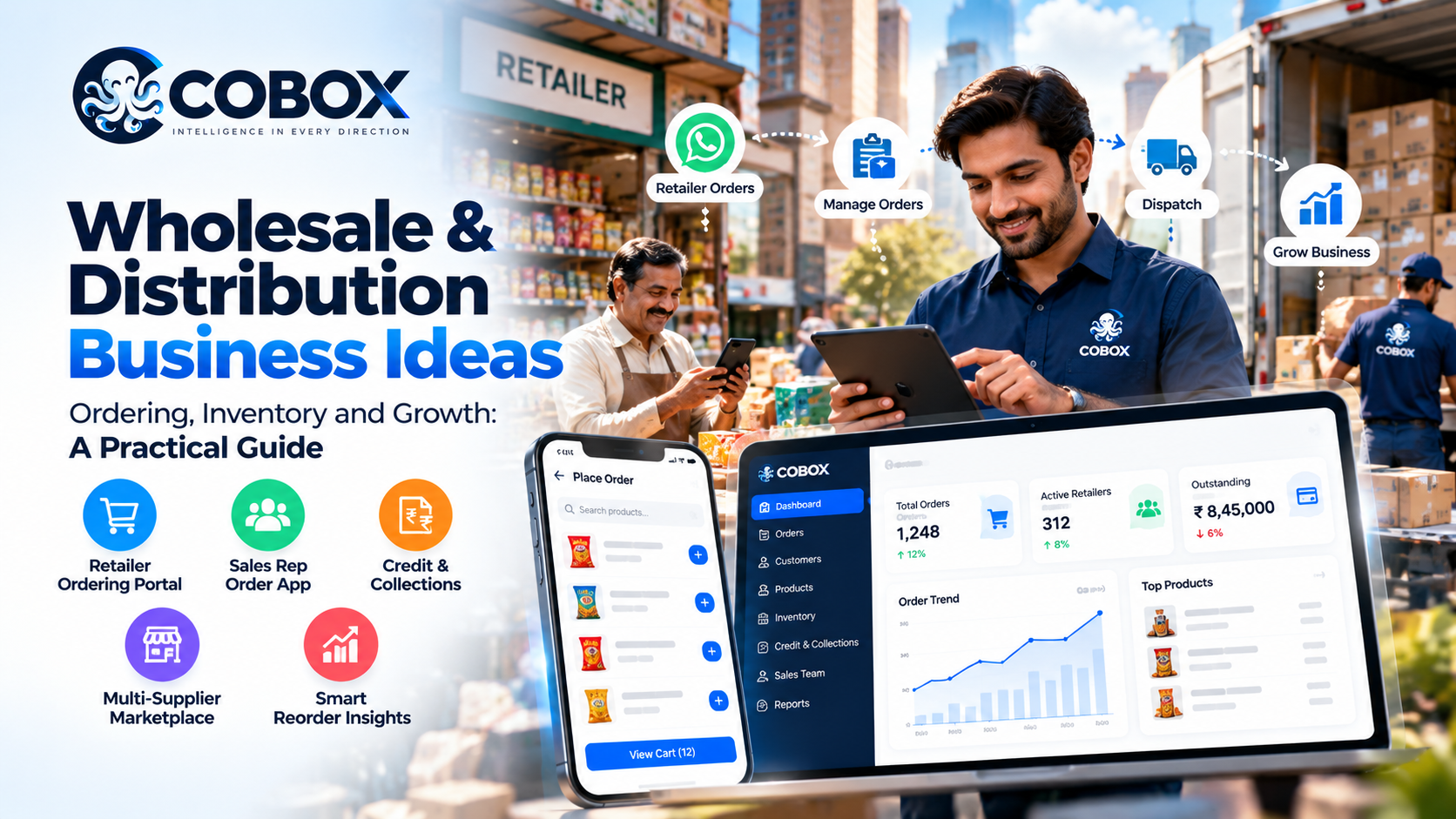
A distributor with 300 retail customers can spend every morning on the same activity: answering WhatsApp messages that say "same as last time, plus 10 boxes of that new one." Someone types the order into accounting software, someone else checks stock and credit, a dispatch clerk prints a challan, and at the end of the day nobody can say with confidence how much each customer owes. Orders are the lifeblood of the business, and the process that handles them is a patchwork.
This guide is for wholesalers, distributors and manufacturers who sell to retailers or businesses, and for entrepreneurs building wholesale platforms. It is deliberately focused on the distributor's ordering problem: catalogues, customer-specific pricing, credit limits, sales representatives and dispatch. The differences between B2B and B2C commerce are covered in B2B vs B2C e-commerce; this article builds on that and shows five concrete business ideas and a worked payback. Figures are illustrative.
How wholesale and distribution businesses work
A distributor buys in bulk from manufacturers and sells in smaller lots to retailers, institutions or other businesses. Margins are thin and volumes high, so a small percentage improvement matters. Customers are repeat buyers who value availability, price and credit terms above brand experience.
What makes wholesale different from retail:
- Customer-specific pricing: price lists by customer, region, volume slab or scheme.
- Credit: many customers buy on credit with limits and due dates; collections are a core function.
- Repeat, predictable baskets: customers reorder similar items.
- Pack sizes and minimums: cases, cartons and minimum order quantities.
- Field sales: representatives visiting shops with order books.
- Schemes and discounts: manufacturers' promotions that change often.
Common pain points: order errors from retyping, stock promises that cannot be met, customers over credit limits getting goods anyway, and no visibility into who ordered what.
Five wholesale business ideas
1. A retailer ordering portal for a distributor
Concept: retailers log in, see their own prices and availability, reorder previous baskets and view statements. Customer: distributors with 100 to 2,000 retailers. Value: fewer order-entry errors and phone calls, higher order frequency. Revenue: for the distributor, lower cost to serve and larger baskets; for a vendor, implementation plus subscription. Product: catalogue, price lists, cart, order history and invoices. Risks: retailers who prefer calling. Validate by: onboarding 20 loyal retailers and measuring repeat use.
2. A sales representative order-taking app
Concept: a mobile app, offline-capable, that lets field reps take orders in shops with live price and stock. Customer: distributors and manufacturers with field teams. Revenue: subscription per user. Product: beat plans, order capture, scheme application, collections and sync. Risks: poor connectivity and rep adoption. Validate by: equipping five reps for a month and comparing errors with paper books.
3. Credit and outstanding management
Concept: track credit limits, ageing, promises to pay and automatically hold orders from overdue accounts. Customer: distributors whose cash is stuck in receivables. Revenue: subscription or implementation fee. Product: ageing reports, limit checks at order time, reminders and collection logs. Risks: commercial sensitivity of putting customers on hold. Validate by: producing a one-time ageing analysis for a distributor and showing the cash at risk.
4. A multi-supplier wholesale marketplace for one category
Concept: a marketplace where small retailers buy from several verified wholesalers, for example hardware, stationery or pharmacy supplies. Customer: small retailers and wholesalers. Revenue: commission, listing fees or financing partnerships. Product: multi-vendor catalogue, order splitting, vendor dashboards and payouts. Risks: cold start, credit risk and off-platform dealing. See how to build a two-sided marketplace. Validate by: aggregating orders manually for 30 retailers in one neighbourhood.
5. Suggested-order and reorder reminders
Concept: analyse each retailer's history and propose a ready-made order at the right time. Customer: distributors with predictable repeat customers. Revenue: add-on to ordering software. Product: basket prediction, reminder messages and one-click confirmation. Risks: poor suggestions erode trust. Validate by: sending suggested lists manually by WhatsApp to 50 retailers and measuring acceptance.
Revenue models
| Model | How it earns | Fits |
|---|---|---|
| Cost-to-serve savings | Fewer staff hours and fewer errors for the distributor | Own ordering portal |
| Larger and more frequent orders | Easy reordering lifts basket and frequency | Ordering portal and reminders |
| SaaS subscription | Per user, per retailer or per distributor | Vendor products |
| Implementation fees | Catalogue setup, data migration, ERP integration | Larger distributors |
| Marketplace commission | Percentage of order value | Multi-supplier platforms |
| Trade credit partnerships | Referral share from a licensed lender | Mature marketplaces (regulatory review needed) |
A hypothetical distributor, end to end
Imagine a hardware distributor serving 300 retailers in a region. This is a composite, not a real client.
- Problem: orders arrive by phone and WhatsApp; two clerks key them in, with frequent errors.
- Customers: small hardware retailers who reorder weekly.
- Opportunity: let retailers and reps place orders directly with the right prices and stock.
- Acquisition of orders: existing customers move to the portal; reps encourage it during visits.
- A transaction: the retailer reorders last week's basket, adjusts quantities, and sees credit available.
- Delivery: the system checks stock and limit, creates the picking list and challan, and dispatch updates status.
- Revenue collection: invoices and outstanding show in the portal; reminders reduce overdue payments.
- Software: portal, rep app, pricing engine, credit control and accounting sync.
- Validate first: whether 20 retailers use it weekly without being chased.
- Expand: suggested orders, more regions and additional product lines.
What the platform needs
- Catalogue: SKUs, pack sizes, units of measure, images and minimum order quantities, kept in sync with stock.
- Pricing engine: price lists per customer group, slabs, schemes and promotions with start and end dates.
- Ordering: quick reorder from history, bulk entry by SKU code or upload, and approval for large orders.
- Credit control: limits, ageing and rules to hold, warn or require payment.
- Inventory visibility: available-to-promise stock, with the option to hide exact quantities.
- Order fulfilment: picking lists, partial shipments, challans, e-way bill and invoice details.
- Customer account area: statements, invoices, returns requests and payment links.
- Sales rep tools: beat plans, offline order capture, collections and targets. See mobile app development.
- Roles: retailer, rep, manager, dispatch, accounts and admin.
- Integrations: accounting and ERP, payment gateway, messaging and transport. See connecting CRM, accounting and order systems.
- Reports: sales by customer and product, order frequency, credit exposure and rep performance.
The solution page on B2B e-commerce describes how we deliver these.
MVP versus later phases
| Capability | MVP | Later phase |
|---|---|---|
| Catalogue and pricing | Customer price lists, pack sizes | Schemes engine, slab and bundle offers |
| Ordering | Portal with reorder and order history | Suggested orders, quick bulk upload, approvals |
| Credit | Credit limit check and ageing view | Automated holds, promise-to-pay workflows |
| Sales reps | Web order entry on behalf of a customer | Offline mobile app with beat planning |
| Accounting | Daily export or sync of invoices | Real-time two-way ERP integration |
| Payments | Payment links on invoices | Instalments, trade credit partners |
Start with the 20% of SKUs that account for most orders. Ready-made tools may suffice for simple catalogues; custom software vs ready-made tools helps decide.
Technology approach
Integration with the accounting or ERP system is the real engineering challenge, because it holds the stock, prices and ledgers. Treat it as the system of record and expose its data through a sync layer. A Next.js or React front end, a Laravel or Node.js back end, MySQL or PostgreSQL, and Redis for caching price lists and queueing syncs work well. For reps, a Progressive Web App or React Native app with an offline database and conflict-safe sync is essential. Keep the pricing engine in one well-tested module, because wrong prices are the fastest way to lose trust. Avoid replacing the existing ERP unless it is the actual problem.
Cost and timeline (illustrative)
Assumptions: India-based team, one distributor, up to a few thousand SKUs, customer-specific pricing, credit check, integration with one accounting package, web portal and rep order entry. Planning ranges, not a COBOX quotation.
| Item | Illustrative range |
|---|---|
| Discovery and Blueprint | 2 to 3 weeks |
| Ordering portal MVP | Roughly ₹12 to 25 lakh (about US$14,000 to 29,500 at around ₹85 per US$), 3 to 5 months |
| Rep mobile app with offline sync | Additional ₹6 to 14 lakh |
| ERP or accounting integration | Depends heavily on the system's API quality |
| Data cleaning (SKUs, prices, customers) | Often underestimated |
| Hosting and messaging | Modest monthly cost |
The business case, with numbers
For the hardware distributor: 300 retailers, about 3,000 orders a month, monthly sales of ₹2 crore, gross margin of 12%.
| Item | Calculation | Monthly amount (₹) |
|---|---|---|
| Order-entry time saved | One of two clerks redeployed, ₹22,000 | 22,000 |
| Fewer order errors | Errors fall from 4% to 1% of 3,000 orders = 90 fewer × ₹600 average cost | 54,000 |
| Basket uplift | 3% of ₹2,00,00,000 = ₹6,00,000 extra sales × 12% margin | 72,000 |
| Total monthly benefit | 22,000 + 54,000 + 72,000 | 1,48,000 |
| Running cost | Hosting, support, messaging | 30,000 |
| Net monthly benefit | 1,48,000 − 30,000 | 1,18,000 |
On a ₹16 lakh build, payback is 16,00,000 ÷ 1,18,000 ≈ 13.6 months. The basket uplift is the least certain number. If it is zero, the net monthly benefit is 76,000 − 30,000 = ₹46,000 and payback stretches to about 35 months (16,00,000 ÷ 46,000 ≈ 34.8). Better credit control can add cash-flow benefits not counted here, such as fewer overdue balances. The sensible plan is to prove the retailer adoption rate in a pilot before committing to the whole build. These are invented figures, not forecasts.
A launch plan in seven phases
- Research and validation: measure order volumes, error rates, channel mix and credit exposure; interview retailers and reps.
- Blueprint and requirements: a Business Blueprint defines pricing rules, integration and rollout order.
- MVP build: portal, pricing, credit check, accounting sync.
- Pilot: 20 to 40 retailers and a few reps for 6 weeks. Success: weekly active use and measurably fewer errors.
- Customer migration: onboard in waves, with reps helping retailers.
- Operational improvement: use data for suggested orders and credit follow-up. See which process to automate first.
- Expansion: more regions, product lines, retailer financing partnerships and marketplace features.
Risks and compliance
- Adoption: retailers and reps may keep phoning. Incentives and rep involvement are essential.
- Price and stock accuracy: wrong data destroys trust. Synchronise carefully and show last-updated times.
- Credit risk: blocking orders can upset good customers; configure rules and exceptions with sales leadership.
- Price confidentiality: customer-specific prices must never leak between accounts.
- Taxes and invoicing: GST invoicing, e-invoicing and e-way bill requirements depend on turnover and goods movement; confirm with your accountant.
- Trade finance: offering credit or financing through a platform is regulated activity in many cases. Use a licensed partner.
- Data security: customer lists and prices are commercially sensitive; see our security checklist.
These are pointers for your advisers, not legal advice.
How COBOX can help
COBOX starts with your actual order flow: how orders arrive, where errors happen, and how credit is controlled. We then write a Blueprint that sequences the ordering portal, rep app and integrations, build the pricing and credit engine, connect it to your accounting or ERP, and refine it with usage data. For related work, see B2B e-commerce and API integrations.
Frequently asked questions
Can I start with a website instead of a mobile app?
Yes, for retailers. A rep app becomes valuable when your field team needs offline ordering.
Do I have to replace my ERP?
Usually not. Integrate with it and let it remain the system of record.
What should the first release include?
Customer price lists, reorder from history, credit check and an accounting sync for your top SKUs.
How do I get retailers to use it?
Through reps, incentives such as faster delivery or better schemes, and making it genuinely quicker than WhatsApp.
Can retailers see real-time stock?
Yes, if your stock data is accurate. Show availability ranges or "in stock" status first.
What happens to phone and WhatsApp orders?
Keep them, but have staff enter them through the same system so everything shares one data set.
What operating costs should I expect?
Hosting, messaging, support, and maintenance of the integration. Budget them as in the worked example.
Is a wholesale marketplace a better first step?
Usually not. A marketplace needs both sides at once. Serving your own customers better is a safer start.
Turn your wholesale plan into a roadmap
Launching a B2B wholesale ordering platform? Start with a Business Blueprint covering catalogues, pricing, credit, logistics, MVP scope and rollout. Paste something like this into the Blueprint tool:
I run a [type] distribution business with [number] retailers and about [number] orders a month, currently taken by [phone/WhatsApp/reps]. I need a B2B ordering portal with customer-specific pricing and credit control, integrated with [accounting software]. Give me an MVP scope, costs and a rollout plan.
Or talk to us.