 COBOX
COBOX
How to Build a Recruitment and Staffing Platform: Job Boards, ATS and Contract Hiring

Hiring is a problem both sides complain about and neither fully solves. Employers say they cannot find good people; candidates say they apply and hear nothing. The truth is that most of the friction lies not in lack of people but in slow, repetitive coordination: collecting profiles, screening, scheduling, chasing feedback and verifying documents. Recruitment is a coordination business, and coordination is exactly what software is good at.
This guide is for founders who want to build a recruitment platform, job board or staffing business, and for agencies who want to run on software instead of spreadsheets and inboxes. We cover five business models, how each earns, the features that matter, placement economics with worked numbers, compliance risks and a launch plan. Scenarios are hypothetical and figures illustrative.
Understand the market before you build
Hiring is not one market. A software engineer in a metro, a delivery rider in a tier-2 city and a nurse for a hospital are different problems with different channels, speeds and payment structures. The first decision is which segment you serve; platforms that try to serve everyone are outcompeted by incumbents with deep brand and data.
- White-collar and tech: long cycles, high fees, strong competition from established portals and professional networks.
- Blue-collar and gig: high volume, fast hiring, low fees, heavy verification and retention issues.
- Healthcare, hospitality and other specialist roles: licences, shifts and credentials matter.
- Contract and temporary staffing: you become the employer of record, so payroll and compliance are central.
Five business models
1. Niche job board
Employers pay to post jobs or buy credits; candidates are free. Success needs traffic and trust within a niche, such as jobs for a single industry or city. Cost to acquire candidates is the long-term problem.
2. Recruitment agency software (ATS and CRM)
Software for agencies and in-house teams: candidate database, pipelines, client management, interview scheduling, reporting. Revenue is a monthly per-seat fee. It follows the SaaS playbook; see building a SaaS product.
3. Managed placement service on a platform
You act as the recruiter and use proprietary software to source and screen faster. Revenue is a fee per successful hire, often 8.33 to 20 percent of annual pay or a flat fee. It earns more per hire but depends on people, so growth is slower.
4. Blue-collar and gig staffing
You supply workers to businesses for shifts or contracts, handling onboarding, attendance and payments. Revenue is a margin on hourly or monthly rates. Operations and compliance are heavy, but volumes are large.
5. Skills assessment and screening tools
Tests, interviews and verification sold to employers. Revenue is per assessment or subscription. This works best as a feature of a broader platform or a niche product.
| Model | Revenue | Cycle time | Main challenge |
|---|---|---|---|
| Niche job board | Job posting fees | Short | Candidate traffic and quality |
| ATS for agencies | Subscription | Medium | Switching from spreadsheets and incumbents |
| Managed placement | Fee per hire | Long | Scaling recruiters |
| Staffing and gig | Margin on pay | Short | Compliance, retention, payments |
| Assessments | Per test or subscription | Medium | Credibility and integration |
A hypothetical scenario: ten warehouse workers by Monday
Consider a fictional company, ShiftBridge, supplying warehouse staff to retailers in one city. A retailer posts a request for ten packers starting Monday for a month. ShiftBridge's system filters its worker pool by location, availability, past attendance and verified documents, and sends an offer by WhatsApp to 25 workers. Fourteen accept within two hours; the system selects ten plus two reserves. Workers receive location, timing and a QR code. Attendance is recorded by QR scan on arrival. Two workers do not show up on day one, and reserves fill in. At month end the system computes hours, deductions and payments, and invoices the retailer.
Notice where software helps: matching, communication, attendance and payment arithmetic. Notice where it does not: workers' reliability is earned through fair pay and on-time payment, which are operational promises, not features.
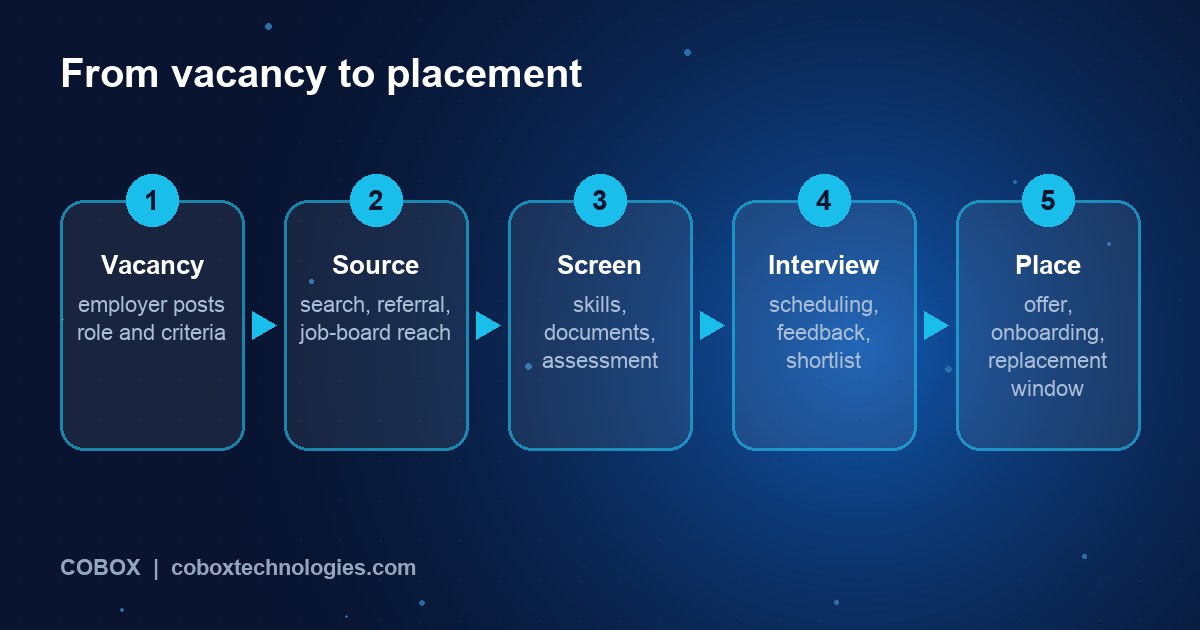
Features: matching and process
| Area | MVP | Later |
|---|---|---|
| Employer side | Job posting, shortlist, interview scheduling, feedback | Branded careers pages, offer management, analytics |
| Candidate side | Profile or resume parsing, job search, application tracking, alerts | Skill assessments, referrals, career guidance |
| Matching | Filters by role, location, salary, availability | Ranking models, recommendations, duplicate detection |
| Screening | Document upload, questionnaire, basic verification | Background check integrations, video interviews |
| Communication | Email, WhatsApp, SMS, templates | Chatbots, campaigns, nurturing |
| Staffing operations | Shift roster, attendance, timesheets | Payroll, compliance reports, rating system |
| Admin and finance | Placements, invoices, commission tracking | Revenue forecasting, recruiter productivity |
Machine-assisted ranking can help, but be careful: models trained on historical hiring decisions can reproduce bias. Keep humans in control, record why a candidate was shortlisted or rejected, and test for unfair outcomes. If you add AI features, read how an AI assistant helps customers find the right product for design principles that apply to matching too.
Architecture in plain language
- Candidate web or mobile web: fast, light, WhatsApp-friendly. For blue-collar users a simple app or WhatsApp flow beats a long form; see mobile app vs web app.
- Employer dashboard: jobs, pipeline, interviews.
- Admin and operations console: verification, placements, payments.
- Backend: profiles, search, matching, workflows, notifications.
- Integrations: resume parsers, calendar, WhatsApp, payment and payroll, verification providers. See API integrations and CRM and customer portals.
Search quality and data quality decide usefulness, so invest in structured profile fields and deduplication early.
Costs and timeline (illustrative)
| Build | Scope | Indicative cost | Indicative time |
|---|---|---|---|
| Niche job board MVP | Postings, profiles, search, applications, payments, admin | ₹8-18 lakh | 3-4 months |
| ATS for agencies | Pipelines, client and candidate records, scheduling, reports | ₹12-28 lakh | 4-6 months |
| Staffing platform | Worker app, shift matching, attendance, payments, client portal | ₹20-45 lakh | 5-8 months |
Quotes should be against written scope; add 15-20 percent per year for maintenance (see the breakdown).
Worked economics
Placement fees for a managed recruiter
Suppose ShiftBridge's sister business places mid-level staff at an annual salary of ₹6,00,000 with an 8.33 percent fee (one month's pay).
- Fee revenue per placement: ₹50,000
- Recruiter cost allocated per placement (salary plus incentive): ₹14,000
- Sourcing and tools: ₹3,000
- Replacement risk: if 10 percent of hires leave within the guarantee period and need a free replacement, allow ₹5,000 per placement
- Contribution per placement: ₹50,000 - ₹14,000 - ₹3,000 - ₹5,000 = ₹28,000
With fixed costs of ₹4 lakh a month, break-even is about 15 placements a month (₹4,00,000 / ₹28,000 = 14.3). The revenue is lumpy because fees arrive after the candidate joins, so working capital matters.
Margin on gig staffing
Suppose a worker costs ₹16,000 a month (wages, statutory contributions) and is billed to the client at ₹19,500.
- Gross margin: ₹3,500 (about 18 percent of billing)
- Onboarding, attendance and payment processing: ₹600
- Replacement and absence cover: ₹500
- Contribution per worker per month: ₹2,400
With clients paying in 45 days while workers are paid monthly, you must fund roughly six weeks of wages. For 500 workers at ₹16,000, that is about ₹1.2 crore of working capital, which can be a larger constraint than any software cost. This is why staffing models fail without financing. Keep revenue, gross margin and contribution distinct, and see weekly dashboard numbers. Test the idea cheaply first using our validation guide.
Growth levers
- Niche SEO: role, city and salary pages that answer real questions.
- Referral loops: reward workers and employees for bringing verified candidates.
- Employer success: fast time-to-shortlist wins repeat clients.
- Community channels: WhatsApp groups and local partners for blue-collar reach.
Measure time to first shortlist, offer-to-join ratio, fill rate, attendance and repeat employer rate. See measuring the first 90 days.
Seven-phase launch plan
- Pick one role family in one city.
- Run it manually with spreadsheets and WhatsApp for 20 placements to learn real fill rates and costs.
- Define the MVP around the slowest manual step.
- Build posting, profiles, matching and communication first.
- Pilot with 5-10 employers.
- Add verification, attendance and payments.
- Expand roles and cities after unit economics hold.
Risks and compliance
- Personal data: resumes, IDs and addresses are personal data under India's Digital Personal Data Protection Act, 2023; get advice on consent, retention and sharing with employers. See our security page.
- Fees from candidates: charging jobseekers for placement is restricted in many contexts and can be illegal; confirm applicable rules before designing candidate-paid features.
- Labour law and contractors: staffing may require licences and compliance with contract-labour, provident fund, insurance and minimum wage rules. Take legal advice.
- Fake jobs and fraud: job scams harm candidates; verify employers and moderate listings.
- Bias and fairness: avoid discriminatory filters and audit automated ranking.
- Overseas recruitment: emigration rules apply; seek specialist advice.
- Taxes: GST and TDS treatment of fees and wages need an accountant.
These are pointers for your advisers, not legal advice.
How COBOX can help
COBOX helps you choose a segment, test it manually, and build the smallest platform that removes the slowest step. We create a Blueprint, build employer, candidate and admin experiences, and integrate messaging, payments and verification. See product discovery, MVP development and business process automation.
Frequently asked questions
Can a new job board compete with established portals?
Only by being narrower and better for a specific audience, such as one industry or region. General portals are very hard to displace.
How much does it cost to build a recruitment platform?
A niche job board MVP is often ₹8-18 lakh in India, and staffing platforms cost more due to operations and payments.
Should I use AI for matching?
Start with clear filters and human judgement. Add ranking only when you have enough data and a way to check fairness.
How do I attract blue-collar candidates?
Use WhatsApp, local partners and simple flows. Pay reliability is the strongest word-of-mouth driver.
What is the biggest risk in staffing?
Working capital and compliance, not software. Model cash flow before scaling.
Can I charge candidates?
Often restricted. Check the rules and prefer employer-paid models.
How do I prevent fake employers?
Verify business documents and contacts, review first postings and let candidates report suspicious jobs.
Do I need an app?
A mobile web experience with WhatsApp notifications is usually enough to begin.
Turn your recruitment idea into a plan
Planning a recruitment or staffing platform? Start with a Business Blueprint covering users, revenue model, MVP features, technology and launch roadmap. Paste something like this into the Blueprint tool:
I want to build a [niche job board / ATS / staffing platform] for [role type and city]. I expect [number] placements a month at about ₹[fee or margin]. I need an MVP plan, compliance questions to ask and a validation plan.
Or talk to us first, and read about the Business Blueprint.