 COBOX
COBOX
How to Digitise a Logistics Business: Fleet Tracking, Dispatch, Billing and Customer Portals
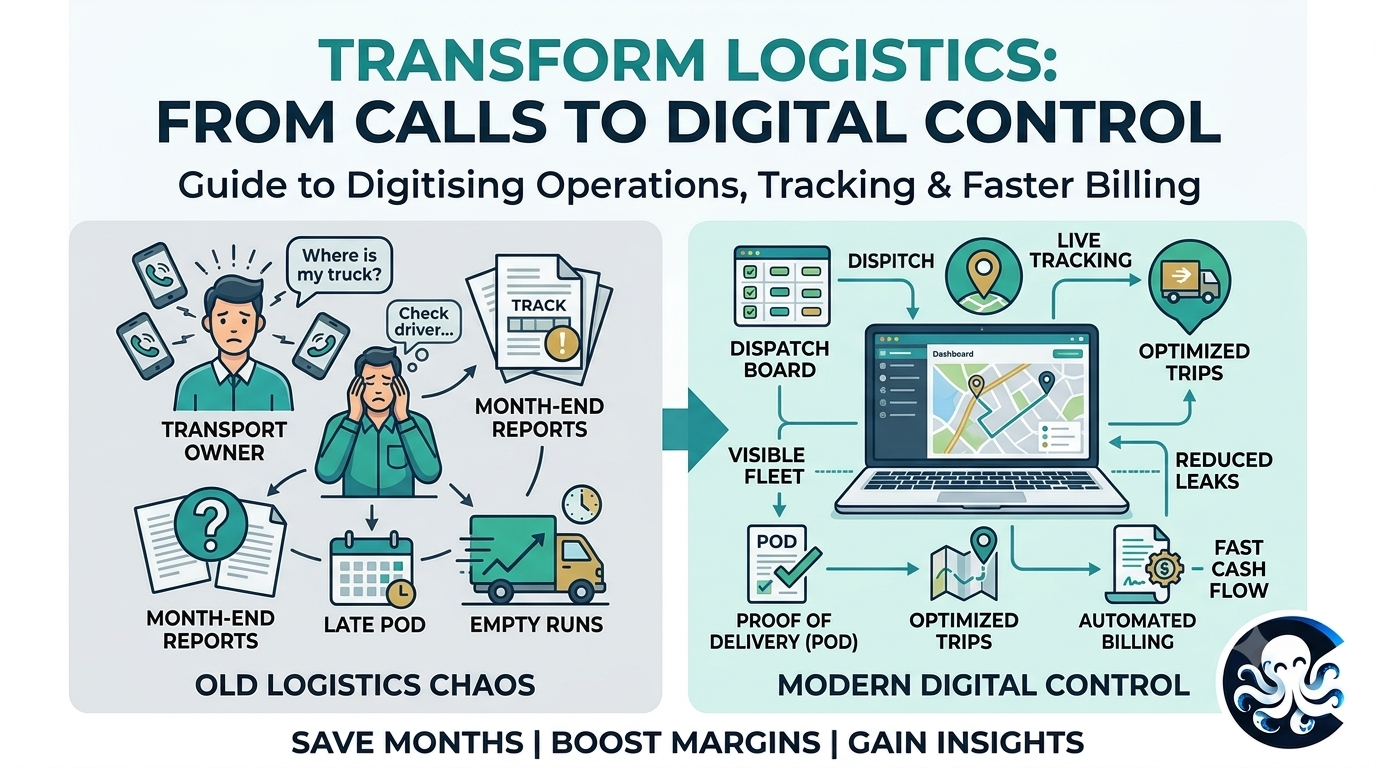
Ask a transport company owner where a truck is and you may get a phone call to the driver, a message in a group chat, or a shrug. Ask what a particular trip earned after fuel, tolls and driver costs, and the answer often arrives at month end, if at all. Logistics is a thin-margin business, where small leaks from empty runs, late billing and lost proof of delivery add up to the difference between profit and loss.
This guide is for transport, courier and distribution business owners who want to digitise operations, and for entrepreneurs who see a business in building logistics software or services. It explains how logistics businesses run, five concrete ideas, what the systems should do and a worked business case. All examples are hypothetical and all figures illustrative.
How logistics businesses operate
A logistics business moves goods for a fee. The main players are fleet owners and transporters, freight brokers, courier and last-mile companies, warehouse operators and contract logistics providers. The daily cycle looks like this: a customer enquiry becomes a booking, a vehicle and driver are assigned, goods are loaded, the trip is tracked, delivery is confirmed with proof, and the customer is invoiced and pays. Each handover is where information is lost.
Typical problems:
- Poor visibility: customers call for status; dispatchers call drivers.
- Empty or partly loaded return trips, because nobody sees available capacity.
- Delayed billing, because proof of delivery paperwork arrives late.
- Cost leakage: fuel, tolls, detention and driver advances not reconciled to trips.
- Compliance paperwork: e-way bills, vehicle documents and driver licences expiring unnoticed.
- Thin margins, so errors that other industries absorb are costly.
Five logistics business ideas
1. A transport management system for regional fleet operators
Concept: bookings, vehicle and driver assignment, trip costs and billing in one system. Customer: fleet owners with 15 to 100 vehicles. Value: control over trips and profitability per vehicle. Revenue: subscription per vehicle or per user. Product: booking desk, dispatch board, trip expenses and invoicing. Risks: resistance from clerks and owners used to paper. Validate by: running one fleet's dispatch through the system for a month.
2. Fleet tracking with trip intelligence
Concept: GPS tracking tied to trips, with alerts for delays, route deviations and idle time. Customer: fleets and shippers who need visibility. Value: fewer status calls and better on-time delivery. Revenue: per-vehicle monthly fee that covers devices and software. Product: map dashboard, geofences, alerts and reports. Risks: hardware logistics and a crowded tracking market. Validate by: fitting devices to ten vehicles and checking whether dispatchers use the dashboard daily.
3. Customer shipment tracking portal
Concept: a branded portal where a transporter's customers see bookings, status, documents and invoices. Customer: transporters whose customers keep calling. Value: fewer calls and a more professional image. Revenue: setup fee plus monthly charge. Product: secure login, shipment list, proof of delivery and invoice download. See customer portals. Risks: depends on data from the operations side being accurate. Validate by: giving five key customers access.
4. Last-mile delivery management for local businesses
Concept: a system for businesses with their own delivery riders, covering order assignment, routes, proof of delivery and cash-on-delivery reconciliation. Customer: pharmacies, restaurants, retailers and regional couriers. Revenue: subscription or per-delivery fee. Product: rider mobile app, dispatcher dashboard, route suggestions and COD tracking. Risks: rider churn and low margins per delivery. Validate by: running a single business's deliveries through a prototype.
5. A freight matching service for one corridor
Concept: connect shippers with available trucks on a specific route. Customer: shippers and small truck owners. Revenue: commission per load or listing subscription. Product: load posting, truck availability, quotes, documentation and payments. Risks: the marketplace cold-start problem, off-platform deals and payment trust. Our guide to two-sided marketplaces covers these. Validate by: manually matching loads on one corridor for a month.
Revenue models
| Model | How it works | Fits |
|---|---|---|
| Freight revenue | The core income of a transporter, per trip or per kilogram | Operating a fleet |
| SaaS per vehicle or user | Monthly fee | TMS, tracking, last-mile software |
| Device plus service | Hardware cost recovered through the subscription | GPS tracking |
| Commission | Percentage of freight booked through the platform | Freight matching |
| Implementation fees | Set-up, data import and training | Custom deployments |
| Per-delivery fee | Small fee per completed delivery | Last-mile platforms |
A hypothetical transporter, end to end
Consider a regional transporter with 40 trucks running between three industrial towns. This is a composite, not a real client.
- Problem: unknown trip profitability, late invoices and constant status calls.
- Customers: manufacturers and traders with regular shipments.
- Opportunity: higher utilisation, faster billing, fewer calls and better service.
- Getting business: existing relationships; digital tracking becomes a selling point to win larger accounts.
- A transaction: a booking is created; a vehicle and driver are assigned; the driver receives the trip on a phone; location updates flow in.
- Delivery: the driver captures proof of delivery by photo or signature at drop-off.
- Revenue collection: the invoice is generated from the trip record and sent the same day; payments are matched.
- Software needed: booking, dispatch, driver app, tracking, expenses, billing and a customer portal.
- Validate first: whether drivers capture proof of delivery on every trip for four weeks.
- Expand: backhaul matching, maintenance scheduling and integration with customer systems.
What the platform needs
- Booking and quotation: customer, route, load details and rates, with a clean history.
- Dispatch board: available vehicles and drivers, assignment and status in one view.
- Driver mobile app: trip details, navigation links, status updates, expense capture and proof of delivery. This is a case where a mobile app is justified, since drivers are on the road; it should work on low-end phones and weak connections.
- Tracking: GPS from devices or driver phones, with geofences and delay alerts.
- Trip costing: fuel, tolls, driver advances, maintenance and detention against trip revenue.
- Billing: invoices generated from completed trips, with GST details, e-way bill references and payment tracking.
- Documents and compliance: vehicle papers, driver licences and permit expiry reminders.
- Customer portal: shipment status, documents and invoices.
- Maintenance: service schedules and tyre and repair history per vehicle.
- Roles: dispatchers, accounts, drivers, customers and owners see different data.
- Integrations: accounting, GPS providers, fuel cards and customer systems. See API integrations.
- Reports: vehicle utilisation, profit per trip, on-time rate and receivables ageing. The weekly dashboard numbers article helps choose them.
MVP versus later phases
| Capability | MVP | Later phase |
|---|---|---|
| Bookings | Booking entry and trip creation | Customer self-booking, rate cards |
| Dispatch | Assignment board | Route optimisation, load consolidation |
| Driver app | Status updates and proof of delivery | Offline mode, expense OCR, in-app payments |
| Tracking | Last known location from driver phone | Device-based live tracking and alerts |
| Billing | Invoice from trip, payment status | Auto reconciliation, credit control |
| Customer visibility | Shared status link | Full portal |
| Analytics | Trip profit, receivables | Forecasting, backhaul analytics |
The first win is almost always proof of delivery to invoice: faster billing releases cash immediately.
Technology approach
A mobile-first driver app (React Native or a progressive web app, depending on offline needs), a Laravel or Node.js back end, PostgreSQL or MySQL, and Redis for queues and live status caching. For tracking, either integrate existing GPS providers through their APIs or ingest location from phones; using a mature mapping service avoids reinventing maps. Design the driver app for poor connectivity: queue updates locally and sync later. Route optimisation and machine learning are later additions, not day-one needs.
Cost and timeline (illustrative)
Assumptions: India-based team, one transporter's operations, dispatch and billing web app, a driver app, integration with one GPS provider and one accounting system. These are planning ranges, not a COBOX quotation.
| Item | Illustrative range |
|---|---|
| Process mapping and Blueprint | 2 to 3 weeks |
| MVP (dispatch, billing, driver app) | Roughly ₹14 to 30 lakh (about US$16,500 to 35,000 at around ₹85 per US$), 4 to 5 months |
| GPS devices (if used) | Hardware plus monthly connectivity per vehicle |
| Maps and messaging usage | Usage-based; grows with fleet size |
| Hosting and support | Monthly |
Main cost drivers are the number of integrations, offline-capable mobile features, customer portal depth and rollout effort for drivers.
The business case, with numbers
Hypothetical: 40 trucks, each earning ₹3 lakh a month, so monthly revenue is ₹1.2 crore.
| Item | Calculation | Monthly amount (₹) |
|---|---|---|
| Utilisation gain | 3% of ₹1,20,00,000 = ₹3,60,000 extra revenue × 40% incremental margin | 1,44,000 |
| Back-office time saved | 1.5 staff × ₹25,000 | 37,500 |
| Faster collections | Receivables down 6 days: ₹4,00,000 per day × 6 = ₹24 lakh released; 12% yearly carrying cost = ₹2.88 lakh ÷ 12 | 24,000 |
| Total monthly benefit | 1,44,000 + 37,500 + 24,000 | 2,05,500 |
| Running cost | GPS subscriptions 40 × ₹300 = ₹12,000 + hosting and support ₹25,000 | 37,000 |
| Net monthly benefit | 2,05,500 − 37,000 | 1,68,500 |
For an ₹18 lakh build, payback is 18,00,000 ÷ 1,68,500 ≈ 10.7 months. The ₹24 lakh of released cash is separate and arguably the biggest benefit. The sensitive assumptions are the utilisation gain and the collection improvement; if the utilisation gain were zero, net benefit falls to 37,500 + 24,000 − 37,000 = ₹24,500 per month, and payback would stretch beyond six years. This is why the Blueprint should test which gains are realistic. These figures are invented and no result is guaranteed.
A rollout plan in seven phases
- Research and validation: measure current utilisation, billing delay and call volume. Milestone: a baseline you trust.
- Blueprint and requirements: process map and phased scope. A Business Blueprint fits here.
- Build the core: booking, dispatch, driver app and billing.
- Pilot: ten vehicles for four weeks. Success: proof of delivery captured on nearly every trip and invoices sent within a day.
- Customer rollout: invite key customers to the tracking link or portal.
- Operational improvement: cost reconciliation, document alerts and weekly dashboards. See which process to automate first.
- Expansion: backhaul matching, maintenance, customer integrations. Our logistics and distribution page outlines wider options.
Risks and compliance
- Driver adoption: if the app is slow or complicated, drivers will skip it. Test with real drivers.
- Connectivity: highways have dead zones; offline support is essential.
- Location privacy: tracking drivers is personal data. Be transparent, track during duty only and review obligations under India's Digital Personal Data Protection Act, 2023.
- Regulatory documents: GST invoicing, e-way bills for goods movement and vehicle compliance apply to transport in India. Certain vehicle categories may have mandatory tracking-device requirements; confirm which apply.
- Fraud and disputes: fuel and advance misuse, fake trips and damage claims. Good records are your protection.
- Unit economics: low margins mean software must show clear savings.
- Security: follow a checklist such as our security guide; shipment and customer data are commercially sensitive.
The rules named are pointers, not legal advice, and change over time.
How COBOX can help
COBOX starts with how your operation actually runs. We help you establish a baseline, write a Blueprint that sequences the work so billing and visibility pay back early, and then design and build the dispatch, driver app, portal and reporting. We handle integrations with accounting, GPS and messaging services, deployment, and continued improvement once real trips generate data. Our process automation and analytics work are part of this.
Frequently asked questions
Do I need a mobile app for drivers?
For tracking and proof of delivery, yes in most cases. A simple, offline-tolerant app is enough at first.
Do I need GPS devices?
Not on day one. Phone-based tracking can prove the value; devices add reliability later.
What should the first release include?
Booking, dispatch, proof of delivery and invoicing. These speed billing and give visibility quickly.
How do I validate the benefit?
Measure days from delivery to invoice, status calls per day and vehicle utilisation before and after a pilot.
Can I build a freight marketplace first?
You can, but marketplaces face the two-sided cold start. Digitising an operation you already run is a safer starting point.
How long does it take?
A first usable version often takes three to five months, then the driver rollout. Expect adjustments.
What ongoing costs should I expect?
Hosting, map and messaging usage, device subscriptions, support and updates.
Will it integrate with my accounting software?
Usually yes through exports or APIs. Check what your current package supports early in the Blueprint.
Turn your logistics plan into a roadmap
Running a transport or logistics business on calls and spreadsheets? Start with a Business Blueprint for digitising dispatch, tracking, billing and customer visibility. Paste something like this into the Blueprint tool:
I run a [transport/courier/distribution] business with [number] vehicles on [routes]. Dispatch and billing happen through [phone/Excel]. I want a phased plan for digitising bookings, driver proof of delivery, tracking and invoicing, with costs and expected payback.
Or get in touch to discuss your operation.