 COBOX
COBOX
How to Start a Digital Healthcare Business: Clinic Management, Appointments and Patient Portals
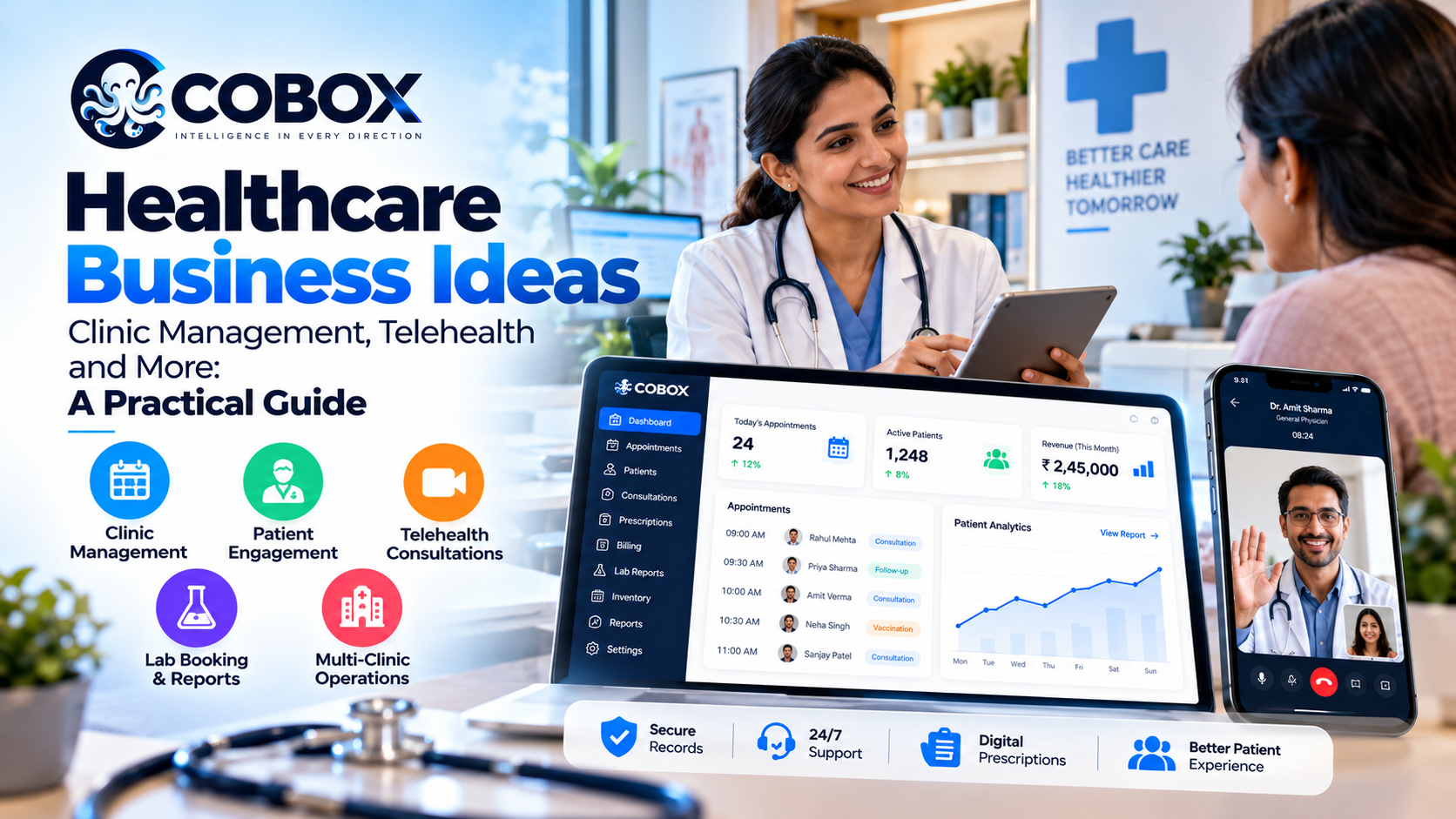
A small clinic can be clinically excellent and still run on a paper diary, a receptionist's memory and a WhatsApp number that patients message at all hours. Missed appointments, lost records, billing mistakes and long waiting rooms are rarely medical problems. They are operations problems, and software can fix many of them.
This guide is for doctors and clinic owners who want to digitise their practice, and for entrepreneurs considering a healthcare software or service business. Healthcare is more regulated than most industries, so this article is careful to separate what is a typical product decision from what needs professional legal or clinical advice. All examples are hypothetical and all figures are illustrative.
How the healthcare business model works
Most independent healthcare providers earn from consultations, procedures, diagnostics, pharmacy sales or packages. Their daily workflow runs through a few steps: patient finds the clinic, books a slot, arrives and is registered, consults, is billed, collects medicines or tests, and is followed up. Each step is an opportunity for friction.
Typical customers of healthcare software are not patients but providers: solo doctors, small clinics, specialist centres, diagnostic labs and small hospitals. Patients are the end users who benefit when it works. Common operational pain points:
- Appointments booked by phone, double-booked or forgotten.
- Patient history scattered across paper files.
- Manual billing and unclear daily collection.
- No follow-up reminders for chronic conditions or repeat visits.
- Prescription and report sharing through personal messaging apps, which creates privacy risk.
Five healthcare business ideas
1. Clinic management software for independent practices
Concept: appointments, registration, consultation notes, prescriptions and billing in one system. Customer: solo and small-group doctors. Value: less admin, fewer no-shows, clean records. Revenue: monthly subscription per clinic. Operations: onboarding, training and support. Product: web app with a reception view and a doctor view. Risks: many competitors, and switching inertia. Validate by: piloting with five clinics for one month and measuring no-shows and billing time.
2. A specialty-focused patient engagement platform
Concept: a system built for one specialty, for example dental, dermatology or physiotherapy, with treatment plans, reminders and progress tracking. Customer: specialty clinics with repeat-visit treatment courses. Value: higher completion of treatment plans. Revenue: subscription, sometimes with a per-patient component. Product: treatment plan tracker, reminders and before/after records. Risks: narrower market. Validate by: working closely with three clinics in the specialty.
3. A telehealth consultation service
Concept: video or chat consultations for follow-ups and minor conditions. Customer: patients who value convenience; doctors who want more reach. Revenue: consultation fee shared with the doctor, or a platform subscription. Operations: doctor onboarding and clinical protocols. Product: scheduling, video, payments and e-prescriptions. Risks: regulation, clinical liability and high patient acquisition cost. Validate by: running consultations through an existing tool with a handful of doctors before building anything.
4. A diagnostic lab booking and reports platform
Concept: online test booking, home sample collection scheduling and digital reports. Customer: small and mid-size labs competing with larger chains. Revenue: subscription or per-booking fee. Operations: phlebotomist scheduling and sample tracking. Product: booking, route planning, report delivery and payments. Risks: sample handling errors and strict quality requirements. Validate by: offering online booking to a single lab and tracking uptake.
5. A multi-clinic group operations system
Concept: centralised management of several clinics: shared patient records, doctor rosters, inventory and consolidated reporting. Customer: clinic chains and growing practices. Revenue: larger contracts with per-location pricing. Product: multi-branch administration, role-based access and reports. Risks: longer sales cycle and customised requests. Validate by: interviewing five multi-branch owners about their most expensive manual task.
How to earn from a healthcare product
| Model | How it works | Fits |
|---|---|---|
| SaaS subscription | Monthly fee per clinic, doctor or location | Clinic and specialty software |
| Per-consultation fee | Share of each paid consultation | Telehealth |
| Implementation and training | One-time fee for set-up and data import | Larger clinics and groups |
| Premium modules | Add-ons such as lab, pharmacy or analytics | All SaaS products |
| Maintenance contracts | Annual support for custom deployments | Hospital and group builds |
Selling patient data or advertising against health information is neither appropriate nor, in many jurisdictions, lawful. Do not design a model that depends on it.
A hypothetical business, end to end
Imagine Dr Rao and a co-founder who build a clinic management product for dental clinics in a mid-sized city. This is a composite, not a real client.
- Problem: dental clinics lose revenue when patients skip multi-visit treatments and no-shows leave chairs empty.
- Customers: independent dental clinics with one to three chairs.
- Opportunity: software built around treatment plans and reminders, not general records.
- Acquiring clinics: demos through local dental associations, referrals and a free first month.
- A transaction: the clinic signs up, imports patient lists, and books appointments; the system sends reminders by WhatsApp or SMS.
- Delivery: receptionists use the daily schedule; doctors record treatments and plans; patients get reminders and receipts.
- Revenue: a monthly subscription per clinic.
- Software needed: scheduling, patient records, treatment plans, billing, reminders and reports.
- Validate first: whether pilot clinics reduce no-shows and still use the system daily after 60 days.
- Expand: add inventory, lab tracking, a patient app and other specialties.
What the platform needs
- Public website and booking page: clear services, doctors, timings and online appointment booking.
- Patient registration: minimal data at first visit, with consent captured.
- Scheduling: doctor calendars, slot lengths per service, walk-ins, cancellations and reminders.
- Electronic records: history, notes, prescriptions, attachments and test results, with an audit trail of who viewed or changed what.
- Billing and payments: consultation and procedure charges, receipts, insurance or credit tracking and daily collection reports.
- Communication: appointment reminders and follow-ups through WhatsApp, SMS or email, using approved templates.
- Roles and access control: receptionists should not see clinical notes they do not need; doctors see only their patients.
- Patient portal or app (optional): reports, prescriptions and bookings. A customer portal is usually a better first step than a native app.
- Integrations: payment gateway, messaging, lab systems and, where relevant, India's Ayushman Bharat Digital Mission (ABDM) health ID and record-sharing standards.
- Security: encryption in transit and at rest, strong authentication, logging and backups. Health data is among the most sensitive data you can hold. See our security page.
- Reports: appointments, no-show rate, revenue by doctor and service.
MVP versus later phases
| Capability | MVP | Later phase |
|---|---|---|
| Scheduling | Calendar, walk-ins, reminders | Online self-booking with rules per service |
| Records | Patient profile, visit notes, prescriptions | Templates by specialty, imaging, structured data |
| Billing | Invoices, receipts, daily report | Insurance workflows, pharmacy billing |
| Communication | Appointment reminders | Follow-up campaigns, recall lists |
| Patients | Booking link and receipts | Patient portal, mobile app |
| Compliance | Consent, access control, audit log | Health ID integration, advanced analytics |
Do not begin with AI diagnosis or complex clinical decision support. They add clinical and regulatory risk. Win on reliable scheduling and billing first.
Technology approach
A web application works on every clinic computer and tablet. A typical stack: Next.js or React front end, Laravel or Node.js back end, PostgreSQL or MySQL, and a managed cloud host with encrypted backups. Choose a region and provider setup that fits your data-location obligations. Keep video consultations on an established video service rather than building your own. Use queue workers for reminders. For a SaaS product, plan multi-tenancy early so each clinic's data is separated; how to build a SaaS product explains the product side and the SaaS page the delivery approach.
Cost and timeline (illustrative)
Assumptions: India-based team, web app only, one specialty, core modules above, standard integrations, no ABDM certification and no native app. These are planning ranges, not a COBOX quotation.
| Item | Illustrative range |
|---|---|
| Discovery with clinicians | 2 to 3 weeks |
| Design | 3 to 4 weeks |
| MVP build | Roughly ₹12 to 28 lakh (about US$14,000 to 33,000 at around ₹85 per US$), 4 to 5 months |
| Security review and testing | Budget separately; essential for health data |
| Hosting and messaging | Monthly, rising with clinics and message volume |
| Maintenance and support | Ongoing; see maintenance costs after launch |
Costs rise with every integration, with national health-record standards and with each additional specialty template.
The economics, with numbers
A hypothetical clinic software company, one specialty, 120 paying clinics.
| Line | Calculation | Amount (₹ per month) |
|---|---|---|
| Revenue (MRR) | 120 clinics × ₹2,500 | 3,00,000 |
| Hosting, messaging, support | 120 × ₹600 | 72,000 |
| Payment fees | 2% of revenue | 6,000 |
| Gross profit | 3,00,000 − 72,000 − 6,000 (74%) | 2,22,000 |
| Team and tools (fixed) | Three people plus tools | 1,80,000 |
| Sales and marketing | 10 new clinics × ₹9,000 acquisition cost | 90,000 |
| Operating result | 2,22,000 − 1,80,000 − 90,000 | −48,000 (loss) |
At 120 clinics this business is still losing money, and that is the honest shape of early SaaS. Gross profit per clinic is ₹1,850. Fixed costs plus the current marketing spend are ₹2,70,000, so break-even needs 2,70,000 ÷ 1,850 ≈ 146 clinics.
Lifetime value: with 3% monthly churn, an average clinic stays about 1 ÷ 0.03 ≈ 33 months. Lifetime gross profit is roughly 33.3 × ₹1,850 ≈ ₹61,700. Against a ₹9,000 acquisition cost the ratio is about 6.9. That is healthy only if churn really stays at 3% and the sales cost is real; churn is the number to protect, and an early product may see much worse. These figures are invented, and no outcome is promised.
A launch plan in seven phases
- Research and validation: shadow clinics, list the three most painful tasks and test willingness to pay. Milestone: five clinics committed to a pilot. See validating an idea before development.
- Blueprint and requirements: a Business Blueprint defines the specialty, pricing, MVP scope and compliance needs.
- MVP design and development: with clinicians reviewing every screen.
- Pilot: two to five clinics, daily use for 60 days. Success: reduced no-shows and staff preferring the system to paper.
- Customer acquisition: professional associations, referrals and demos.
- Operational improvement: faster onboarding, better support, template library.
- Expansion: new specialties, patient app, multi-branch features.
Risks and compliance
- Data privacy: health records are sensitive personal data. India's Digital Personal Data Protection Act, 2023 applies to digital personal data, and sector rules may add obligations. Capture consent, limit access and log activity.
- Telemedicine rules: India has Telemedicine Practice Guidelines issued under the medical council framework; they set expectations about who can consult remotely and how prescriptions are issued. Confirm the current version before launching teleconsultations.
- Clinical liability: software should support, not replace, clinical judgement. Avoid presenting automated output as medical advice.
- Standards and registrations: ABDM integration and clinic registration requirements vary by state and service type; check what applies to you.
- Security incidents: a breach destroys trust. Follow a structured checklist such as ours for business software and add health-specific controls.
- Adoption: busy clinics abandon tools that slow them down. Design for speed.
- Competition: established products exist. Specialise or serve an underserved segment.
Named regulations are pointers for your adviser, not legal advice, and requirements change.
How COBOX can help
COBOX helps you define a clear, focused starting point instead of a vast "healthcare platform". That means discovery with clinicians, a Blueprint covering users, workflows, compliance questions and a phased roadmap, then UX design and development of the scheduling, records, billing and communication modules. We build the integrations with payments and messaging, set up secure cloud deployment, and keep improving the product from real usage. Our healthcare page outlines how we approach these projects, and MVP development explains the build process.
Frequently asked questions
Can I start with a website instead of a mobile app?
Yes. A web app works on clinic computers and phones, and a mobile-friendly booking page serves patients. Build a native app after you see sustained patient usage.
What should the first release include?
Scheduling with reminders, patient records, billing and a daily collection report. Everything else can wait.
Do I need ABDM integration?
Not necessarily at launch. It becomes important if you want to share records with the national ecosystem or serve customers who expect it. Confirm current requirements.
Is WhatsApp allowed for patient reminders?
Often yes, using official business messaging and approved templates with patient consent. Avoid sending clinical details over general chat.
How do I keep patient data safe?
Encrypt data, restrict access by role, log all record views and edits, back up regularly and test your recovery process.
Can I add telemedicine later?
Yes. Many products add video consultations after scheduling and billing are stable, using a trusted video provider and reviewing current guidelines.
How do I validate demand?
Run a paid or committed pilot with a handful of clinics. A clinic that pays and keeps using it is stronger evidence than praise in a meeting.
What ongoing costs should I expect?
Hosting, messaging fees, support staff, security reviews and regular updates. Budget these as a monthly cost per clinic, as in the example.
Turn your healthcare idea into a plan
Planning a clinic software product or digitising your practice? Start with a Business Blueprint covering your users, workflows, revenue model, compliance questions and launch roadmap. Paste something like this into the Blueprint tool:
I want to build clinic management software for [specialty] clinics in [city or country]. Clinics currently use [paper/Excel/other software]. I need a plan for the MVP, pricing per clinic, data privacy considerations and a pilot with five clinics.
Or contact us to talk it through.