 COBOX
COBOX
How to Build an AgriTech Platform: Farm-to-Buyer Marketplace, Inputs and Advisory

Agriculture employs a very large share of India's workforce, yet the path from a farmer's field to a buyer's kitchen is long, fragmented and opaque. A farmer may sell to the nearest trader at whatever price is offered, a buyer may not know the quality until delivery, and everyone in between takes a margin they can rarely justify to the others. This makes agritech attractive and difficult at the same time: the problems are real, but the users are dispersed, the margins are thin, and the technology must work where connectivity does not.
This guide is for founders, agribusinesses, cooperatives and FPOs (farmer producer organisations) who want to build an agritech platform. We cover five business models, how each earns, the features that matter, the architecture needed for low-connectivity use, unit economics with worked numbers, risks and a launch plan. Scenarios are hypothetical and figures illustrative; agricultural margins vary widely by crop, season and region, so use your own data.
Where software helps in agriculture, and where it does not
Software can improve information (prices, weather, quality), coordination (collection, transport, scheduling) and trust (records, grading, payments). It cannot grow crops, fix a broken cold chain by itself, or substitute for the relationships that make farmers sell to you. The most successful agritech companies treat software as the nervous system of an operation that also has trucks, warehouses and field teams.
Four constraints shape product decisions:
- Connectivity: patchy networks mean offline-first design.
- Literacy and language: voice, icons and regional languages beat dense text.
- Seasonality: revenue concentrates in harvest windows.
- Perishability: a delay of a day can cost real money, so time-critical coordination is the product's core value.
Five business models
1. Farm-to-buyer marketplace
You connect farmers or FPOs with buyers such as retailers, restaurants, processors and exporters, and earn a margin or commission on trades. Buyers want consistent quality and delivery; farmers want fair, fast payment. The heart of the model is aggregation and quality control. For marketplace mechanics read building a two-sided marketplace.
2. Input supply and credit enablement
You sell seeds, fertiliser and equipment, often bundled with agronomy advice, and sometimes with credit through lending partners. Input sales are repeat and seasonal; credit introduces regulatory and default risk, and should be handled with licensed partners.
3. Advisory and precision agriculture
Subscriptions or bundled services providing crop advice, pest alerts, weather and soil analysis, possibly using satellite or sensor data and image recognition. Value is hard for farmers to see directly, so many advisory businesses attach themselves to an input or procurement business.
4. Farm and FPO management software
Software for cooperatives and agribusinesses to manage members, produce collection, payments, warehousing and compliance. Buyers are organisations with a clear need for records, making this the most predictable revenue.
5. Traceability and quality software
For exporters and premium retail brands that need to show where produce came from, how it was grown and how it was handled. Revenue comes from enterprise contracts. Requirements depend on destination-market standards, which change.
| Model | Revenue | Capital intensity | Hardest problem |
|---|---|---|---|
| Farm-to-buyer marketplace | Trade margin or commission | High (logistics, working capital) | Quality, aggregation, payment cycles |
| Input supply and credit | Product margin, partner fees | Medium to high | Trust, repeat purchase, credit risk |
| Advisory | Subscription, bundled revenue | Low to medium | Proving value to farmers |
| FPO and farm software | Subscription, implementation fees | Low | Slow sales, training and adoption |
| Traceability | Enterprise contracts | Low to medium | Standards and integration complexity |
A hypothetical scenario: tomatoes from 60 farmers
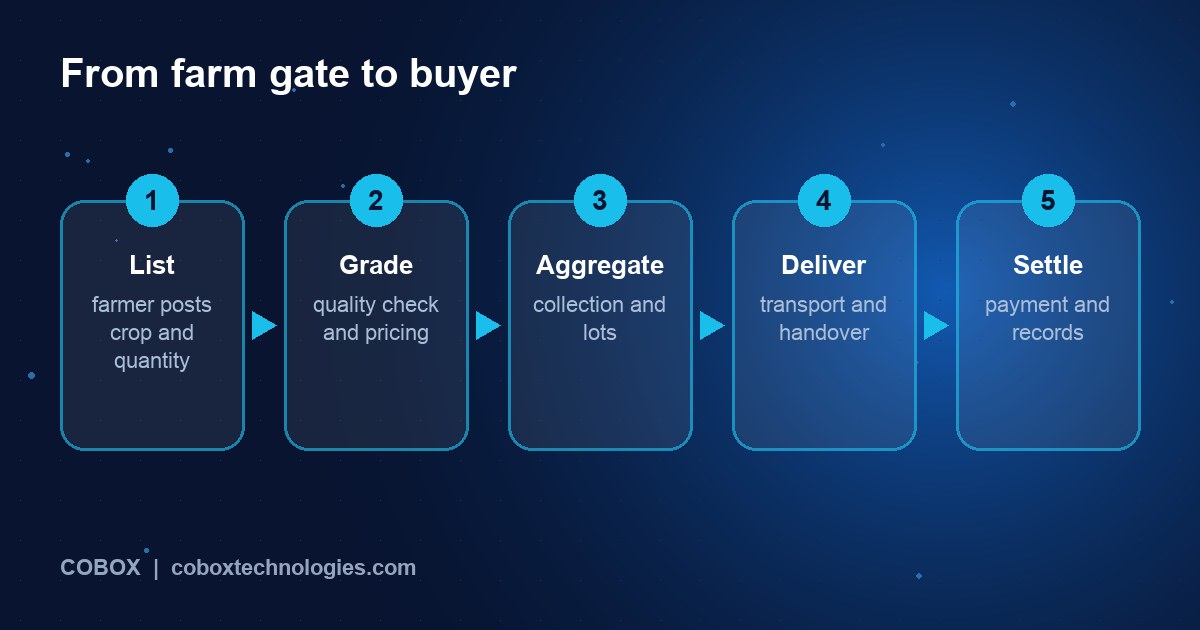
Consider a fictional company, Harvest Link, aggregating tomatoes from 60 smallholder farmers near a mid-sized city and selling to restaurants and retailers. A field executive registers each farmer on a simple app, even without network coverage, capturing the farmer's name, plot, expected harvest dates and quantities. A buyer places a weekly order of 2,000 kg with grade and delivery day.
The platform matches expected supply to the order and assigns collection slots. At the collection point, an executive weighs each farmer's produce, records grade and photo, and the farmer receives an SMS with the weight and amount due. Produce goes into lots, a truck is assigned, and the buyer receives an advance shipment notice. On delivery the buyer accepts or rejects by lot; the system adjusts the farmer payments accordingly, and payment settles to the farmer's bank account within an agreed number of days. The platform's value is visible at every step: faster payments, fewer disputes about weight and grade, and a record that supports future credit.
Features: the field-ready essentials
| Area | MVP | Later |
|---|---|---|
| Farmer registry | Profile, plots, crops, bank details, consent | Satellite plot boundaries, yield history, scoring |
| Supply and demand | Expected harvest, buyer orders, matching | Forecasting, price recommendations, contracts |
| Collection | Offline weighing and grading, photos, receipt SMS | IoT scale integration, barcode lots, QR traceability |
| Logistics | Route and vehicle assignment, delivery status | Route optimisation, cold chain monitoring |
| Payments | Bank transfers, UPI, ledger of dues, deductions | Instalments, credit linkage, automated reconciliation |
| Quality and returns | Grade definitions, rejection with photo and reason | Image-based grading, supplier scorecards |
| Communication | SMS, WhatsApp, voice messages, regional languages | IVR, chatbot, community groups |
| Management reports | Volume, margin per lot, payment delays, wastage | Cost-to-serve analysis, demand forecasts |
Apply the scoping discipline from what to include in an MVP: the first release should handle one crop, one region and one buyer type well.
Design for offline and low literacy
- Offline-first mobile app for field executives, syncing when connectivity returns, with conflict handling so two edits to the same record do not corrupt data.
- Simple farmer interaction through SMS, WhatsApp voice notes or a missed-call flow rather than requiring app installs.
- Regional languages and icon-led screens tested with real users in real fields.
- Low-end device support and small downloads.
The decision between native, web and hybrid approaches is practical here; see mobile app vs web app: which to build first.
Architecture in plain language
- Field app (offline-first): registration, weighing, grading, receipts.
- Buyer portal: orders, schedules, quality records, invoices. See CRM and customer portals.
- Operations console: matching, routing, payments, dispute handling.
- Backend: farmers, lots, orders, ledger, notifications, reporting.
- Integrations: payments and bank APIs, SMS and WhatsApp, maps, weather and mandi price data, accounting. See API integrations.
A reliable ledger matters more than a flashy interface. Payments to hundreds of farmers with deductions and adjustments need an audit trail that finance and farmers can both trust. Our analytics dashboards work explains how to show these numbers clearly to managers.
Costs and timeline (illustrative)
| Build | Scope | Indicative cost | Indicative time |
|---|---|---|---|
| Aggregation operations MVP | Farmer registry, offline collection app, buyer orders, ledger, reports | ₹12-28 lakh | 4-5 months |
| FPO management software | Members, collection, payments, inventory, compliance reports | ₹10-22 lakh | 3-5 months |
| Full marketplace with advisory | Buyer marketplace, logistics, payments, content, multilingual apps | ₹35-70 lakh | 7-10 months |
Software is a smaller share of total cost than operations: warehouses, vehicles, field staff and working capital often exceed it by a wide margin. Maintenance of 15-20 percent of build cost per year is a sensible placeholder; see software maintenance costs.
Worked economics: tomatoes, per kilogram
Assume Harvest Link (hypothetical) buys tomatoes from farmers at ₹18 per kg and sells to buyers at ₹26 per kg. Weekly volume is 2,000 kg ordered, but 6 percent is lost to damage and rejection.
- Quantity purchased to deliver 2,000 kg sellable: 2,000 / 0.94 = about 2,128 kg
- Purchase cost: 2,128 x ₹18 = ₹38,304
- Sales revenue: 2,000 x ₹26 = ₹52,000
- Gross margin: ₹52,000 - ₹38,304 = ₹13,696 (about 26 percent of revenue)
- Transport and handling at ₹3 per kg of purchased quantity: about ₹6,384
- Crates, field staff share and payment costs: about ₹3,000
- Contribution: ₹13,696 - ₹6,384 - ₹3,000 = about ₹4,312 per week (about 8 percent of revenue)
An 8 percent contribution is thin, and it is sensitive. If wastage rises from 6 to 10 percent, purchased quantity becomes 2,222 kg, purchase cost ₹40,000, gross margin ₹12,000 and contribution roughly ₹2,300, a fall of nearly half from a four-point wastage change. If a buyer pays in 21 days while farmers are paid in 3 days, you also need working capital to cover 18 days of purchases, which at about ₹38,000 of purchases a week means roughly ₹1 lakh of your own cash is tied up at any time. These are the numbers to put in your model before building anything: wastage, payment cycle gap, and cost per kilogram of logistics, not features.
The software's job is to reduce wastage (faster collection, better matching), shrink payment disputes and expose these figures weekly. Always distinguish revenue, gross margin and contribution when reporting, and keep working capital separate from profit. Our validation guide shows how to test assumptions like these before development.
Growth levers
- Deepen before widening: add farmers and buyers in the same cluster to improve truck utilisation.
- Reliable payment: paying farmers on time is the strongest retention tool.
- Buyer contracts: recurring orders with restaurants, retailers and processors stabilise demand.
- Add products on the same network: inputs, advisory and credit once trust exists.
- FPO partnerships: organised groups bring volume and cut onboarding cost.
Track fill rate, wastage percentage, payment turnaround for farmers and buyers, cost per kilogram, and farmer repeat rate. See what to measure in the first 90 days and weekly dashboard numbers.
Seven-phase launch plan
- Pick one crop and one cluster: choose a produce with reliable buyers and manageable perishability.
- Run it manually for 4-6 weeks: use spreadsheets, calls and WhatsApp to learn the real process and costs.
- Define the MVP: registry, collection, order matching, payment ledger.
- Build the field app first with offline support, then buyer ordering and reports.
- Pilot with 30-60 farmers and a few buyers; measure wastage and disputes weekly.
- Scale the cluster, then add a second crop or region.
- Add advisory, inputs or credit through licensed partners once operations are stable.
Moving from spreadsheets to software without disrupting operations is a recurring theme; see Excel and WhatsApp: when to upgrade and which business process to automate first.
Risks and compliance
- Price and weather risk: volatility affects both margin and farmer trust. Consider contracts and buffers.
- Quality disputes: clear grade definitions with photos reduce arguments.
- Food safety and licensing: handling or selling food may require registrations and standards, such as FSSAI requirements; confirm which apply.
- Agri-input regulation: sale of seeds, pesticides and fertilisers is regulated and often needs state-level licences; check before selling inputs.
- Credit and insurance: offering loans or insurance requires licensed partners and clear disclosure; do not offer them without proper authorisation.
- Personal data: farmer records, bank details and land information are personal data under India's Digital Personal Data Protection Act, 2023. Get advice on consent and storage. See our security page.
- Subsidy and scheme data: government programmes and their rules change; verify before building features that depend on them.
- Technology adoption: a product that field teams avoid fails regardless of design. Test with them early and train repeatedly.
These are pointers for your advisers, not legal advice.
How COBOX can help
COBOX helps agribusiness founders decide what to build and what to keep manual. We start with discovery in the field context, produce a Blueprint, build offline-capable field tools, buyer portals and a reliable payment ledger, and integrate messaging and payments. See product discovery, MVP development and business process automation. For larger operators, we can also help with connecting accounting and order systems.
Frequently asked questions
Is agritech profitable?
It can be, but margins are thin and capital needs are real. Success depends on operations (wastage, logistics, payment cycles) as much as software.
How much does an agritech platform cost to build?
An aggregation MVP commonly costs around ₹12-28 lakh in India, with fuller marketplaces costing more. Operations costs usually exceed software costs.
Do farmers need smartphones?
Not necessarily. Field executives can use the app while farmers interact through SMS, calls or WhatsApp. Design for the least capable user.
How do I handle poor connectivity?
Build the field app offline-first so it records data locally and syncs later, with clear conflict rules.
Should I start with a marketplace or with software for FPOs?
Software for FPOs has lower capital needs and clearer revenue, while a marketplace has larger upside and higher risk. Choose based on your resources and relationships.
How do I convince farmers to join?
Offer something concrete: faster payment, transparent weighing, a fair price. Work through trusted local people rather than advertising alone.
Can I add credit later?
Yes, through licensed lending partners once you have transaction records that prove farmer reliability. Do not lend without proper authorisation.
What data should I collect first?
Farmer identity, crop and expected harvest, delivered quantity and grade, and payment history. Add more only when you have a use for it.
Turn your agritech idea into a plan
Planning an agritech platform? Start with a Business Blueprint covering farmers, buyers, revenue model, MVP features, technology and launch roadmap. Paste something like this into the Blueprint tool:
I want to build a [farm-to-buyer marketplace / FPO software / input platform] for [crop and region]. I expect [number] farmers and [number] kg per week at ₹[price] per kg. I need an MVP plan, offline requirements and a validation plan.
Or talk to us first, and read about the Business Blueprint.