 COBOX
COBOX
How to Build a Home Services Marketplace: Plumbers, Cleaners, Electricians and More

Few purchases cause as much anxiety as letting a stranger into your home. Customers want a plumber who arrives on time, quotes honestly and does not vanish after the first visit. Professionals want steady work and prompt payment without the cost of finding customers. Meanwhile a typical neighbourhood handles this through a notebook of phone numbers and a few relatives' recommendations. A home services marketplace replaces that notebook with matching, tracking and accountability.
This guide is for founders who want to build a home services marketplace, and for service companies (cleaning, pest control, appliance repair, painting, salons at home) who want to run operations on software. We cover business models, features, worked economics including the critical problem of leakage, risks and a launch plan. Scenarios are hypothetical and figures illustrative.
Why this category is attractive and unforgiving
Demand is steady and local, tickets are small, and customers have repeated needs. But the unit economics are fragile: a booking is worth a few hundred rupees, acquisition is expensive, and the customer can call the professional directly next time. The businesses that survive solve three problems: reliable quality, efficient dispatch and keeping transactions on the platform.
Five business models
1. Lead-generation marketplace
Customers post a request and several professionals quote. You earn lead fees or commission. It is asset-light but quality varies, and professionals dislike paying for leads that do not convert.
2. Managed on-demand marketplace
You standardise services (a 2-hour deep clean, an AC service), price them, train and certify professionals, and dispatch them. You earn a margin on each job and own the customer relationship. Quality is higher but operations are heavier.
3. Subscription and maintenance plans
Customers pay monthly for recurring services such as cleaning, pest control or appliance protection. Revenue is predictable, and customer lifetime value is high. Scheduling and retention drive profitability.
4. Field service management software for companies
You sell dispatch, job cards, invoicing and customer notifications to small service companies. Revenue is a monthly subscription. See how to build a SaaS product.
5. Vertical specialist business
You focus on one trade (for example, water purifier service or solar panel cleaning) and build a tight operation with software. Focus lets you win through depth rather than breadth.
| Model | Revenue | Control of quality | Main challenge |
|---|---|---|---|
| Lead marketplace | Lead fees, commission | Low | Lead quality, leakage |
| Managed on-demand | Margin per job | High | Operations, training, unit costs |
| Subscriptions | Monthly fees | High | Scheduling, churn |
| Field service SaaS | Subscription | Not applicable | Adoption by small firms |
| Vertical specialist | Service fees | High | Market size, scaling |
A hypothetical scenario: an AC that stops cooling
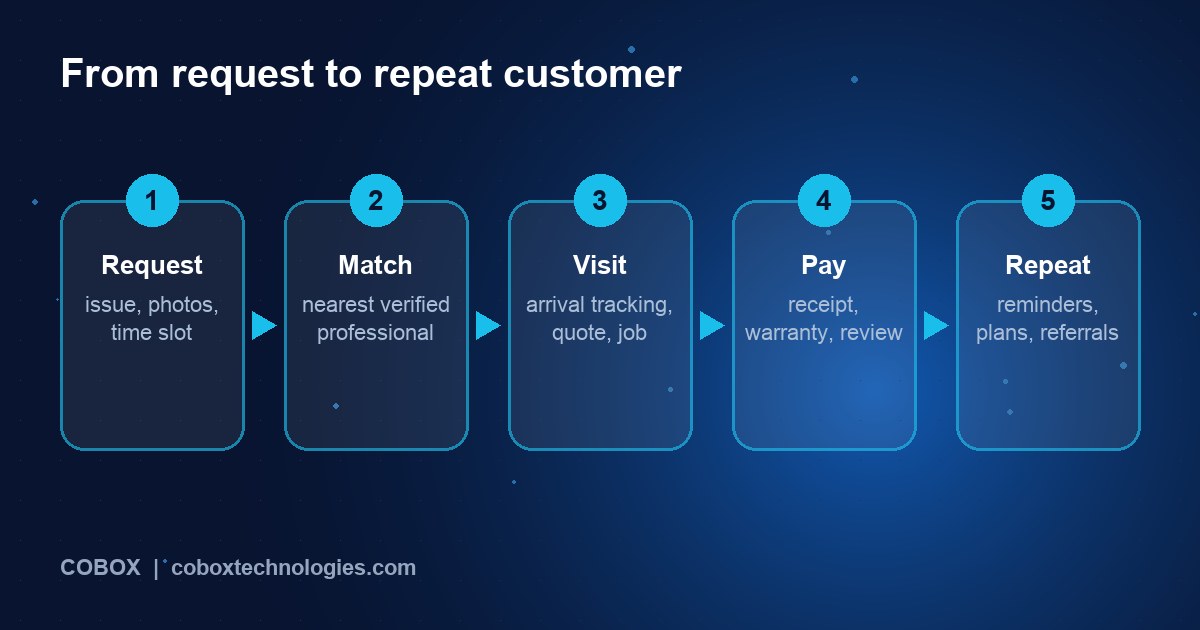
Consider a fictional platform, FixNest. A customer's AC stops cooling on a hot afternoon. She opens a link, selects AC repair, describes the issue and uploads a photo. FixNest shows an inspection fee of ₹399 and offers slots within two hours. The system dispatches the nearest certified technician with the right skills and parts. She tracks his arrival on a map, receives a verification code to share on arrival, and gets an itemised quote on her phone after diagnosis: a gas refill for ₹1,800. She approves; the technician completes the job, uploads before-and-after photos, and she pays by UPI. A 30-day warranty is recorded, and a service reminder is scheduled for six months later. She rates the visit, and the platform's quality team reviews low ratings the same day.
Each step reduces anxiety: verified identity, known price, visible progress, protected payment and a warranty.
Features that matter
| Area | MVP | Later |
|---|---|---|
| Catalogue and pricing | Services with fixed prices or inspection fees, add-ons, area coverage | Dynamic pricing, packages, plans |
| Booking | Slot selection, address, photos, rescheduling, cancellation rules | Recurring bookings, group services, corporate accounts |
| Matching and dispatch | Skill and distance based assignment, acceptance flow, fallback | Route batching, demand forecasting, auto-scaling supply |
| Professional app | Job list, navigation, checklists, quotes, photos, earnings | Training modules, equipment tracking, incentives |
| Trust and safety | ID and background verification, OTP at start, ratings, support, insurance options | Panic button, live monitoring, behaviour scoring |
| Payments | Online payment, cash recording, receipts, payouts, GST invoices | Wallets, instalments, refunds automation |
| Admin | Job monitoring, dispute handling, supply onboarding, reports | Quality scorecards, cohort analytics |
For scoping see what to include in an MVP.
Preventing leakage
Leakage is when customer and professional deal directly after the first job, avoiding your commission. You cannot eliminate it, but you can make staying on-platform better: warranties and re-service guarantees that apply only to platform jobs, easy rebooking of the same professional, payment protection, insurance cover, and invoices that customers need for resale or claims. Charging a smaller commission on repeat jobs also reduces the incentive to leave. These issues are the same in any marketplace; see building a two-sided marketplace.
Architecture in plain language
- Customer web or app: booking, tracking, payments. Start with mobile web or a PWA; see mobile app vs web app.
- Professional mobile app: real-time jobs and navigation need a native or hybrid app; see mobile app development.
- Dispatch engine and backend: availability, assignment, real-time status.
- Admin console: operations, support, finance.
- Integrations: maps, payment gateway, identity verification, WhatsApp and SMS, telephony masking, accounting. See API integrations.
Costs and timeline (illustrative)
| Build | Scope | Indicative cost | Indicative time |
|---|---|---|---|
| Single-vertical service MVP | Booking, dispatch, professional app, payments, admin | ₹15-30 lakh | 4-6 months |
| Multi-service marketplace v1 | Several categories, subscriptions, ratings, support tools | ₹35-70 lakh | 7-10 months |
| Field service SaaS v1 | Multi-company, job cards, scheduling, invoicing, customer notifications | ₹20-45 lakh | 5-8 months |
Marketing, supply onboarding, training and support costs often exceed software costs. Plan 15-20 percent of build cost a year for maintenance (details here).
Worked economics: a managed cleaning service
Assume FixNest (hypothetical) sells a home deep clean at ₹2,400 per job, with a professional payout of ₹1,500.
- Platform gross revenue per job: ₹2,400 - ₹1,500 = ₹900 (37.5 percent of the price)
- Materials and consumables: ₹180
- Travel allowance and dispatch cost: ₹120
- Payment cost at about 2 percent of ₹2,400: ₹48
- Support, insurance and refunds allowance: ₹100
- Contribution per job before marketing: ₹900 - ₹180 - ₹120 - ₹48 - ₹100 = ₹452
If acquiring a customer costs ₹800 and the average customer books 2.5 times in the first year, first-year contribution is 2.5 x ₹452 = ₹1,130, leaving ₹330 after acquisition. Now see what leakage does. If 25 percent of repeat bookings go direct, the customer books 1 platform job plus 1.5 repeat jobs, of which 1.125 stay on the platform: total 2.125 jobs and first-year contribution of ₹960, leaving ₹160 after acquisition. Cut acquisition cost to ₹500 through referrals, and the same customer leaves ₹460.
The fixed side matters too. If city-level operations, supply team and support cost ₹6 lakh a month, you need about 1,327 completed jobs a month at ₹452 contribution to break even (₹6,00,000 / ₹452). That is roughly 44 jobs a day, which a city with a few hundred active professionals can reach. Always distinguish gross booking value (₹2,400), platform revenue (₹900) and contribution (₹452); see weekly dashboard numbers. Test the assumptions with the validation guide.
Growth levers
- Dense city launches: fast arrival depends on professionals being close.
- Service plans: annual maintenance contracts convert one-off needs into recurring revenue.
- Housing society partnerships: bulk bookings with predictable schedules.
- Local SEO and reviews: "AC repair in [locality]" pages built from real jobs.
- Professional welfare: fair payouts and quick settlement reduce churn on the supply side.
Measure on-time arrival rate, first-visit resolution, repeat rate, leakage estimate, rating distribution and supply utilisation. See what to measure in the first 90 days.
Seven-phase launch plan
- Choose one service and one dense area.
- Run it manually with a phone line, a spreadsheet and 10-20 vetted professionals for 4-6 weeks.
- Define standard jobs and prices from what you learned.
- Build the MVP: booking, dispatch, professional app, payments.
- Pilot in one neighbourhood, reviewing every complaint.
- Expand services and areas only after quality and unit economics hold.
- Add plans, referrals and corporate accounts.
Risks and compliance
- Worker classification and welfare: whether professionals are contractors or employees, and obligations under India's evolving gig and platform worker laws and codes, need legal advice. Rules are changing, so confirm the current position.
- Safety: background checks and identity verification, along with clear complaint handling, are essential for entering homes.
- Insurance and liability: damage to property or injuries need defined responsibility and cover.
- Personal data: addresses, photos and phone numbers are personal data under India's Digital Personal Data Protection Act, 2023; use masked calling and limit retention. See our security page.
- Consumer protection: clear pricing, refunds and warranty terms reduce disputes.
- Licensing: some trades (pest control chemicals, electrical work) have licensing or safety rules; confirm which apply.
- Taxes: GST on services and commissions depends on structure; confirm with an accountant.
These are pointers for your advisers, not legal advice.
How COBOX can help
COBOX helps you choose one service and one area, test it manually and then build the platform: customer booking, professional app, dispatch, payments and admin. We produce a Blueprint, integrate maps, payments, verification and messaging, and instrument the product so you can see leakage and unit economics. See MVP development, business process automation and marketplaces.
Frequently asked questions
Can a new company compete with established home-services apps?
Yes, by focusing on one category, one city or an underserved niche, and delivering better quality and service plans.
How much does a home services app cost?
A single-vertical MVP is typically ₹15-30 lakh in India. Multi-category marketplaces cost more.
How do I stop customers going direct to professionals?
Offer warranties, easy rebooking, payment protection and invoices that only platform jobs provide. Some leakage is inevitable; design economics that survive it.
Do I need a professional app?
Yes. Dispatch, navigation, job photos and earnings need a mobile app or at least a progressive web app for professionals.
How do I verify professionals?
Check identity, address, references and skills, and consider police verification and a probation period.
What is a healthy repeat rate?
It depends on the service. Cleaning and maintenance repeat often; one-off repairs do not. Measure by cohort.
Should I use subscriptions?
For recurring services, yes. Plans improve retention and cash flow.
What should I measure first?
On-time arrival, first-visit resolution, repeat rate and leakage.
Turn your idea into a plan
Planning a home services marketplace? Start with a Business Blueprint covering customers, professionals, revenue model, MVP features, technology and launch roadmap. Paste something like this into the Blueprint tool:
I want to build a [managed / lead-based] home services marketplace for [service type] in [city]. I expect [number] jobs a month at about ₹[price] with ₹[payout] paid to professionals. I need an MVP plan, a dispatch approach, and a plan to limit leakage.
Or talk to us first, and read about the Business Blueprint.