 COBOX
COBOX
How to Build an Online Travel Booking Business: Tours, Packages and Revenue Models
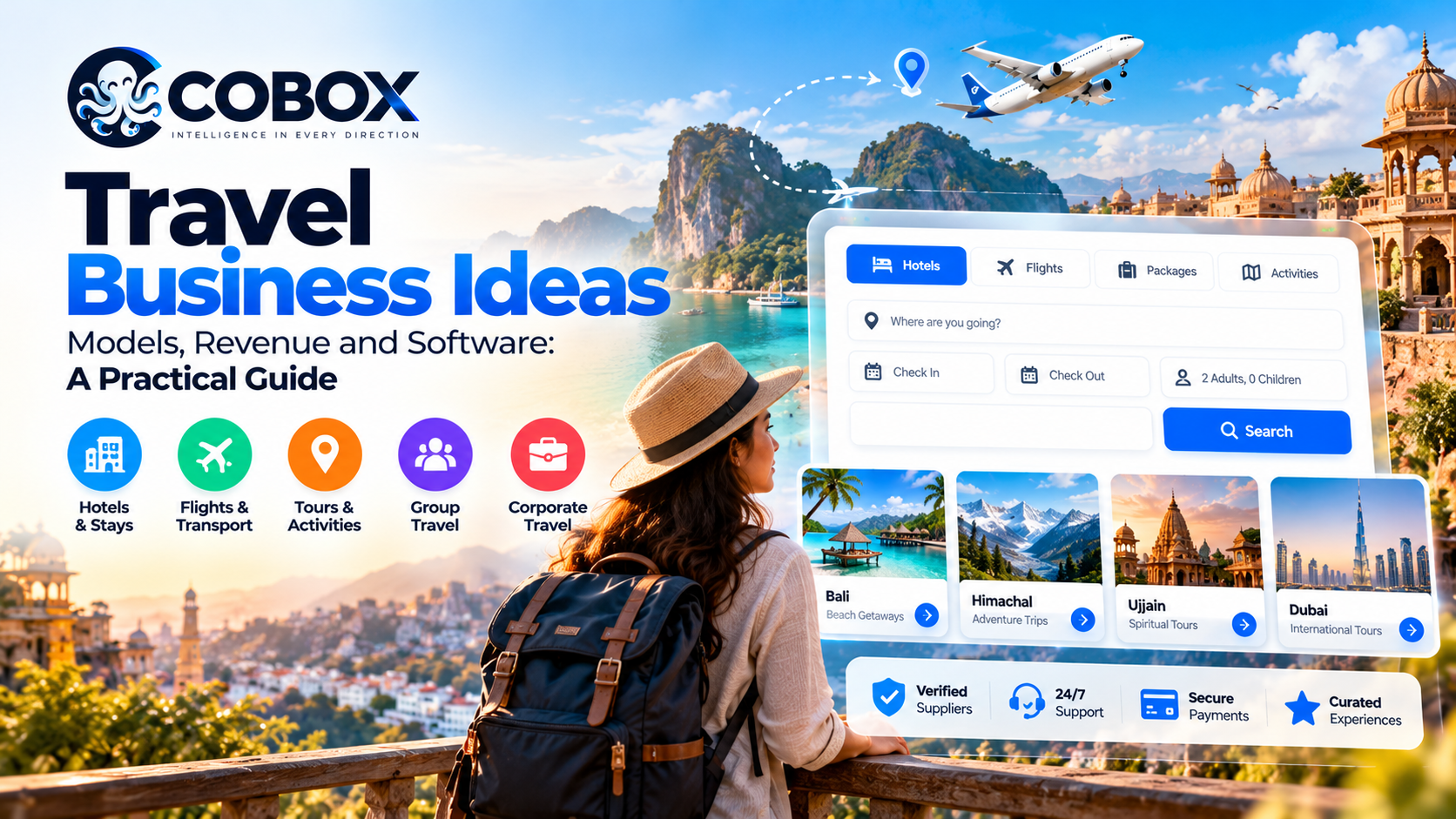
Travel looks like an easy business to put online: list hotels, add a payment button, take a commission. In practice, a travel business sells something it does not own, to customers who are about to spend a large amount of money on an experience they cannot test first, using suppliers whose prices and availability change by the hour. The hard parts are trust, supplier relationships and what happens when a trip goes wrong. The booking website is a smaller part of the job than it appears.
This guide is for someone planning an online travel business, or a traditional travel agent moving online. It covers five distinct business models, the revenue each one realistically earns, the software involved, a worked example with arithmetic, and the risks. All examples are hypothetical and every figure is illustrative, because margins vary widely by destination, season and supplier.
How travel businesses actually work
Most travel businesses sit between a traveller and a set of suppliers: hotels, transport, guides and activity operators. They earn by one of three means: a markup on a package they assemble, a commission paid by the supplier, or a fee charged to the traveller or business customer. Who does what in the middle matters:
- A retail agency sells directly to travellers and assembles trips.
- A destination management company (DMC) owns the local knowledge and sells ground services to other agencies.
- An aggregator or marketplace lists many suppliers and lets travellers book directly.
Customers range from first-time family holidaymakers to corporate teams planning offsites. They share the same worries: is this real, is the price fair, and who helps me if my flight is cancelled? Software that answers these three questions earns more bookings than software with more features.
Where new travel businesses struggle
- Supplier dependence. Without direct contracts, you depend on whatever inventory and rates an aggregator or supplier gives you.
- Price comparison. Travellers compare against large platforms in seconds. You need a reason to book with you.
- Long, custom sales cycles. Itineraries are negotiated over WhatsApp and calls, and leads go cold when follow-up is slow.
- Cancellations and changes. Refund rules differ per supplier; mismatches become your loss.
- Seasonality. Cash flow is lumpy, with peaks and dead months.
Five travel business ideas worth validating
1. A curated itinerary agency for one niche
Concept: expert-designed trips for one traveller type, such as solo women, families with young children or photographers. Customer: travellers who want guidance, not a search box. Value: trust, safety and a well-sequenced plan. Revenue: margin built into the package price. Operations: vetted local suppliers and a support line during the trip. Product: enquiry-to-quote workflow, itinerary builder and payment collection. Risks: dependence on the founder's expertise and difficulty scaling. Validate by: selling five trips by hand through Instagram or WhatsApp before building any system.
2. A destination management platform for one region
Concept: a B2B platform where a local operator in one region sells ground packages, transfers and activities to other agencies. Customer: travel agents who lack local contacts. Value: reliable on-ground delivery and instant quotes. Revenue: margin on services, sometimes plus a platform fee. Operations: local supplier contracts, guides and transport. Product: quote engine, agent portal and booking confirmations. Risks: concentrated geography and seasonality. Validate by: getting ten agents to request quotes through a simple form.
3. A group departures business
Concept: fixed-date group trips (trekking, cultural circuits, festival travel) sold by seat. Customer: individuals who want a ready-made trip with others. Revenue: per-seat pricing with a target margin once the minimum group size is met. Operations: block bookings, trip leaders, minimum-seat rules. Product: departure calendar, seat inventory, instalment payments and waitlist. Risks: unfilled departures and fixed supplier commitments. Validate by: opening bookings for one departure and counting deposits before committing to hotels.
4. A corporate offsite and team travel planner
Concept: planning team trips, incentive travel and offsites for companies. Customer: HR and operations managers who dislike coordinating logistics. Revenue: planning fee plus supplier margin, billed on invoice. Operations: approvals, GST invoices and group coordination. Product: request intake, proposal comparison, approval workflow and invoicing. Risks: long payment cycles. Validate by: planning one offsite manually for a company you already know.
5. A local experiences marketplace for a single destination
Concept: a listing and booking site for tours, classes and activities in one place. Customer: visitors who decide on arrival, and local operators who lack distribution. Revenue: commission per booking. Operations: onboarding operators and handling cancellations. Product: two-sided marketplace with availability calendars and payouts. Risks: the classic marketplace problem of getting both sides on board. See how to build a two-sided marketplace. Validate by: manually listing twenty operators and tracking whether visitors book.
Revenue models for travel businesses
| Model | How it earns | Fits |
|---|---|---|
| Package markup | Sell a bundle above the combined supplier cost | Curated agencies, group departures |
| Supplier commission | Supplier pays a percentage of each booking | Marketplaces, hotel and activity listings |
| Planning or service fee | Flat fee for designing and managing the trip | Premium and corporate travel |
| Convenience fee | Small fee on online bookings | Retail booking sites |
| B2B platform licence | Agents pay to use your quoting and booking system | DMCs and tech providers |
| Add-ons | Insurance, visas, airport transfers, forex partners | Most retail models |
Pure advertising and subscription models rarely fit a new travel brand; they need large traffic first.
A hypothetical business, end to end
Imagine Arjun, who has guided Himalayan treks for years and wants to launch a booking business for small-group treks. This is a composite, not a real client.
- Problem: travellers find treks through scattered Instagram posts and pay by bank transfer with no clear policy.
- Customers: first-time trekkers aged 25 to 40 from major cities.
- Opportunity: a trusted, well-described trek catalogue with dates, difficulty ratings and safety information.
- Acquisition: Instagram content, trek reviews and referrals from past guests.
- Transaction: traveller picks a departure, pays a deposit online, receives a confirmation and a packing list, then pays the balance 21 days before.
- Delivery: local guides and a lodge network host the trek; the system sends reminders and collects feedback.
- Revenue: per-seat package price, plus add-ons like gear rental.
- Software: departure calendar with seat counts, deposits and balances, waitlist, traveller documents and a simple admin dashboard.
- Validate first: whether strangers will pay a deposit on the website without speaking to him.
- Expand: add more regions, private departures and corporate groups.
The software a travel business needs
- Public website: destination and trip pages with clear inclusions, exclusions, cancellation policy and reviews. Trust signals matter more here than anywhere.
- Search and availability: dates, seats or rooms, with prices that match what you can deliver.
- Enquiry and quote management: a pipeline that tracks every lead, quote and follow-up. This is where a CRM and customer portal pays for itself.
- Itinerary builder: reusable day-by-day templates that staff can adjust, then share as a clean PDF or web page.
- Booking and payments: deposits, instalments, balances, refunds and cancellation rules per supplier.
- Supplier management: contacts, rates by season, confirmations and payables.
- Traveller portal: documents, vouchers, itinerary and emergency contacts. A mobile app is optional; a mobile-friendly web portal usually does the job.
- Integrations: payment gateway, WhatsApp or SMS, accounting and, for flights and hotels, third-party inventory connections. Live flight and hotel inventory usually requires commercial agreements with aggregators or consolidators, and access is not instant. Plan time for that. Our API integration work covers how these connections are built safely.
- Reports: bookings by source, quote-to-booking conversion, margin per trip and outstanding balances.
- Roles: sales, operations, accounts and trip leaders see different things.
MVP versus later phases
| Capability | MVP | Later phase |
|---|---|---|
| Trip content | Own packages with static dates and prices | Dynamic packaging from supplier inventory |
| Booking | Deposit and balance payments | Instalments, wallets, multi-currency |
| Leads | Enquiry form feeding a simple pipeline | Automated follow-up, scoring |
| Itineraries | Template-based, exported as PDF | Interactive itinerary builder with live pricing |
| Suppliers | Manual confirmations tracked in the admin | Supplier portal, API-based confirmations |
| Traveller experience | Responsive web, email and WhatsApp | Native app with offline itineraries |
The common mistake is starting with live flight search. It is expensive, it requires supplier access, and it competes head-on with giants. Start with packages you control. See mobile app vs web app before committing to a native build.
Technology choices
A typical stack is Next.js for fast, search-friendly trip pages, a Laravel or Node.js back end for bookings and payments, and MySQL or PostgreSQL for data. Use a mature payment gateway with refund APIs, object storage for images and documents, and a queue (Redis) for confirmation emails and reminders. If you later sell live hotel or flight inventory, isolate those integrations behind their own service layer so a supplier outage does not take down your site. Avoid building your own search engine for inventory you do not own.
Cost and timeline (illustrative)
Assumptions: India-based team, own-package website with admin, payment gateway and CRM basics, no live flight or hotel inventory, no native app. These are planning ranges, not COBOX quotations.
| Item | Illustrative range |
|---|---|
| Discovery and Blueprint | 1 to 2 weeks |
| Design | 2 to 3 weeks |
| MVP (site, booking, payments, admin, CRM) | Roughly ₹7 to 16 lakh (about US$8,000 to 19,000 at around ₹85 per US$), 10 to 14 weeks |
| Supplier API integrations (each) | Highly variable; depends on supplier access and fees |
| Hosting and tools | Modest monthly cost at launch |
| Maintenance | Ongoing; see what maintenance costs after launch |
Cost drivers: number of supplier integrations, multi-currency, custom itinerary tooling and mobile apps. For general budgeting logic read how much an MVP costs.
The economics, with numbers
A hypothetical online agency selling domestic holiday packages, in a typical month. All figures are invented to show the method.
| Line | Calculation | Amount (₹) |
|---|---|---|
| Bookings | 300 bookings × ₹45,000 average booking value | 1,35,00,000 gross booking value |
| Net revenue | 12% margin on gross booking value | 16,20,000 (₹5,400 per booking) |
| Payment fees | 2% of gross booking value | 2,70,000 |
| Support and ops per booking | 300 × ₹600 | 1,80,000 |
| Contribution before marketing | 16,20,000 − 2,70,000 − 1,80,000 (₹3,900 per booking) | 11,70,000 |
| Marketing | 300 × ₹2,500 acquisition cost per booking | 7,50,000 |
| Contribution after marketing | 11,70,000 − 7,50,000 | 4,20,000 |
| Fixed costs | Staff ₹2,50,000 + technology and tools ₹40,000 | 2,90,000 |
| Operating profit (before tax) | 4,20,000 − 2,90,000 | 1,30,000 |
The key point: ₹1.35 crore of "sales" is gross booking value, most of which belongs to hotels and transport suppliers. Your revenue is the margin, ₹16.2 lakh, and your profit is far lower. Reporting gross booking value as revenue is a common way founders mislead themselves.
Break-even: each booking contributes ₹3,900 − ₹2,500 = ₹1,400 after acquisition cost. Fixed costs of ₹2,90,000 ÷ ₹1,400 ≈ 208 bookings per month. If repeat travellers cost less to acquire, the number improves. If margins fall to 9%, net revenue per booking drops to ₹4,050 and the contribution after payment fees, support and marketing becomes ₹4,050 − ₹900 − ₹600 − ₹2,500 = ₹50 per booking, and the business barely breaks even. Margin discipline matters more than volume. This is an illustration, not a forecast.
A launch plan in seven phases
- Research and validation: speak to 20 travellers in your niche; check which competitors serve them. Milestone: five paid bookings handled manually. See validating an idea before development.
- Blueprint and requirements: a Business Blueprint fixes the niche, margins, features and roadmap.
- MVP build: trip pages, booking, payments, admin.
- Pilot: run two or three departures. Success means no payment confusion and good traveller feedback.
- Acquisition: test content, partnerships and search. Track cost per booking by channel.
- Operations: automate confirmations, reminders and supplier payments.
- Expansion: new destinations, private trips and B2B only after the first niche is repeatable.
Risks and compliance
- Customer trust and disputes: clear policies, refund timelines and a visible support contact.
- Supplier failure: a hotel overbooks or a vendor cancels. Have alternates and clear terms.
- Payments and handling customer money: collecting funds that belong to suppliers can raise payment-regulation questions. Use a licensed payment gateway and ask an adviser how settlement should be structured.
- Taxes and registrations: GST on travel services and tax collection rules for certain overseas packages apply in India and change; airline ticketing may require accreditation. Confirm with an accountant.
- Consumer protection and data: you will hold passport, ID and contact details. Apply strong access control (our security checklist is a starting point) and check obligations under India's Digital Personal Data Protection Act, 2023.
- Safety and liability: adventure and international trips may require insurance and waivers.
These items are named so you know what to ask; they are not legal advice and rules change.
How COBOX can help
COBOX starts with the business. We help you test the niche and margin assumptions, define a Blueprint covering customers, packages, policies and MVP scope, then design and build the booking system, CRM and admin. We also build the integrations to payment, messaging and supplier systems, and continue improving the product with real booking data. If your travel idea is a marketplace, the marketplaces page and the online marketplace use case explain how we approach it.
Frequently asked questions
Can I start with a website instead of a mobile app?
Yes. A fast responsive site plus WhatsApp and email covers almost every first-year need. Add an app when travellers need offline itineraries or repeat usage justifies it.
Do I need live flight and hotel booking?
No. It requires supplier agreements and competes with large platforms. Start with packages you can control and price confidently.
How do I take payments safely?
Use an established gateway, collect deposits and balances with clear dates, and publish your cancellation policy before payment.
How much should I charge as margin?
It depends on destination, season and competition. Work backwards from your cost per booking, as in the example, and test whether customers accept that price.
How do I handle cancellations?
Map each supplier's terms and set your own policy no more generous than what you can recover. Automate refund calculations to avoid errors.
What does it cost to run?
Staff, marketing, payment fees, software tools and supplier deposits. Seasonal cash flow often needs a reserve.
How do I get my first customers?
Through a specific niche, content that shows real expertise, and referrals. Broad "all destinations" positioning is hard to win.
Is a marketplace better than an agency?
A marketplace needs two sides to join before it works. An agency can earn from the first booking. Start with the simpler model unless you already have supplier relationships.
Turn your travel idea into a plan
Planning to launch your own travel booking business? Start with a Business Blueprint covering your customers, revenue model, MVP features, technology and launch roadmap. Paste something like this into the Blueprint tool:
I want to start an online travel business selling [type of trips] to [type of traveller] in [region]. I expect around [number] bookings a month at about ₹[amount] each. I need to know the margin I should target, the MVP features and whether I need supplier integrations.
Prefer to talk first? Get in touch.