 COBOX
COBOX
How to Start a Fitness and Gym Business with Software at the Core

Gyms and fitness studios have a strange economic shape. Most of the revenue comes from people who pay every month and rarely visit. That is profitable, but fragile: the moment members stop feeling progress, they stop paying, and the owner learns about it only when the renewal fails. Software in this business is not decoration. It is how you see who is slipping away while there is still time to act.
This guide is for people starting a gym, boutique studio, yoga or Pilates centre, personal training business, or an online fitness product, and for existing owners who run on registers and WhatsApp groups. We cover business models, how each earns, the features that matter, churn and lifetime-value arithmetic, risks and a launch plan. Scenarios are hypothetical and figures illustrative.
How fitness businesses make money
Almost every fitness business sells access, expertise or accountability, often mixed:
- Access: use of equipment and space, sold as monthly, quarterly or annual memberships.
- Expertise: classes, personal training, nutrition guidance.
- Accountability: community, challenges, check-ins, coaching that keeps people turning up.
The pricing structure matters as much as the product. Annual prepaid plans bring cash in early but invite refund disputes. Monthly auto-renewals smooth revenue but expose you to churn. Class packs create urgency but expire unused. A good system lets you run several of these at once without spreadsheets.
Five business ideas worth considering
1. A boutique studio with class booking
Customer: urban professionals who want a specific discipline such as yoga, cycling or functional training. Revenue: class packs and monthly unlimited plans. Product need: class schedule, capacity limits, waitlists, late-cancel rules. Risk: small capacity caps revenue, so utilisation per class is everything. Validate by: pre-selling founding memberships before opening.
2. A neighbourhood gym with access control
Customer: residents looking for affordable, convenient workouts. Revenue: memberships with add-ons such as lockers or personal training. Product need: membership engine, door or turnstile integration, payment reminders, trainer assignment. Risk: high fixed rent and equipment cost. Validate by: measuring walk-ins and trial conversion in a pop-up or partnership first.
3. A personal training and coaching business
Customer: individuals wanting accountability. Revenue: monthly coaching fees. Product need: client app with workout plans, check-ins, progress photos with consent, messaging. Risk: depends on a few trainers and does not scale without a method. Validate by: running 10 paying clients manually first.
4. An online fitness platform
Customer: people who cannot or will not travel to a gym. Revenue: subscriptions to live and recorded sessions. Product need: content delivery, live streaming integration, subscription billing, community. Risk: crowded market and low switching costs. Validate by: a paid challenge with a specific niche (post-pregnancy strength, desk-worker mobility) before building a catalogue.
5. Software for gyms (SaaS)
Customer: gym owners. Revenue: monthly subscription per location. Product need: everything in this guide, built for many gyms. Risk: established vendors exist; choose a niche such as yoga studios or women-only gyms. See how to build a SaaS product.
| Model | Main revenue | Key constraint | Software priority |
|---|---|---|---|
| Boutique studio | Class packs, unlimited plans | Seats per class | Booking, waitlist, penalties |
| Neighbourhood gym | Memberships | Rent and churn | Access, renewals, retention alerts |
| Personal coaching | Coaching fees | Trainer hours | Client app, plans, check-ins |
| Online platform | Subscriptions | Acquisition cost | Billing, content, community |
| Gym SaaS | Per-location fees | Competition | Multi-tenant platform, support |
A hypothetical scenario: the quiet churn
Take a fictional neighbourhood gym, PulseFit, with 400 members. The owner believes things are fine because monthly collections look steady. In reality 40 members have not visited in three weeks, and about half of them will not renew. Nobody notices until the plan lapses.
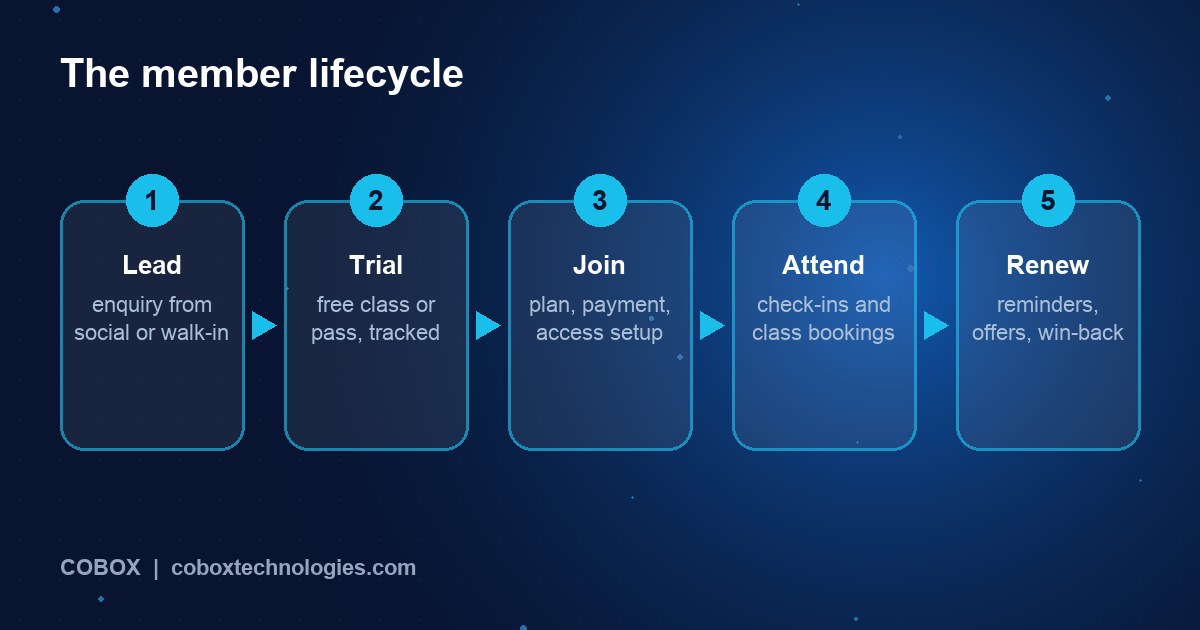
With a membership platform, each door check-in is recorded. When a member's visit gap crosses 14 days, the system sends a friendly WhatsApp message from the trainer and creates a task. If the gap crosses 21 days and the renewal is within 10 days, the owner sees the member on a risk list and can offer a free session. Payment failures trigger automatic retries and reminders. The business is not working harder; it is seeing sooner.
Software the business actually needs
Keep the first release focused. Our guide on what to include in an MVP applies directly.
| Area | MVP | Later |
|---|---|---|
| Memberships | Plans, freeze, upgrade, auto-renew, payment reminders | Family plans, corporate plans, referral rewards |
| Scheduling | Class timetable, capacity, booking and cancellation rules | Waitlist automation, trainer rosters, resource booking |
| Access | QR or app check-in, front-desk screen | Turnstile and biometric integration |
| Payments | Online payment, auto-debit where supported, invoices | Instalments, gift vouchers, refunds workflow |
| Engagement | Visit tracking, inactivity alerts, reminders | Challenges, leaderboards, wearable sync |
| Owner insight | Active members, churn, revenue by plan | Cohort retention, trainer performance, forecasting |
Choosing between a mobile app and a web app is a real decision here. Members use a gym app several times a week, which favours a native app eventually, but a web-based front desk and booking page is enough to begin. Read mobile app vs web app: which to build first before committing.
Architecture in plain language
- Member app or web page: plans, bookings, QR code, payments, progress.
- Front desk and trainer console: check-in, sales, member notes.
- Backend: memberships, billing engine, scheduling, notifications.
- Integrations: payment gateway, WhatsApp or SMS, access hardware, accounting export. See API integrations.
- Reporting: a simple owner dashboard, discussed in analytics dashboards.
Billing logic deserves special care: pro-rated upgrades, freezes, failed payments and refunds create edge cases that turn into disputes if handled loosely.
Costs and timeline (illustrative)
| Build | Scope | Indicative cost | Indicative time |
|---|---|---|---|
| Single-gym MVP | Memberships, check-in, billing, reminders, owner reports | ₹7-16 lakh | 10-14 weeks |
| Studio with app | Class booking, member app, waitlist, packs | ₹12-25 lakh | 4-5 months |
| Gym SaaS v1 | Multi-location accounts, onboarding, billing, support tools | ₹20-40 lakh | 5-7 months |
Obtain quotes against a written scope. Annual maintenance of roughly 15-20 percent of build cost is a sensible starting assumption; see software maintenance costs. Buying a ready-made gym tool costs a monthly fee instead; compare honestly using custom software vs ready-made tools.
Worked economics: churn and lifetime value
Assume PulseFit (hypothetical) charges ₹1,500 per month, and monthly churn is 8 percent.
- Average membership lifetime = 1 / churn = 1 / 0.08 = 12.5 months
- Revenue per member over that lifetime = 12.5 x ₹1,500 = ₹18,750
- Variable cost per member (payment fees, towels, trainer time allocation) of about ₹300 a month gives a monthly contribution of ₹1,200
- Lifetime contribution = 12.5 x ₹1,200 = ₹15,000
If acquiring a member costs ₹2,500 in ads, offers and sales time, the lifetime contribution is six times acquisition cost, a healthy picture on paper. Now improve churn to 6 percent through inactivity alerts:
- Lifetime = 1 / 0.06 = 16.7 months
- Lifetime contribution = 16.7 x ₹1,200 = about ₹20,000
For 400 members that is an extra ₹5,000 of lifetime contribution each, about ₹20 lakh across the base over time, from a two-point change in churn. This is the strongest argument for retention software, though the improvement must be measured, not assumed. Keep revenue, gross profit and contribution distinct when you report numbers, and do not count free trial sign-ups as members.
Also check the fixed side: rent, equipment, salaries and software. A gym needs enough members to cover fixed costs before any contribution becomes profit. Use our validation guide to test demand before signing a lease.
Retention and growth levers
- Onboarding in the first 14 days: a goal conversation, a plan and a first-week schedule. Early habits predict retention.
- Inactivity alerts to trainers, with templates, so outreach is personal and quick.
- Challenges and community that create social accountability.
- Corporate and referral plans for cheaper acquisition.
- Clear, fair freeze and cancellation rules that reduce angry exits and negative reviews.
Track visit frequency, trial-to-paid conversion, churn by plan, and revenue per square foot. See dashboard numbers owners should check weekly, and attribute ad spend with lead tracking from click to revenue.
Seven-phase launch plan
- Demand check: pre-sell founding memberships or run a 30-day pop-up.
- Define the model: choose plans, capacity and pricing; write the MVP list.
- Design: check-in, booking and renewal journeys.
- Build: memberships and billing first, then booking and alerts.
- Pilot: run with 30-50 founding members and fix friction.
- Launch: open to the neighbourhood with referral incentives.
- Improve: add app features, challenges and analytics from the data.
Risks and compliance
- Health and safety: injuries, waivers and trainer qualifications matter. Take legal advice on liability waivers and insurance.
- Personal data: weight, photos and health notes are sensitive. India's Digital Personal Data Protection Act, 2023 applies to personal data handling; get advice on consent and retention. See our security page.
- Recurring payments: auto-debit and card-on-file rules from the RBI and your gateway apply; confirm what your payment provider supports.
- Consumer complaints: unclear cancellation and refund terms are the main source of disputes. Publish them plainly.
- Hardware dependence: turnstiles and biometric devices fail; keep a manual fallback.
- GST and invoicing: confirm rates and invoice format with an accountant.
These are pointers for your advisers, not legal advice.
How COBOX can help
COBOX helps you decide what to build and what to buy, then delivers it. We validate pricing and churn assumptions with you, create a Blueprint, build the membership, booking and billing platform, connect payments, messaging and access systems, and set up reporting so you can see churn early. Relevant services: MVP development, mobile app development and business process automation.
Frequently asked questions
Should I build a custom gym app or buy a ready-made tool?
For one gym, a ready-made tool is usually cheaper and faster. Build when you are making a product for many gyms, need a unique model, or want to own the member experience and data.
How much does gym management software cost to build?
A focused single-gym MVP commonly sits around ₹7-16 lakh in India, with studios and SaaS products costing more. Integrations and app polish are the main drivers.
What is a healthy churn rate for a gym?
It varies by market and plan. Measure your own and compare month on month; the direction and the reasons for leaving matter more than a generic benchmark.
Can I run an online fitness business without an app?
Yes. A website, a live-class tool and subscription billing are enough to test demand. Build an app when daily use justifies it.
Do I need hardware for check-in?
No. QR check-in on a tablet works for most gyms. Add turnstiles or biometrics only when access control is a real problem.
How do I handle membership freezes fairly?
Set limits (for example, a maximum number of days per year), require notice and encode the rules in the system so staff do not improvise.
How do I keep members' health data safe?
Collect only what you need, ask for consent, restrict access by role, and delete data when it is no longer required.
What should I measure first?
Active members, visit frequency, trial conversion and monthly churn. Add the rest once those are reliable.
Turn your fitness idea into a plan
Planning a gym, studio or fitness product? Start with a Business Blueprint covering members, revenue model, MVP features, technology and launch roadmap. Paste something like this into the Blueprint tool:
I want to start a [gym / yoga studio / online fitness platform / gym software product] in [city] for [member type]. I expect [number] members at ₹[price] per month. I need an MVP plan, the tools I should buy versus build, and a validation plan.
Or talk to us first, and read more about the Business Blueprint.