 COBOX
COBOX
How to Start an E-commerce Business: Business Models, Features, Costs and Growth
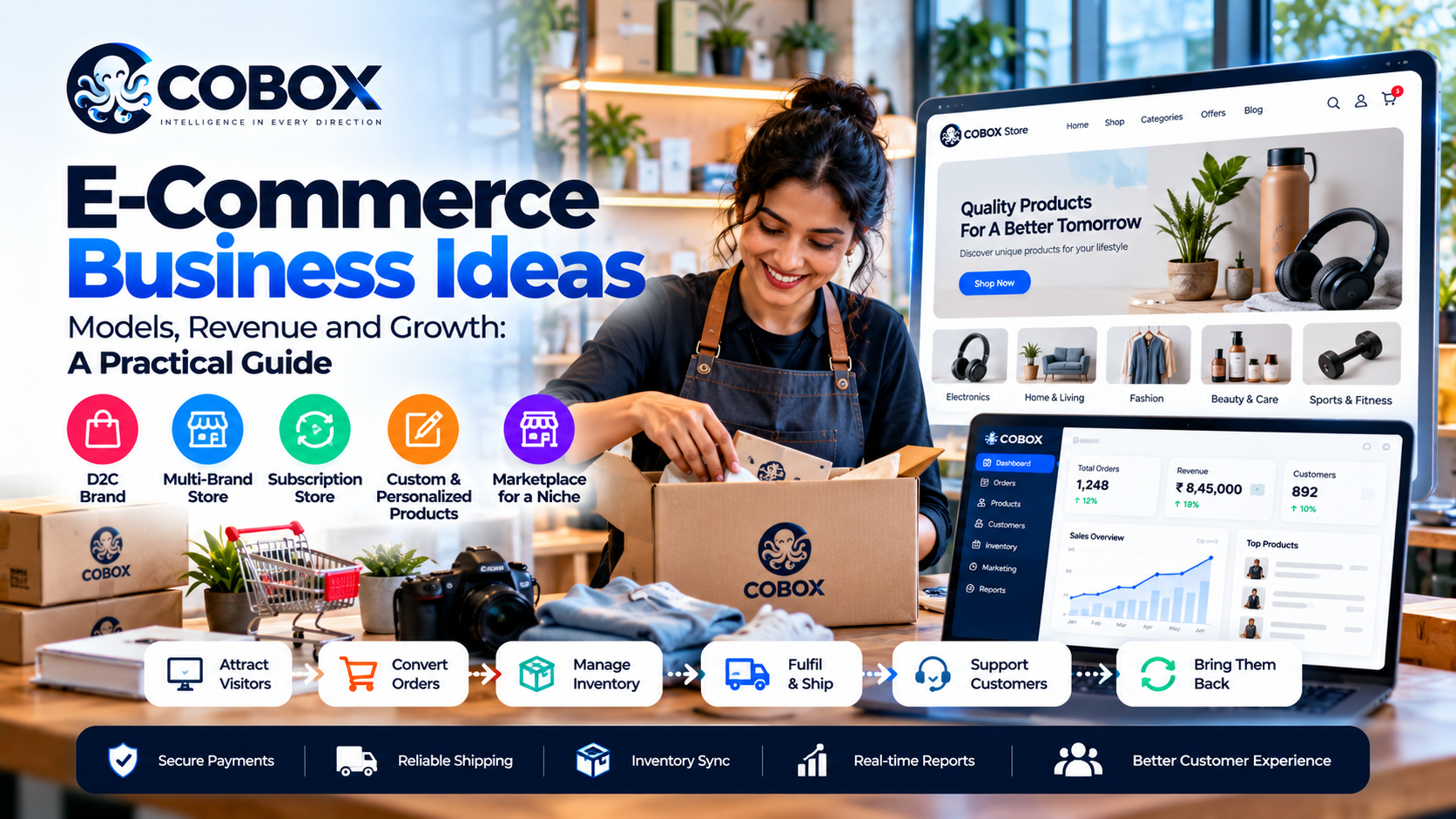
Most people who say "I want to start an e-commerce business" have already made the decision that matters least: they have decided to sell online. The decisions that determine whether the business survives come later: what to sell, to whom, at what margin, and how orders get from a shelf to a doorstep without eating the profit. The website is the easy part.
This guide is written for someone starting a new online store, or an offline seller moving online, who wants to understand the whole business before spending on software. It covers five realistic business models, how they earn money, what the platform actually needs, a worked example with real arithmetic, what it costs to build, and what can go wrong. Every example is hypothetical and every number is illustrative. Your categories, suppliers and city will change them.
What an e-commerce business really is
An online store is a chain of five jobs: attract a visitor, convert them into a paying customer, fulfil the order, support them if something goes wrong, and bring them back. Software touches all five, but only two of them (attract and convert) happen on your website. Fulfilment, returns and repeat purchases are operations problems that your software has to support.
That is why new sellers who focus only on the storefront are often surprised. A beautiful site with a manual spreadsheet behind it works for ten orders a day and collapses at a hundred. The opposite also happens: founders over-build a custom platform before they know whether anyone wants the product.
Typical customers differ by model. A niche D2C brand sells to people who share a specific interest or problem. A multi-brand retailer sells convenience and choice. A subscription seller sells predictability. Pick the customer first; the platform follows.
Common problems new online sellers hit
- Thin margins after real costs. Product cost is only one line. Shipping, packaging, payment fees, returns and marketing all come out of the same sale.
- Paid traffic that never pays back. Customer acquisition cost rises quickly in crowded categories.
- Cash-on-delivery and returns. In many Indian markets a large share of orders are COD, and refused or returned parcels cost you shipping twice.
- Stock that does not match the website. Selling something you do not have creates refunds and bad reviews.
- Disconnected tools. Orders in one place, stock in another, accounting in a third.
Five e-commerce business ideas worth validating
1. A niche D2C brand with a hero product
Concept: a small range of products for a defined customer, for example specialty coffee, desk accessories for remote workers, or a regional food brand. Target customer: people who are underserved by marketplaces. Value: quality, story and a better experience than a marketplace listing. Revenue: direct product sales, with bundles to lift order value. Operations: sourcing or manufacturing, storage, packing, courier partners. Digital product: a branded store with a simple stock and order back office. Key risks: acquisition cost and dependence on one or two products. Validate by: pre-selling a first batch to a waiting list, or running a small paid test to a single landing page before building anything custom.
2. A curated multi-brand store for one category
Concept: a store that stocks several brands in a tightly focused category (for example sports nutrition, baby care or plant care) and adds expert guidance. Customer: shoppers overwhelmed by choice. Value: trusted curation, comparison and advice. Revenue: product margin plus supplier-funded promotions. Operations: supplier relationships, inventory and returns policy. Product: catalogue with strong filtering and comparison. Risks: stock depth, supplier pricing and price wars with large marketplaces. Validate by: selling a small curated set through WhatsApp or Instagram to see whether people buy on your recommendation.
3. A subscription or replenishment store
Concept: consumables people reorder, such as coffee, pet food, supplements or household staples. Value: convenience and a predictable delivery. Revenue: recurring orders, often with a small discount for subscribing. Operations: predictable forecasting, scheduled packing and failed-payment recovery. Product: subscription management, pause/skip controls and renewal reminders. Risks: churn, failed recurring payments and regulatory rules for the product category. Validate by: measuring how many first-time buyers reorder within 45 days before building a subscription engine.
4. A made-to-order or personalised products business
Concept: products customised by the buyer: printed items, gifts, jewellery or furniture. Value: a product that cannot be bought from a shelf. Revenue: higher margin per item. Operations: production workflow, approval of customer designs, lead times. Product: a product configurator, proof approval and a production queue. Risks: returns are harder to resell, and custom work scales poorly without process. Validate by: taking custom orders manually for a month to learn which options customers actually choose.
5. A local-first online store for an existing shop
Concept: an offline retailer adds online ordering for its city, with same-day delivery or store pickup. Value: trusted local availability. Revenue: existing margin on a wider customer base. Operations: keeping store and online stock in sync. Product: catalogue linked to in-store inventory and billing. Risks: stock mismatches and delivery cost. Validate by: accepting online orders through a simple form and fulfilling them by hand for several weeks.
How e-commerce businesses make money
| Model | How revenue works | Fits best |
|---|---|---|
| Direct product sales | You buy or make, then sell at a markup | Almost all models |
| Bundles and upsells | Raises average order value without raising acquisition cost | D2C, curated stores |
| Subscriptions | Recurring orders at a fixed cadence | Consumables |
| Customisation fees | Premium for personalised options | Made-to-order |
| Supplier or brand promotions | Brands pay for visibility in your curated store | Established multi-brand stores |
| Loyalty and memberships | Paid or earned programmes that increase repeat rate | Stores with frequent reorders |
Marketplace commissions and B2B credit terms belong to other models. Wholesale selling to businesses has its own pricing and credit rules, covered in B2B vs B2C e-commerce.
A hypothetical business, end to end
Imagine Meera, who roasts specialty coffee in a small facility in a tier-2 city and currently sells through Instagram messages and bank transfers. She wants an online business with a stable recurring customer base. This is a composite, not a real client.
- The problem: she loses orders in chat threads and cannot tell who has paid.
- Target customers: home brewers and small offices who want fresh beans delivered regularly.
- The opportunity: a subscription-friendly store with a sampler pack to lower the first-purchase barrier.
- Acquiring customers: Instagram content, a referral offer and a small paid test to a sampler landing page.
- A transaction: customer picks a pack, pays by UPI or card, and receives an order confirmation by email and WhatsApp.
- Delivery: the roaster batches orders daily, prints labels, hands parcels to a courier, and the customer gets tracking updates.
- Revenue: product sales, with a discount for choosing a repeat subscription.
- Software needed: storefront, checkout, order dashboard, stock tracking by batch and a reorder reminder.
- Validate first: whether sampler buyers come back for a full bag within roughly six weeks.
- Expansion: add gear, gift boxes and office subscriptions once repeat behaviour is proven.
What the software has to do
An e-commerce platform has two sides. The customer side is a public storefront; the business side is an admin back office. Features worth planning:
- Catalogue and search: product pages with variants, images, clear delivery information and filters that match how people shop in your category.
- Cart and checkout: guest checkout, address validation and a short path to payment. Every extra form field costs you orders.
- Payments: UPI, cards and wallets through an established payment gateway such as Razorpay, Cashfree or PayU in India; cash-on-delivery rules if you offer it, with limits on high-value or high-risk orders.
- Orders and fulfilment: order statuses, packing slips, courier integration and automatic tracking updates.
- Inventory: stock levels that update on every sale, low-stock alerts and, for perishable items, batch or expiry tracking.
- Customers and communication: order emails, WhatsApp or SMS notifications, abandoned-cart reminders.
- Returns and refunds: a simple return request flow and refund status.
- Roles and permissions: separate access for owner, packers and support so not everyone can change prices or refund orders.
- Reports: sales by product, repeat purchase rate, return rate and acquisition cost by channel.
- Integrations: accounting, GST invoicing, courier aggregators and analytics. These are where API integrations save hours of manual re-entry.
Not every business needs a custom build for these. See the next section.
MVP versus later phases
| Capability | MVP | Later phase |
|---|---|---|
| Storefront | Product pages, cart, checkout | Personalised recommendations, advanced search |
| Payments | One gateway, UPI and cards | Multiple gateways, EMI, wallets |
| Orders | Order list, status updates, labels | Warehouse workflows, multi-location stock |
| Customer messaging | Order confirmations, shipping updates | Segmented campaigns, automated win-back |
| Subscriptions | Manual reorder reminder | Full subscription engine with pause and skip |
| Mobile | Responsive web | Native app once repeat usage justifies it |
| Analytics | Sales, repeat rate, returns | Cohort analysis, attribution |
Start on the web. A mobile app only makes sense when customers are returning often enough to justify the cost; our note on mobile app vs web app explains the trade-off. For a fuller view of scope, read what to include in an MVP.
Build or buy: choosing the technology
This is the most expensive decision in the article, so it deserves honesty. Hosted store platforms (Shopify, WooCommerce and similar) are often the right first answer. They give you a working store in days and let you test demand cheaply. Custom development earns its cost when you need something they cannot do well:
- Unusual pricing or personalisation logic.
- Deep connection to your own production, inventory or ERP systems.
- A model that mixes retail with bookings, subscriptions or B2B account pricing.
- Strict control over data, speed or user experience at scale.
When custom is justified, a typical approach is a React/Next.js storefront for speed and SEO, a Laravel or Node.js back end for orders and inventory, and a relational database such as MySQL or PostgreSQL. Add Redis for queues and caching if traffic grows. A cloud host and object storage handle images. Choose boring, well-supported tools; shoppers do not care about your framework. Avoid microservices and AI features until real volume demands them. A sensible later addition is an AI assistant to help shoppers find products.
Cost and timeline (illustrative)
Assumptions: an India-based team, a single storefront in one language, standard payment gateway and courier integrations, no native mobile app. These figures are illustrative ranges for planning, not a COBOX quotation or a verified market price.
| Item | Illustrative range |
|---|---|
| Discovery and scope definition | 1 to 2 weeks |
| Hosted-platform store set-up | Days to a few weeks; low upfront cost, monthly fees apply |
| Custom MVP (storefront, admin, payments, courier) | Roughly ₹6 to 15 lakh (about US$7,000 to 18,000 at around ₹85 per US$), 10 to 14 weeks |
| Hosting, domain, email | Small monthly cost at launch; grows with traffic |
| Third-party services | Payment fees per transaction, SMS/WhatsApp messages, courier charges |
| Maintenance | Ongoing; budget a yearly percentage of the build (see what maintenance costs after launch) |
The biggest cost drivers are the number of integrations, custom pricing rules, a mobile app, and how much admin automation you want. A more detailed breakdown is in how much an MVP costs.
The business economics, with numbers
Continue the coffee example with a hypothetical month at maturity. All figures are invented to show the method.
| Line | Calculation | Amount (₹) |
|---|---|---|
| Orders | 1,000 orders; 600 from new customers, 400 repeat | - |
| Revenue | 1,000 × ₹900 average order value | 9,00,000 |
| Product cost | 40% of revenue | 3,60,000 |
| Gross profit | 9,00,000 − 3,60,000 (60% gross margin) | 5,40,000 |
| Shipping and packaging | 1,000 × ₹110 | 1,10,000 |
| Payment fees | About 2% of revenue | 18,000 |
| Refund and damage allowance | 3% of revenue | 27,000 |
| Contribution before marketing | 5,40,000 − 1,10,000 − 18,000 − 27,000 (₹385 per order) | 3,85,000 |
| Marketing | 600 new customers × ₹450 CAC | 2,70,000 |
| Contribution after marketing | 3,85,000 − 2,70,000 | 1,15,000 |
| Fixed costs | Platform and tools ₹25,000 + staff and packing ₹50,000 | 75,000 |
| Operating profit (before tax) | 1,15,000 − 75,000 | 40,000 |
Notice how different these figures are. Revenue is ₹9 lakh, gross profit is ₹5.4 lakh, contribution after marketing is ₹1.15 lakh, and operating profit is ₹40,000, before tax and before paying the founder a salary. Founders who only watch revenue overestimate their business by a factor of more than twenty.
Break-even: fixed costs plus marketing are 75,000 + 2,70,000 = ₹3,45,000. Dividing by the ₹385 contribution per order gives about 897 orders per month, so 1,000 orders is only marginally above break-even in this example.
Lifetime value: if a typical customer places 2.5 orders in their first year, their lifetime contribution before marketing is 2.5 × ₹385 ≈ ₹962. Against a ₹450 acquisition cost, that is an LTV:CAC ratio of about 2.1. A subscription that lifts repeat orders to four per year would raise it to roughly 3.4 (4 × 385 = 1,540; 1,540 ÷ 450). This is why repeat purchase rate is the number to protect. No business is guaranteed profit; these figures show what to measure, not what to expect.
A launch plan in seven phases
- Research and validation: interview 15 to 20 potential customers, price-check competitors, and pre-sell or run a landing page test. Success looks like real orders or deposits, not likes. See how to validate a business idea before spending money.
- Business Blueprint and requirements: define customers, margins, MVP scope, tools and roadmap. A Business Blueprint is designed for this stage.
- MVP design and build: start with a hosted platform or a minimal custom storefront as the economics justify.
- Pilot launch: sell to a small circle, fulfil by hand where needed, and record every problem. Target: all pilot orders delivered and every complaint understood.
- Customer acquisition: test two or three channels with small budgets. Track CAC per channel, not overall.
- Operational improvement: automate the steps that repeat daily (labels, status messages, stock updates). A guide on which process to automate first helps with ordering.
- Expansion: add products, subscriptions or new regions only when repeat rate and margins support it. The first-quarter measurements in what to measure in the first 90 days apply directly.
Risks and compliance
- Competition and price pressure: large marketplaces can undercut you. Differentiate on curation, quality or service.
- Acquisition cost: if CAC exceeds first-order contribution and customers do not return, the business loses money on growth.
- Fulfilment and returns: poor packaging, late delivery and refused COD parcels quietly erase margin.
- Payments and fraud: use a reputable gateway, never store card details yourself, and set rules for high-risk COD orders.
- Data privacy and security: you will hold names, addresses and phone numbers. Use HTTPS, restrict admin access and follow our security checklist. India's Digital Personal Data Protection Act, 2023 may apply to how you collect and handle personal data.
- Consumer and tax rules: e-commerce entities in India may be subject to the Consumer Protection (E-Commerce) Rules, 2020, GST registration and invoicing requirements, and category-specific licences (food products, for example, generally require FSSAI registration or licensing).
The rules above are named so you know what to ask about; they are not legal advice, thresholds change, and their application depends on your category and turnover. Confirm the details with a qualified accountant or lawyer before launch.
How COBOX can help
COBOX works from the business backwards. For an e-commerce idea that usually means three things. First, a discovery step to test whether your model, margins and customer are realistic, using the product discovery process. Second, a Business Blueprint that turns the answers into scope, a phased roadmap and a technology recommendation, including an honest call on whether a hosted platform is enough. Third, if custom software is justified, building the storefront, back office and integrations with the MVP development approach, followed by improvement once real orders reveal what to change. If you already sell online and your tools are disconnected, the retail page describes the systems we help connect.
Frequently asked questions
Should I build a custom store or use a hosted platform?
Start hosted unless you have a clear need that it cannot meet, such as complex pricing, deep operations integration or an unusual business model. You can move to custom later when volume and requirements justify it.
How much money do I need to start?
It depends on inventory. The software can be a small part of the budget. Inventory, packaging, marketing tests and working capital for returns often exceed it. Build a month-by-month cash plan before committing.
Do I need a mobile app?
Usually not at the start. A fast, responsive website serves most first customers. Consider an app once people are reordering frequently.
How do I know if there is demand?
Pre-sell: collect a waiting list, take deposits, or sell a first batch manually. Paying customers are stronger evidence than survey answers.
Which payment methods are needed in India?
UPI and cards are the baseline, and many customers also expect cash on delivery in some categories. Offer COD cautiously, since refused parcels cost you outbound and return shipping.
What operating costs should I expect?
Product cost, shipping and packaging, payment fees, marketing, platform and hosting fees, staff or packing labour, and a returns allowance. Model all of them, as in the worked example above.
How long until the business is profitable?
No honest answer applies to everyone. The pace depends on margin, acquisition cost and repeat purchase. Track contribution per order and repeat rate from the first week.
Can an existing offline shop sell online without a big rebuild?
Yes. Many shops begin with a catalogue, order form and manual fulfilment, then connect stock and billing once volume grows.
Turn your store idea into a plan
Planning to launch an online store? Start with a Business Blueprint covering your customers, margins, MVP features, technology and launch roadmap. Paste something like this into the Blueprint tool:
I want to start a D2C e-commerce business selling [product] to [customer] in [city or country]. Average order value around ₹[amount], with cash on delivery and UPI. I want a roadmap for an MVP, the margins I should target and whether to use a hosted platform or custom software.
If you would rather talk it through first, get in touch. We will tell you plainly if you do not need custom software yet.