 COBOX
COBOX
How to Build an Event and Wedding Planning Platform: Vendors, Bookings and Payments

An event is a one-time promise with a hard deadline. A wedding cannot be rescheduled because the caterer's confirmation was lost in a chat thread. That pressure is exactly why event planning is a strong software category: the work is full of coordination between many independent parties, lots of money moves in stages, and mistakes are expensive and public.
This guide is for founders who want to build an event or wedding planning platform, and for planners, venues and agencies who want to run their business on proper software instead of WhatsApp groups and spreadsheets. We cover business models, how each earns, the features that matter, payment-milestone design, worked economics, risks and a launch plan. Scenarios are hypothetical and numbers illustrative.
Why this category is hard, and why that creates opportunity
An event is assembled from many vendors: venue, decorator, caterer, photographer, makeup artist, music, transport. Each is usually a small business with its own calendar and pricing. The customer has a budget, a date and strong emotions. Three recurring problems create room for software:
- Discovery is unreliable. Customers find vendors through word of mouth, and quality is hard to judge.
- Quotes are opaque. The same request returns inconsistent formats, so comparison is painful.
- Coordination collapses near the date. Changes, timings and payments scatter across chats.
Business models you can build
1. A vendor marketplace
Customers describe an event and browse or request quotes from vendors. You earn through commission, lead fees or featured listings. It needs supply in each city and category, and trust through verified portfolios and reviews. Read how marketplaces get started in building a two-sided marketplace.
2. A planner's operating system
You build software for wedding planners and agencies: client briefs, budgets, vendor directories, task timelines, contracts and payment tracking. Revenue is a subscription. Planners are fewer than customers but more reliable and sticky.
3. A managed planning service with a software spine
You act as the planner but run operations on custom software that makes you faster than competitors. Revenue is a planning fee plus margin on vendor services. It scales slowly but earns more per event.
4. Corporate events and conferences
Companies run offsites, launches and conferences repeatedly. A platform for registration, ticketing, agenda, attendee communication and vendor coordination can sell to corporate buyers on yearly contracts, with fewer emotions and more procurement process.
5. Digital invitations and guest management
A lighter product: invitation pages, RSVPs, guest lists, seating and reminders. Low price, high volume, an easy way to enter the wedding ecosystem and to collect leads for vendor services.
| Model | Revenue | Sales cycle | Biggest challenge |
|---|---|---|---|
| Vendor marketplace | Commission, lead fees | Short for customers, long for vendors | Supply quality and leakage |
| Planner OS | Subscription | Medium | Habit change among planners |
| Managed service | Fee plus margin | Medium | Scaling people |
| Corporate events | Contracts, per-event fees | Long | Procurement and customisation |
| Invitations and RSVPs | Per-event or freemium | Very short | Low pricing, many competitors |
A hypothetical scenario: a 300-guest wedding
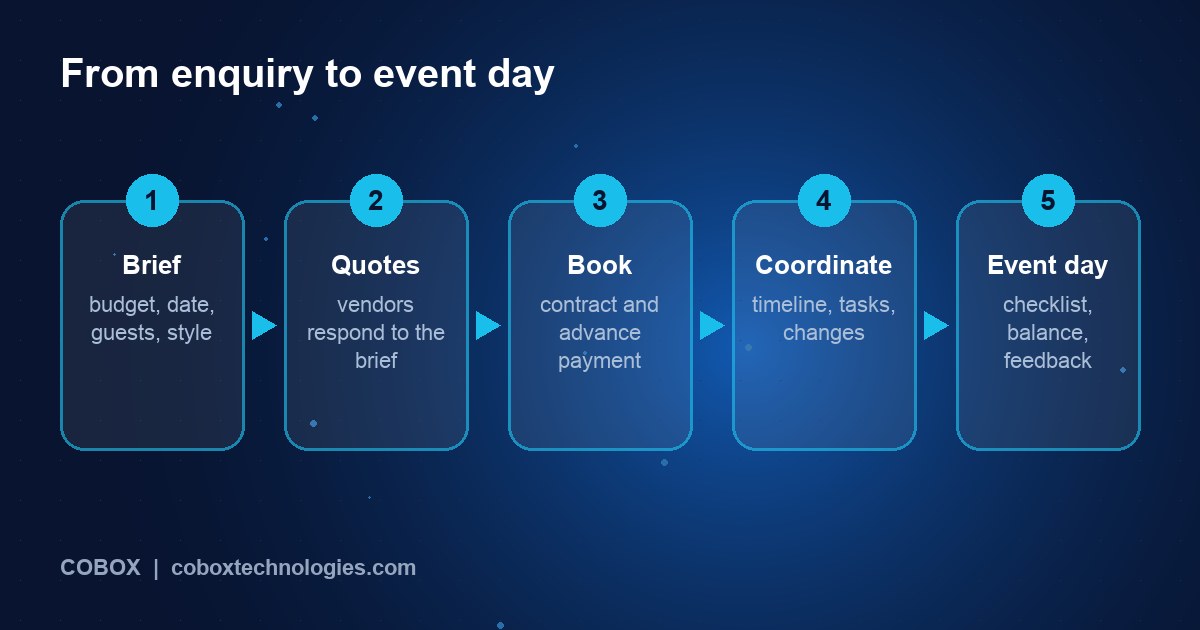
Consider a fictional couple, Riya and Kabir, planning a 300-guest wedding in four months with a budget of ₹25 lakh. On a typical marketplace platform they post a brief: city, date, guest count, budget range, style, and the services they need. Six photographers and four decorators respond with itemised quotes in a standard format. They shortlist, chat in-app, and book with a 20 percent advance held on the platform. The platform creates a shared timeline: decorator access at 6 am, catering setup at noon, photographer arrival at 3 pm. Two weeks before the date the guest count changes from 300 to 340; the system alerts the caterer and updates the balance due. On the day, a checklist confirms arrivals, and the final payment is released after the event on the couple's confirmation.
Notice what the software did not do: it did not make the wedding. It removed ambiguity in quotes, timing and money, which is where weddings fail.
Features: marketplace and planning essentials
Pick one model first and build only the features that model needs. Use our MVP feature guide as a filter.
| Area | MVP | Later |
|---|---|---|
| Brief and discovery | Structured event brief, vendor profiles, portfolio, filters by city and budget | AI-assisted matching, moodboards, vendor recommendations |
| Quotes | Standard quote template, comparison view, expiry dates | Package builder, negotiation history |
| Booking | Calendar availability, advance payment, simple contract | E-signature, cancellation rules per vendor |
| Payments | Milestone schedule, escrow-style hold, receipts | Split payouts, instalments, refunds workflow |
| Coordination | Shared timeline, task list, change log, notifications | Vendor check-in app, live day-of dashboard |
| Trust | Verified badges, reviews after events | Dispute handling, insurance partners |
| Guests | Invitation page, RSVP list | Seating, travel coordination, gifts |
Design the payment milestones carefully
Events involve deposits months before service, so payment design is where trust is won or lost. A common pattern is a booking advance, a mid-point instalment and a balance due before or after the event. Decide upfront: who holds the money, when it is released to the vendor, what happens on cancellation, and how disputes are resolved. Whether money can be held in a platform account is a regulated question in India; confirm how your payment provider and legal advisers recommend structuring it. Our guide on building a financial services platform explains why this deserves care.
Prevent leakage
Marketplaces lose revenue when customers and vendors take the deal off-platform after the first contact. Defences include delivering real value in the booking (payment protection, timeline tools, reviews), hiding direct contact details until booking, and charging commission on the advance only rather than the final bill so vendors feel fairly treated.
Architecture in plain language
- Customer web app and mobile web: briefs, shortlists, chat, bookings. Customers often discover on mobile and plan on a laptop with family.
- Vendor dashboard: calendar, quote builder, orders, payouts.
- Admin console: vendor verification, disputes, content, finance.
- Backend: search, availability, quotes, bookings, payments, notifications.
- Integrations: payment gateway with payout support, WhatsApp, maps, e-signature, calendar. See API integrations.
Search and filters need care once vendor counts grow, and vendor-supplied images must be compressed to keep pages fast. For a deeper look at this class of product see our marketplaces page and the use case on building an online marketplace.
Costs and timeline (illustrative)
| Build | Scope | Indicative cost | Indicative time |
|---|---|---|---|
| Invitation and RSVP product | Templates, guest list, RSVP, reminders | ₹3-8 lakh | 6-10 weeks |
| Planner operating system | Briefs, vendors, tasks, budgets, payments tracking | ₹10-25 lakh | 3-5 months |
| Vendor marketplace v1 | Listings, quotes, bookings, milestone payments, two dashboards, admin | ₹25-50 lakh | 5-8 months |
Marketplace costs are not only software: you must also pay for supply acquisition, vendor onboarding and customer support. Budget for them separately. For ongoing costs, see software maintenance costs.
Worked economics: commission on a wedding
Using the hypothetical 300-guest wedding with ₹25 lakh budget, suppose ₹15 lakh of it is booked through your platform.
- Gross booking value (GBV): ₹15,00,000
- Commission at 8 percent: ₹1,20,000 (this is revenue, not profit)
- Payment gateway cost at about 2 percent of GBV: ₹30,000
- Support and operations time for the event: about ₹15,000
- Contribution before marketing: about ₹75,000
Now the customer-acquisition side. Weddings are bought once, so there is no repeat purchase from the same customer, only referrals. If you spend ₹30,000 in marketing and sales to win each such customer, you earn a contribution of about ₹45,000 per customer after acquisition. To reach a net monthly profit of ₹5 lakh with ₹3 lakh of monthly fixed costs (team, tools, rent), you need about ₹8 lakh of contribution per month, around 18 weddings a month at ₹45,000, assuming volumes are steady. Weddings are seasonal, so monthly averages hide strong peaks and quiet periods; model cash flow by month, not by average.
If commissions are 8 percent, a reasonable question is whether vendors will accept them. Ask vendors early what they currently pay for leads. If they already pay 10 percent or more to agents, 8 percent plus protected payments may be attractive; if they pay nothing, you must prove the value of the leads. Our validation guide explains how to test this before building.
Growth levers
- Local supply first: start in one city and 3-4 categories (photography, decor, catering, makeup) and win quality over count.
- SEO content: city and category pages ("wedding photographers in [city] by budget") built from real vendor data.
- Partnerships: venues, banks and jewellers meet couples early.
- Reviews and referrals: couples recommend vendors to friends, so make reviews easy after the event.
- Corporate pipeline: repeat events smooth out seasonality.
Track enquiry-to-booking conversion, quote response time, vendor repeat rate, leakage estimate and disputes per 100 events. Learn how to attribute spend in tracking marketing leads to revenue and review numbers with the first 90 days measurement guide.
Seven-phase launch plan
- Interview: 15 vendors and 15 recent couples about discovery, quotes and payment pain.
- Concierge test: run 5 events manually with forms, spreadsheets and a WhatsApp group to learn the real workflow.
- Scope: choose the model and write the MVP list.
- Build: briefs, quotes and bookings first, then timelines and payments.
- Seed supply: onboard 40-60 verified vendors in one city.
- Launch: open to couples through content and partners.
- Improve: reduce leakage and disputes; add category depth.
Risks and compliance
- Money held for events: holding customer funds is regulated; get legal and payment-provider advice on the structure.
- Vendor reliability: a no-show on a wedding day is catastrophic. Verification, contracts and backup vendors help.
- Personal data: guest lists and family details are personal data under India's Digital Personal Data Protection Act, 2023. See our security page and security checklist.
- Reviews integrity: fake or incentivised reviews damage trust and attract regulatory attention. Only allow reviews from completed bookings.
- Seasonality: revenue concentrates in wedding seasons; plan cash flow.
- Cancellations and force majeure: write clear policies and have the system apply them consistently.
- Taxes: GST on commissions and vendor services depends on structure; confirm with an accountant.
These are pointers for your advisers, not legal advice.
How COBOX can help
COBOX helps you pick the right model and the smallest version worth launching. We run discovery, produce a Blueprint, design and build the vendor, customer and admin experiences, integrate payments, messaging and e-signature, and iterate from real bookings. See product discovery, MVP development and CRM and customer portals.
Frequently asked questions
Should I build a marketplace or software for planners?
A marketplace has the bigger upside and the harder start. Planner software has a clearer customer and steadier revenue. Pick based on whether you can win supply or planners first.
How much does an event marketplace cost to build?
A first version commonly lands between ₹25-50 lakh in India, depending on payments, search and dashboards. Marketing and vendor onboarding are additional.
How do I stop vendors and customers going off-platform?
Give them reasons to stay: payment protection, shared timelines, verified reviews, and fair commission structured around the advance.
Can I hold customers' money until the event?
It is possible only through compliant structures with a licensed payment provider. Take legal advice before designing it.
Do I need a mobile app?
Start with a responsive web app. Vendors may benefit from a lightweight app for day-of coordination later.
How do I handle seasonality?
Add corporate events, birthdays and festivals, and plan cash buffers for quiet months.
What is the minimum supply I need to launch?
Enough verified vendors in each category to give a customer a real choice. A few dozen in one city is a typical starting point.
How do I validate demand cheaply?
Run a manual concierge service for a handful of events. It teaches you the workflow and proves willingness to pay.
Turn your event platform idea into a plan
Planning an event or wedding platform? Start with a Business Blueprint covering customers, revenue model, MVP features, technology and launch roadmap. Paste something like this into the Blueprint tool:
I want to build a [wedding vendor marketplace / planner software / corporate events platform] for [city]. I expect [number] events a month with an average value of ₹[amount] and a [percent] commission. I need an MVP plan, payment structure options and a validation plan.
Or talk to us first, and read about the Business Blueprint.