 COBOX
COBOX
How to Launch an Online Education Business: LMS, Courses, Subscriptions and Revenue
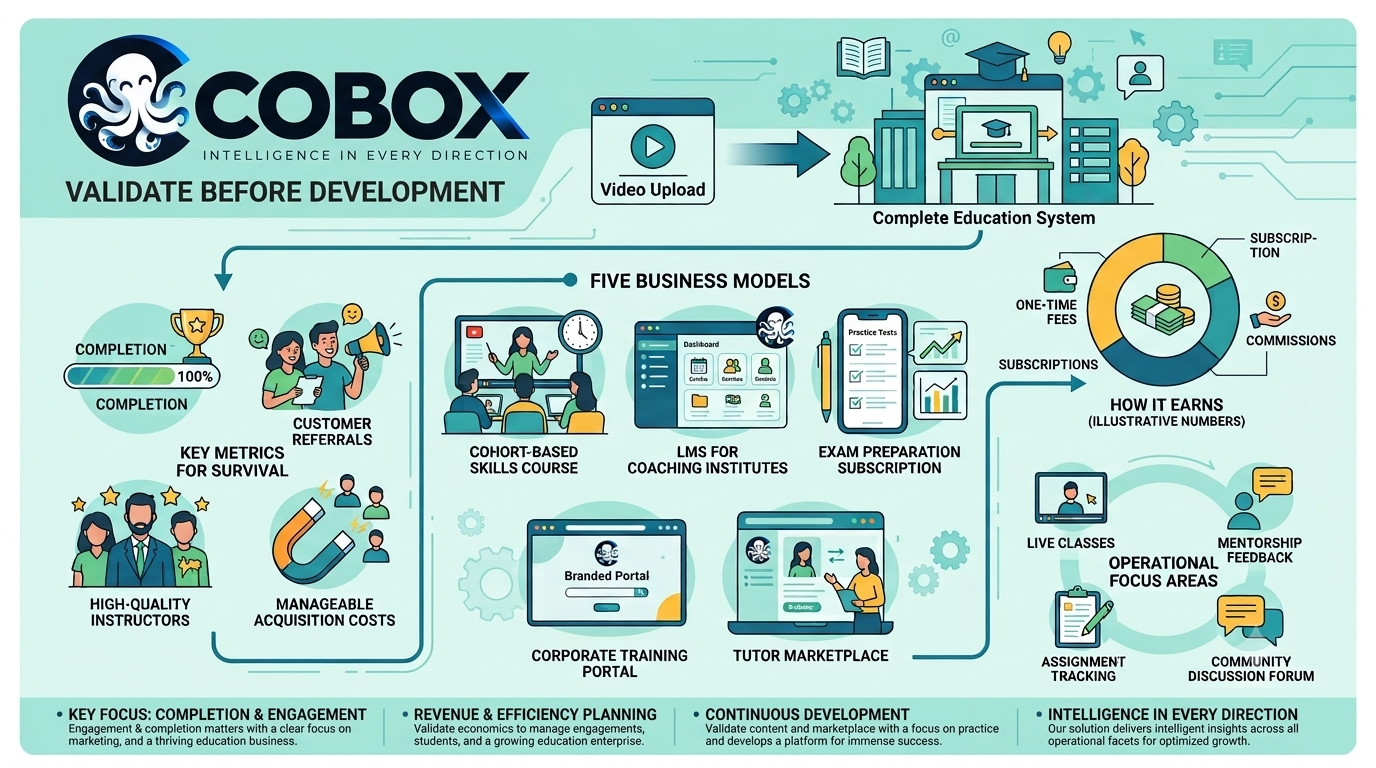
Online education has a deceptive entry price. Recording a video and uploading it takes an afternoon. Building a business where thousands of people finish what they paid for, recommend it, and come back for the next course takes much longer, and almost none of that work is in the video player. Completion, trust, instructor quality and acquisition cost decide who survives.
This guide is for educators, coaches, training companies and entrepreneurs who want to launch an online education business or move a classroom business online. It covers five business models, how each earns, the platform features that matter, the economics of a cohort course with worked arithmetic, and the risks, including the special care required when learners are minors. All scenarios are hypothetical and all figures illustrative.
How online education businesses work
Most education businesses sell one of three things: content (recorded courses), access (live classes, mentoring, communities) or outcomes (certifications, job readiness, exam results). The more a business sells outcomes, the higher the price it can charge and the more it must prove. Customers are either individual learners paying personally, or organisations (schools, coaching institutes, companies) paying for many learners.
Recurring problems:
- Low completion. Self-paced courses are often abandoned, which hurts reviews and referrals.
- High acquisition cost for generic topics; learners compare many providers.
- Instructor dependence. The business is only as scalable as its teachers.
- Refund and credibility claims. Promises about jobs or marks attract scrutiny.
- Admin load for institutes: attendance, fees, batches, results, parent communication.
Five online education business ideas
1. A cohort-based skills course
Concept: live, time-bound courses with a fixed start date, assignments and a community, in a narrow skill such as financial modelling, UX writing or Tally and GST accounting. Customer: working adults upgrading skills. Value: accountability and feedback, which raise completion. Revenue: one-time fee per cohort seat. Operations: instructors, mentors, scheduling. Product: enrolment, payments, class links, assignments and certificates. Risks: acquisition cost and instructor capacity. Validate by: pre-selling one cohort of 20 seats before producing full material.
2. Learning management software for coaching institutes
Concept: a system for small coaching centres to run batches, fees, attendance, tests and parent updates. Customer: institute owners with 100 to 1,000 students. Value: less admin and a professional image. Revenue: monthly subscription based on student count. Product: batch management, fee tracking, test engine and a parent app or portal. Risks: price sensitivity and many competitors. Validate by: piloting with three institutes during one exam season.
3. An exam-preparation subscription
Concept: practice tests, analytics and explanations for one exam family. Customer: aspirants preparing over months. Revenue: monthly or annual subscription. Product: question bank, timed tests, performance analytics and revision plans. Risks: content quality, seasonal demand and copyright. Validate by: selling a weekly test series by link before building the app.
4. A corporate training portal
Concept: a branded learning portal for companies to train employees on compliance, onboarding or product knowledge. Customer: HR and L&D teams. Revenue: annual contracts per employee or per programme. Product: courses, assignments to teams, completion tracking and reports. Risks: long sales cycles. Validate by: delivering one paid programme manually to a single company.
5. A tutor marketplace for one subject or region
Concept: connect learners with vetted tutors. Customer: parents and students, plus independent tutors. Revenue: commission per session. Product: tutor profiles, scheduling, payments and reviews. Risks: learners and tutors moving off-platform after the first session. See how to build a two-sided marketplace. Validate by: matching 30 students with tutors by hand.
How online education makes money
| Model | How it earns | Fits |
|---|---|---|
| Course or cohort fee | One-time payment per learner | Skills courses |
| Subscription | Monthly or annual access to content and tests | Exam prep, libraries |
| SaaS licensing | Institutes pay per student or per branch | LMS products |
| Enterprise contracts | Companies pay per seat or programme | Corporate training |
| Commission | Percentage of each tutoring session | Marketplaces |
| Certification fees | Paid assessment and credential | Professional programmes |
A hypothetical business, end to end
Imagine Kavya, an accountant who wants to run a cohort course on practical GST filing for small business bookkeepers. This is a composite, not a real client.
- Problem: bookkeepers learn GST on the job and make costly filing errors.
- Customers: bookkeepers, accounts assistants and small-firm staff.
- Opportunity: a six-week practical course using real filing scenarios.
- Acquiring learners: LinkedIn posts, a free webinar, referrals from past learners.
- A transaction: a learner registers for a cohort, pays online and receives joining details.
- Delivery: two live sessions a week, assignments reviewed by mentors, a community group and a final assessment.
- Revenue: the cohort fee; later an advanced course and a corporate version.
- Software needed: landing pages, enrolment and payments, class access, assignments, certificates and a mentor dashboard.
- Validate first: whether 20 learners will pay before the course exists, and whether most finish.
- Expand: new cohorts, recorded libraries and company programmes.
What the platform needs
- Public website: clear syllabus, instructor credibility, outcomes you can honestly support and a refund policy.
- Enrolment and payments: UPI, cards and instalments for higher-priced programmes, GST invoices and coupon handling.
- Content delivery: hosted video, documents and quizzes. Use an established video host rather than building your own streaming.
- Live classes: integration with a meeting tool, with attendance captured automatically.
- Assignments and assessment: submission, mentor feedback, grading and certificates.
- Learner progress and engagement: reminders to those falling behind. This is the feature that most affects completion.
- Institute administration (for LMS products): batches, timetables, fees, attendance and parent communication.
- Roles: learner, mentor, instructor, admin and, for institutes, parent.
- Analytics: enrolment funnel, completion rate, satisfaction and revenue per cohort.
- Integrations: payments, email and WhatsApp, meeting tools and accounting. Our marketing automation work covers the follow-up flows.
MVP versus later phases
| Capability | MVP | Later phase |
|---|---|---|
| Course delivery | Live classes via a meeting tool, recordings in a private library | Full LMS with learning paths |
| Enrolment | Landing page, payment, confirmation | Instalments, coupons, referral programme |
| Assessment | Assignments and a final test | Question banks, proctoring, adaptive tests |
| Engagement | Manual reminders and a community group | Automated nudges, gamification |
| Certificates | PDF with a verification link | Public credential pages |
| Mobile | Responsive web | Native learner app |
Do not build a video platform. Use existing tools and spend your effort on the learner experience. The MVP feature guide explains how to draw the line.
Technology approach
A Next.js front end for fast, search-friendly course pages, a Laravel or Node.js back end for enrolment, progress and payments, and MySQL or PostgreSQL work well. Host videos with a dedicated service and stream through signed links so paid content is not freely shareable. Use queues (Redis) for reminders and certificate generation. For an LMS product serving many institutes, design multi-tenant from the start; how to build a SaaS product covers this and the SaaS use case shows the delivery approach. AI features such as tutoring assistants are a later experiment, not a launch requirement.
Cost and timeline (illustrative)
Assumptions: India-based team, web platform, third-party video and meeting tools, no native app. Planning ranges only, not a COBOX quotation.
| Item | Illustrative range |
|---|---|
| Discovery and Blueprint | 1 to 2 weeks |
| Cohort course platform MVP | Roughly ₹5 to 12 lakh (about US$6,000 to 14,000 at around ₹85 per US$), 8 to 12 weeks |
| LMS SaaS for institutes (MVP) | Roughly ₹12 to 28 lakh (about US$14,000 to 33,000), 4 to 5 months |
| Video hosting and tools | Usage-based monthly cost |
| Content creation | Often the largest cost and not software; budget separately |
| Maintenance | See maintenance costs after launch |
The economics, with numbers
A hypothetical cohort business running two cohorts a month with 60 learners each.
| Line | Calculation | Amount (₹ per month) |
|---|---|---|
| Revenue | 120 enrolments × ₹12,000 | 14,40,000 |
| Payment fees | 2% of revenue | 28,800 |
| Refunds | 5% of revenue | 72,000 |
| Mentors and instructors | 25% of revenue | 3,60,000 |
| Video, tools per learner | 120 × ₹150 | 18,000 |
| Contribution before marketing | 14,40,000 − 28,800 − 72,000 − 3,60,000 − 18,000 (₹8,010 per learner) | 9,61,200 |
| Marketing | 120 × ₹4,000 acquisition cost | 4,80,000 |
| Contribution after marketing | 9,61,200 − 4,80,000 | 4,81,200 |
| Fixed costs | Team ₹3,00,000 + tools ₹30,000 | 3,30,000 |
| Operating profit (before tax) | 4,81,200 − 3,30,000 | 1,51,200 |
Each learner contributes ₹8,010 − ₹4,000 = ₹4,010 after acquisition cost, so break-even is 3,30,000 ÷ 4,010 ≈ 83 enrolments a month. The sensitive numbers are refunds and acquisition cost: if refunds double to 10% (a further ₹72,000) and acquisition cost rises to ₹5,500 (a further ₹1,80,000), the same month turns into a loss of about ₹1 lakh (1,51,200 − 72,000 − 1,80,000 = −1,00,800). Course businesses can look healthy until a single cost moves. These are invented figures, not forecasts.
A launch plan in seven phases
- Research and validation: interview 15 target learners and pre-sell a cohort. See validating your idea.
- Blueprint and requirements: a Business Blueprint fixes audience, pricing, delivery model and MVP scope.
- Build: landing pages, enrolment, class access, assignments.
- Pilot cohort: run 15 to 25 learners. Success: completion above your target and learners willing to give testimonials you can verify.
- Acquisition: webinars, content and referrals; track cost per enrolment by channel (see tracking leads to revenue).
- Operations: automate reminders, certificates and mentor workflows.
- Expansion: advanced courses, recorded libraries, institute or company versions.
Risks and compliance
- Misleading claims: promising jobs, salaries or exam ranks you cannot guarantee invites refund demands and regulatory attention. Advertising rules for coaching and education claims exist in India; keep claims verifiable.
- Children's data: India's Digital Personal Data Protection Act, 2023 sets stricter rules for children's personal data, including parental consent. If learners are under 18, take legal advice before launch.
- Content ownership: make sure you have rights to everything you teach from, including videos, images and question banks.
- Payments and refunds: publish a clear refund policy and honour it.
- Security: protect learner accounts and paid content; apply our security checklist.
- Taxes: GST and invoicing for educational services depend on the type of service and the recipient; confirm with an accountant.
- Competition: generic topics are crowded. Specificity and outcomes are your defence.
These are pointers for your advisers, not legal advice.
How COBOX can help
COBOX helps you decide what to build, and what not to. We test the audience and pricing assumptions, produce a Blueprint with scope and roadmap, then design and build the enrolment, learning and administration platform with the integrations you need and keep improving it from learner data. If your plan is an LMS product for institutes, our SaaS work and MVP development process apply directly.
Frequently asked questions
Can I start with a website instead of a mobile app?
Yes. A responsive site with live classes through a meeting tool is enough for a first cohort. Build an app when daily engagement justifies it.
Should I buy an existing LMS or build one?
Use a ready-made one for a single course business. Build only if you are creating an LMS product or need workflows no tool supports.
How do I improve completion rates?
Use cohorts, deadlines, mentor feedback and reminders. Completion is mostly a design problem, not a content problem.
How do I validate demand?
Pre-sell a cohort. Payments are better evidence than registrations for a free webinar.
What does it cost to run?
Instructors and mentors, marketing, payment fees, video and tools, and refunds. Model all of them, as above.
Can I sell to schools or companies?
Yes, but sales cycles are long. Start with direct learners to prove the content, then add institutional sales.
Is it safe to teach children online?
It requires extra care with consent, privacy and moderation. Seek legal advice and design for safety from the start.
How do I stop people sharing paid content?
Use signed video links, per-user access and watermarking for sensitive content. You cannot eliminate sharing entirely, so rely on live components that cannot be copied.
Turn your education idea into a plan
Planning to launch an online education business? Start with a Business Blueprint covering your learners, revenue model, MVP features, technology and launch roadmap. Paste something like this into the Blueprint tool:
I want to launch an online [cohort course / exam-prep subscription / LMS for coaching institutes] teaching [subject] to [learner type]. I expect around [number] learners at ₹[price]. I need an MVP plan, the tools I should buy versus build, and a validation plan.
Or talk to us first.