 COBOX
COBOX
How to Build a Beauty and Wellness Booking Platform: Features, Revenue and Costs
A salon owner rarely loses money because the haircuts are bad. Money leaks through the gaps around the chair: a client who booked on WhatsApp and never turned up, a stylist whose Saturday is double-booked, a loyal customer who moved to a competitor because nobody followed up, and a diary that lives on one person's phone. Beauty and wellness is a business of small, perishable time slots, and software that fills and protects those slots has a direct, measurable effect on income.
This guide is for founders who want to build a booking platform for salons, spas, clinics-lite and wellness studios, and for owners of an existing beauty business who want to move beyond a paper diary. We cover three business models, how each earns, the scheduling features that matter, the economics with worked arithmetic, the risks, and a phased launch plan. All scenarios are hypothetical composites and all figures are illustrative, so replace them with your own numbers.
Why booking software is the heart of a beauty business
Unlike a product business, a salon sells time. An empty hour cannot be stored and sold tomorrow. That single fact explains most of what a good booking platform does: it fills slots, prevents double bookings, reduces no-shows, and nudges customers to come back before a competitor does.
Three things make this category different from generic appointment software:
- Services have variable duration and dependencies. A colouring service may need 30 minutes of application, 40 minutes of waiting and 20 minutes of finishing, during which the stylist can serve someone else. Booking logic must understand that.
- Staff matter as much as the venue. Customers often book a person, not a salon. Individual schedules, skills, leave and commission all need to be modelled.
- Retention beats acquisition. A client who rebooks every six weeks is worth far more than a new client found through discounts.
Three business models you can build
1. Software for salons (a SaaS product)
You sell a subscription to salon owners: appointment diary, billing, staff management, client records and reminders. Customers are the salons, and churn depends on how deeply the product becomes the daily system. This is the most predictable model but faces established competitors, so you need a clear niche such as bridal studios, barbershop chains, Ayurvedic spas or multi-branch franchises. If you take this route, read our guide on how to build a SaaS product first.
2. A consumer marketplace for beauty services
You list many independent salons and freelancers on one app and earn a commission on each booking. Demand is easy to understand and hard to build: you need supply (good professionals) and demand (customers) at the same time, in the same neighbourhood. Marketplaces reward focus, so begin in a single city zone. Our post on building a two-sided marketplace covers the chicken-and-egg problem in depth.
3. At-home beauty and wellness services
A professional travels to the customer for a facial, massage or bridal makeup. This adds logistics (travel time, serviceable areas, safety, reliability) and usually carries higher prices and higher cancellation risk. Trust and verification of professionals decide whether it works.
| Model | Who pays you | Typical revenue | Hardest problem |
|---|---|---|---|
| Salon SaaS | Salon owners | Monthly subscription, add-on messaging fees | Switching owners away from habits and incumbents |
| Consumer marketplace | Customers and/or salons | Commission per booking, featured listings | Building supply and demand together |
| At-home services | Customers | Margin on each service | Reliability, safety, travel logistics |
A hypothetical scenario: one stylist, one Saturday
Consider a fictional studio, Aarav Hair Studio, with four stylists. Today bookings arrive through calls, Instagram messages and walk-ins, recorded in a notebook. On a Saturday the owner finds two clients booked with the same colourist at 11:00 and one client who booked three weeks ago with no reminder and does not show up.
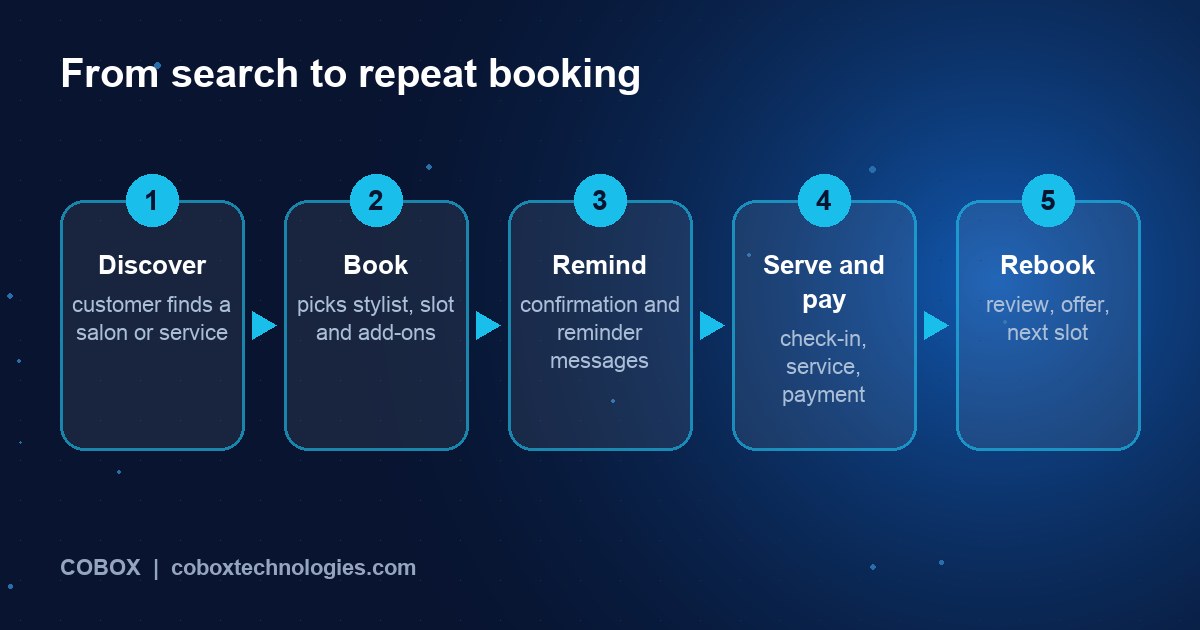
With a booking platform the same Saturday looks different. The customer opens a link from Instagram, chooses a colour service, sees the colourist's real availability (including the waiting time that frees her for a haircut in between), pays a small deposit, and receives a confirmation and two reminders. The system rejects the clash at the point of booking. If the client cancels within the free window, the slot reopens and a waitlisted customer is notified. After the service the client gets a thank-you message and, six weeks later, a rebooking reminder. Nothing about the stylist's craft changed, but the diary stopped leaking.
Features that matter, and what can wait
Resist the urge to build everything a large competitor offers. A focused first version wins more than a wide one. Use our guide on what to include in an MVP to keep scope honest.
| Area | MVP (first release) | Later phases |
|---|---|---|
| Booking | Service menu, staff selection, real-time availability, buffer times, deposits | Packages and memberships, waitlist, recurring bookings, group bookings |
| Staff | Individual schedules, leave, service skills | Commission rules, targets, payroll export |
| Clients | Profile, visit history, notes, consent for messages | Preference tags, birthdays, segmentation, loyalty points |
| Payments | Online deposit, in-store billing, receipts, GST-ready invoices | Split payments, gift cards, refunds workflow |
| Messaging | Confirmation and reminder via WhatsApp/SMS/email | Campaigns, review requests, win-back flows |
| Owner tools | Daily diary, simple revenue and no-show report | Multi-branch, inventory, advanced analytics |
The scheduling logic is the product
Most failed beauty apps look beautiful and schedule badly. Insist on these rules from the first version:
- Service blocks with gaps. A service is a sequence of active and passive segments, so the stylist can be booked during the passive part.
- Resource constraints. A chair, a wash basin, a steam room or a laser machine can be the real bottleneck rather than the person.
- Buffers. Cleaning and travel time between appointments.
- Concurrency safety. Two customers tapping the last slot at once must not both succeed. This needs correct locking at the database level, not just a friendly message.
- Time zones and holidays if you serve more than one region.
Recommended architecture, in plain language
For a first release you do not need a complicated system. A responsive web app or a progressive web app lets customers book from an Instagram link without installing anything, which is usually the biggest source of beauty bookings. A native app can come later once repeat usage justifies it; see mobile app vs web app: which to build first.
- Customer booking front end: fast, mobile-first, shareable link per salon or stylist.
- Owner and staff dashboard: diary view, client records, billing.
- Backend and database: availability engine, bookings, clients, payments, messaging jobs.
- Integrations: payment gateway, WhatsApp Business or SMS provider, calendar sync, accounting export. See our notes on API integrations.
- Hosting and backups: managed cloud, daily backups, monitoring.
If you already have a spreadsheet or WhatsApp-based operation, the transition path is covered in Excel and WhatsApp: when to upgrade.
Costs and timeline (illustrative)
Costs depend on scope, team and region, so treat these as planning ranges and get quotes against a written specification. Ranges below assume an Indian development context and a single-location MVP.
| Build | What you get | Indicative cost | Indicative time |
|---|---|---|---|
| Salon booking MVP | Booking, staff diary, deposits, reminders, basic reports | ₹6-15 lakh (about US$7,000-18,000) | 10-14 weeks |
| Salon SaaS v1 | Multi-salon accounts, billing, subscriptions, admin console | ₹15-35 lakh | 4-6 months |
| Marketplace v1 | Listings, search, reviews, payouts, two dashboards | ₹20-45 lakh | 5-8 months |
Ongoing costs are real: messaging fees, payment gateway fees, hosting, support and improvements. A safe planning figure is 15-20 percent of build cost per year; our post on software maintenance costs explains the breakdown. For a broader view, see MVP development cost.
Worked economics: no-shows and commission
What no-shows cost one studio
Assume Aarav Hair Studio (hypothetical) has 4 stylists, each handling 6 paid appointments a day, 26 days a month, at an average ticket of ₹900.
- Appointments per month: 4 x 6 x 26 = 624
- Monthly revenue if every slot is used: 624 x ₹900 = ₹5,61,600
- If 12 percent are no-shows or late cancellations: 624 x 0.12 = 75 lost appointments
- Lost revenue: 75 x ₹900 = ₹67,500 per month
Now suppose deposits, reminders and a waitlist cut the loss rate to 6 percent and refill half of the remaining gaps. Lost appointments fall to about 37 and refills recover roughly 19, leaving about 18 lost appointments, or around ₹16,000. The recovered revenue is roughly ₹51,000 a month. Even if the studio pays ₹4,000 a month for the software, the return is clear, provided the assumptions hold. Test them with your own data before you commit.
What a marketplace earns on the same bookings
Suppose your marketplace takes a 15 percent commission and a customer pays ₹900.
- Gross booking value: ₹900
- Your commission (revenue): ₹135
- Payment gateway cost at about 2 percent of ₹900: about ₹18
- Messaging and support allocation: about ₹10
- Contribution before marketing: about ₹107
If acquiring a customer costs ₹400 and an average customer books 4 times a year, the first-year contribution is about ₹428 against ₹400 spent, which barely breaks even. The business works only when repeat rate is high or acquisition is cheap, which is why retention features and local focus matter more than a large feature list. Note the difference between revenue (₹135), gross profit after direct costs and contribution after variable costs; mixing them up is a common founder mistake. A broader treatment is in our guide to validating a business idea before development.
Growth and retention levers
- Instagram and Google Business links that open straight into a booking page.
- Rebooking reminders timed to the service cycle (for example six weeks after a haircut).
- Packages and memberships that prepay several visits and lock in loyalty.
- Review requests sent only after a completed visit.
- Referral credit that rewards both sides, with abuse limits.
Measure the right numbers from day one: no-show rate, repeat rate within 60 days, utilisation of staff hours and revenue per available hour. Our first 90 days measurement guide and weekly dashboard numbers show how to set up the reporting. For acquisition tracking, see tracking leads from first click to revenue.
Seven-phase launch plan
- Research (week 1-2): interview 10-15 owners and shadow a busy day. Capture how they take bookings and where slots are lost.
- Define scope (week 2-3): pick one segment and one city zone; write the MVP list.
- Design (week 3-5): booking flow, owner diary, reminder messages.
- Build (week 5-12): availability engine first, then payments and messaging.
- Pilot (week 12-14): run with 3-5 friendly salons, fix issues daily.
- Launch: onboard salons in a cluster, measure no-shows and repeat rate.
- Iterate: add memberships, campaigns and analytics from what the data shows.
Risks and compliance
- Personal data: you hold names, phone numbers and visit history. India's Digital Personal Data Protection Act, 2023 sets obligations around consent and handling; get legal advice on your notices and retention. See our security approach and the security checklist.
- Messaging consent: WhatsApp and SMS marketing rules require opt-in; keep transactional and promotional messages separate.
- Health and safety: spas and clinics may need licences and hygiene standards that vary by state and service. Confirm locally; software does not replace them.
- Payments and refunds: define deposit and cancellation rules clearly to avoid disputes.
- Taxes: GST treatment of services and commissions depends on structure; confirm with an accountant.
- Dependence on a few stylists: if a top stylist leaves with the client list, you lose revenue. Decide upfront who owns client relationships.
These are pointers for your advisers, not legal advice.
How COBOX can help
COBOX starts by checking the assumptions above with you: which model, which segment, what the numbers must look like. We then produce a Blueprint with scope and roadmap, design and build the booking, staff and billing platform, integrate payments and messaging, and keep improving it from usage data. Relevant services include MVP development, business process automation and marketing automation. If you are weighing a ready-made tool against a custom build, read custom software vs ready-made tools.
Frequently asked questions
Should I build my own booking app or use an existing salon tool?
If you run one or two salons, an existing tool is usually enough. Build when you are creating a product for many salons, need workflows no tool supports, or want to own your customer data and brand.
How much does a salon booking app cost in India?
A focused MVP typically falls in the range of ₹6-15 lakh, with a SaaS or marketplace costing more. Scope, design depth and integrations move the price most.
How do I reduce no-shows?
Combine small deposits, WhatsApp reminders, easy rescheduling and a waitlist that refills cancelled slots. Measure the rate before and after.
Do customers need to install an app?
Not necessarily. A mobile web booking page reached from Instagram or Google often converts better than an app download.
Can the platform handle multiple branches?
Yes, but design for it early. Multi-branch affects staff, inventory, reporting and permissions, so plan it for a later phase rather than bolt it on.
How do commissions work for staff?
Rules can be a percentage per service, tiered by monthly revenue, or a mix with a fixed salary. Model them as configurable rules, since every salon has its own.
Is it safe to store client photos and notes?
Only with consent and access controls. Limit who can view sensitive notes and define a retention period.
How long until the platform pays for itself?
It depends on your no-show rate, utilisation and pricing. Use the worked example above with your own numbers rather than relying on a generic figure.
Turn your beauty business idea into a plan
Thinking of building a salon booking product or marketplace? Start with a Business Blueprint covering your customers, revenue model, MVP features, technology and launch roadmap. Paste something like this into the Blueprint tool:
I want to build a [salon SaaS / beauty marketplace / at-home wellness service] for [city or segment]. I expect [number] salons or [number] monthly bookings at about ₹[price]. I need an MVP plan, the integrations I will need and a validation plan.
Or talk to us first. To understand how the Blueprint works, read about the Business Blueprint.