 COBOX
COBOX
How to Build a Platform for Spiritual and Religious Services: Pujas, Consultations and Donations

Spirituality is one of the oldest service categories and one of the least digitised. People still find a priest through a relative, book a consultation by phone, and pay in cash at a temple counter. Yet the same people already pay for meditation apps, watch devotional streams for hours, and send money for rituals they cannot attend in person. Demand is large and emotional, and trust is the whole product.
This guide is for founders, temple trusts, practitioners and organisations who want to build a platform for religious or spiritual services such as pujas, astrology consultations, meditation and yoga programmes, pilgrimage assistance and donations. We cover business models, how each earns, the features that matter, the trust problem, worked economics, risks and a launch plan. Scenarios are hypothetical and figures illustrative. This guide is about building software and a business responsibly; it takes no position on any belief or practice.
Why this category rewards careful builders
Three features distinguish this sector from most others:
- Trust outweighs convenience. A customer paying for a ritual cannot easily verify it was performed. Proof, transparency and the practitioner's reputation are the product.
- Demand is occasion-driven. Festivals, birthdays, new homes and life events create sharp peaks. Planning capacity for a festival week matters more than average days.
- Customers can be vulnerable. People often seek guidance at stressful moments, so manipulative sales practices harm users and the brand. Build ethical guardrails into the product from the start.
Business models you can build
1. Online puja and ritual booking
Customers choose a ritual, a temple or priest and a date, and receive proof such as a video or photographs. Revenue comes from a margin or commission per booking. Fulfilment is the difficulty: you rely on priests and temples whose operations are informal.
2. Consultation marketplace
Astrologers, counsellors and teachers list their services and customers book calls or chats by the minute or session. Revenue is a commission. Reviews, verification and clear expectations are the main trust levers. Pricing per minute creates addictive behaviour that harms users, so many ethical platforms prefer fixed-price sessions with spending limits.
3. Meditation, yoga and wellness programmes
Subscriptions to guided content, live sessions and retreats. The product looks like an online education or fitness business; see our guides on launching an online education business and starting a fitness business with software.
4. Temple and trust management software
Temples and religious trusts manage donations, events, volunteers, inventories, accounts and darshan or seva bookings. Revenue is a software subscription or an implementation fee. Buyers are institutions with limited budgets and strong requirements on transparency and record keeping.
5. Pilgrimage and travel assistance
Packages for pilgrims including travel, stay, guides and rituals. It resembles travel platforms; compare with building an online travel booking business.
| Model | Revenue | Trust risk | Operational difficulty |
|---|---|---|---|
| Puja booking | Margin per ritual | High (proof of fulfilment) | High (priests, temples, festivals) |
| Consultations | Commission | High (quality, vulnerable users) | Medium |
| Wellness programmes | Subscription | Medium | Medium (content, retention) |
| Temple software | Subscription or project fee | Medium (financial transparency) | Medium (long sales cycle) |
| Pilgrimage | Package margin | Medium | High (logistics) |
A hypothetical scenario: a festival puja booked from abroad
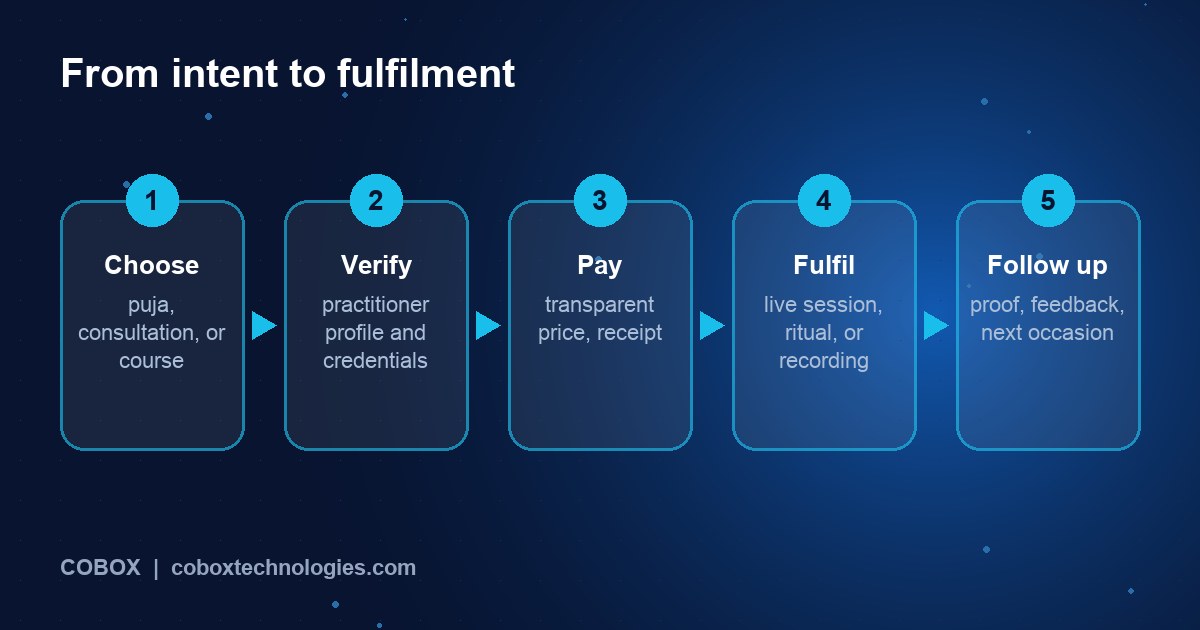
Consider a fictional platform, Seva Connect. A customer in another country wants a puja performed at a family temple in India on a festival morning. They select the ritual, name and gotra details, and an available priest at that temple. The price is itemised: the priest's offering, materials, temple contribution and platform fee. They pay by card or UPI.
The priest receives the request and the exact details on a simple app, confirms, and on the day streams or records the ritual. The customer gets a video, a short message and a digital receipt, and the platform releases payment to the priest after the proof is uploaded and the customer has had a window to raise an issue. A reminder is scheduled for the next occasion. The platform's real work is operational: ensuring the priest is available, the materials are bought, and the proof is genuine.
Features: trust first, convenience second
| Area | MVP | Later |
|---|---|---|
| Practitioner profiles | Identity verification, experience, languages, ratings after completed services | Credential checks, video introductions, specialisations |
| Catalogue | Services with clear inclusions, durations and fixed prices | Packages, seasonal offers, personalised recommendations |
| Booking | Calendar, time zones, reminders, rescheduling rules | Group bookings, recurring observances |
| Fulfilment proof | Photo or video upload, completion confirmation | Live streaming, audit trail for temples |
| Payments | Cards, UPI, international cards, receipts, delayed payout to practitioner | Subscriptions, donation receipts, recurring giving |
| Communication | In-app chat or call booking, language support, notifications | Community spaces, content library |
| Safeguards | Spending limits, clear refund policy, report and block | Wellness check prompts, moderation tools |
| Admin | Verification queue, dispute console, payouts | Fraud detection, analytics |
Language support often decides adoption. Plan for Hindi and regional languages and for right-to-left or multi-script display where relevant, rather than treating translation as a late patch. Our notes on MVP feature selection will help you hold scope.
Donations and records
Donation flows require careful receipts and records. Temples and trusts typically need donor receipts, purpose tagging, audit trails and reports for their accountants. Tax treatment of donations and eligibility of receipts depend on the institution's status, so confirm requirements with a chartered accountant before building the receipt format.
Architecture in plain language
- Customer web and mobile web: most users arrive from search or social content, so fast, shareable pages matter.
- Practitioner app or dashboard: requests, calendar, proof upload; simple enough for a first-time smartphone user. See mobile app vs web app.
- Admin console: verification, payouts, disputes, content.
- Backend: bookings, availability, payments, media storage, notifications.
- Integrations: payment gateway with international card support, WhatsApp, video calling or streaming, maps. See API integrations.
Video proof means storage and bandwidth costs; compress uploads and set retention periods. Peak load on festival days is real, so plan hosting that scales for them; see cloud infrastructure.
Costs and timeline (illustrative)
| Build | Scope | Indicative cost | Indicative time |
|---|---|---|---|
| Puja or consultation MVP | Listings, booking, payments, proof upload, admin | ₹10-22 lakh | 3-4 months |
| Temple management system | Donations, events, volunteers, receipts, reports | ₹8-20 lakh | 3-5 months |
| Full platform with app | Marketplace, live sessions, subscriptions, native apps | ₹30-60 lakh | 6-9 months |
Obtain quotes against a written scope and add maintenance of 15-20 percent of build cost per year; see software maintenance costs.
Worked economics: puja booking margin
Suppose Seva Connect (hypothetical) sells a puja at ₹2,100.
- Priest fee and materials passed to the practitioner: ₹1,400
- Temple contribution: ₹200
- Platform gross revenue (the margin): 2,100 - 1,400 - 200 = ₹500
- Payment gateway cost at about 2 percent: about ₹42 (international cards cost more)
- Proof handling, support and refunds allowance: about ₹80
- Contribution before marketing: about ₹378
If acquiring a customer costs ₹600 and the average customer books 3 times a year because of repeat occasions, annual contribution is about ₹1,134, so a customer pays back within the year. If customers book only once, you lose ₹222 on each. The business therefore depends on repeat occasions, so reminders for annual observances and birthdays are a core feature rather than a nice extra.
For a consultation marketplace, suppose a session costs ₹800 with a 25 percent commission: revenue ₹200, minus gateway ₹16, support ₹20, contribution about ₹164. Here quality drives repeat usage, so fraud controls and ratings protect lifetime value. Keep revenue, gross profit and contribution separate in your reports; our weekly dashboard guide shows how.
Growth levers
- Content and search: explain observances, meanings and preparation in plain language; this attracts organic traffic and builds credibility.
- Diaspora communities: people abroad are a high-value segment for remote rituals.
- Temple and trust partnerships: official partnerships bring trust and fulfilment capacity.
- Calendar-based reminders: festivals and anniversaries drive repeat bookings.
- Referral from practitioners: practitioners bring their own followers if the tools help them.
Measure booking conversion, completion rate with proof, dispute rate, repeat rate and peak-day capacity. See what to measure in the first 90 days.
Seven-phase launch plan
- Choose one service and one fulfilment partner: for example one ritual at one temple.
- Concierge test: take 20 orders by form and WhatsApp, deliver proof manually, and observe where it breaks.
- Define the MVP: booking, payment, proof and refund rules.
- Build: customer flow and practitioner tools together.
- Verify practitioners: identity, references and a trial service.
- Launch around an occasion: a festival gives a natural campaign and a capacity test.
- Improve: add services, languages and subscriptions based on repeat behaviour.
To check demand before building, use our validation guide.
Risks and compliance
- Claims and consumer protection: avoid promising outcomes such as guaranteed results. India's consumer protection and advertising rules on misleading claims apply; get advice on your marketing language.
- Fulfilment integrity: unverifiable rituals invite complaints and reputational damage. Proof and delayed payout protect customers and your brand.
- Vulnerable users: add spending limits and clear pricing; do not design for addiction.
- Personal data: birth details, family names and concerns are sensitive. India's Digital Personal Data Protection Act, 2023 applies to personal data; consult counsel on consent, storage and cross-border transfers. See our security approach.
- Donations and trusts: accepting donations may need specific registrations and reporting; confirm with an accountant or lawyer for your structure.
- Foreign payments: receiving money from abroad has additional rules, especially for charitable organisations; confirm applicable requirements.
- Cultural sensitivity: practices vary by community and region; work with practitioners rather than imposing one format.
- Festival peaks: outages on the busiest day damage trust; load test beforehand.
These are pointers for your advisers, not legal advice.
How COBOX can help
COBOX helps you pick a focused starting service, test it before heavy building, and then deliver the platform. We produce a Blueprint, build customer, practitioner and admin experiences, integrate payments, media and messaging, and prepare hosting for peak days. See product discovery, MVP development and our security practices.
Frequently asked questions
Is there real demand for online spiritual services?
Many people already pay for devotional content, consultations and remote rituals. The real question is whether your specific service and price work for your audience; test it with a small concierge launch.
How do I prove a ritual was performed?
Require photo or video proof uploaded by the practitioner and release payment only after the customer's review window passes.
How much does a platform like this cost?
An MVP commonly falls around ₹10-22 lakh in India, with a full marketplace and apps costing more. Scope and integrations drive the figure.
Should I charge per minute for consultations?
Per-minute pricing can encourage unhealthy overuse. Fixed-price sessions with spending limits are safer for users and for your reputation.
Can a temple trust use a platform like this?
Yes, for donations, bookings and records. Confirm accounting and legal requirements first, since trusts have specific reporting duties.
Do I need a mobile app?
Not at the start. A fast website with WhatsApp notifications works for many users. Practitioners may benefit from a simple app.
How do I handle refunds?
Publish a clear policy, tie it to proof of fulfilment, and automate the rules so decisions are consistent.
How do I handle festival traffic spikes?
Use scalable hosting, cache public pages, queue notifications and run a load test before the festival.
Turn your idea into a plan
Planning a spiritual or religious services platform? Start with a Business Blueprint covering your users, revenue model, MVP features, technology and launch roadmap. Paste something like this into the Blueprint tool:
I want to build a [puja booking / consultation marketplace / temple management / meditation] platform for [audience]. I expect [number] bookings a month at about ₹[price]. I need an MVP plan, a trust and payments design, and a validation plan.
Or talk to us first, and read about the Business Blueprint.