 COBOX
COBOX
How to Launch an Equipment Rental Platform: Inventory, Bookings, Deposits and Damage
Most equipment is idle most of the time. A drill sits in a cupboard for 360 days a year, a professional camera lens is used in a handful of shoots, an excavator waits between projects. Rental turns idle assets into income for owners and spares users from buying something they will use once. That simple idea supports many business models, from a single-shop rental company to marketplaces where individuals rent from each other.
The hard parts are not obvious from the idea. They are availability that changes by the hour, deposits and damage disputes, maintenance that decides whether an asset can be rented again, and the dull arithmetic of utilisation. This guide is for founders who want to launch a rental business or marketplace and for existing rental operators moving to software. Scenarios are hypothetical and figures illustrative.
Five business models
1. Own-inventory rental company
You buy the equipment, rent it out and maintain it. Examples: cameras and lenses, party and event gear, tools, scaffolding, medical equipment, bikes. Revenue is rental income; capital is tied up in assets. You control quality but carry the risk of idle stock.
2. Peer-to-peer or owner marketplace
Owners list assets and you take a commission, handling payments, trust and insurance options. It is asset-light but needs supply, trust and dispute handling. Our two-sided marketplace guide explains how to seed both sides.
3. B2B heavy equipment rental platform
Contractors rent excavators, generators, cranes and lifts from dealers and small fleet owners. Transactions are large, delivery and operator availability matter, and creditworthiness decides who can rent. Related: digitising a construction business.
4. Rental software for operators (SaaS)
You sell booking, inventory, contracts and billing software to rental shops. Revenue is a monthly subscription. Choose a niche: camera rental, event equipment, or construction tools. See how to build a SaaS product.
5. Subscription or rent-to-own
Customers pay monthly for furniture, appliances or devices and may buy later. Revenue is recurring, but credit, repossession and refurbishment make it operationally heavy and regulated in parts.
| Model | Revenue | Capital need | Main challenge |
|---|---|---|---|
| Own-inventory rental | Rental income | High | Utilisation, maintenance |
| Peer-to-peer marketplace | Commission | Low | Trust, damage disputes, supply |
| B2B heavy equipment | Commission or rental | Medium to high | Credit, logistics, operators |
| Rental SaaS | Subscription | Low | Niche selection, adoption |
| Subscription or rent-to-own | Monthly fees | High | Credit risk, reverse logistics |
A hypothetical scenario: a camera lens for a weekend
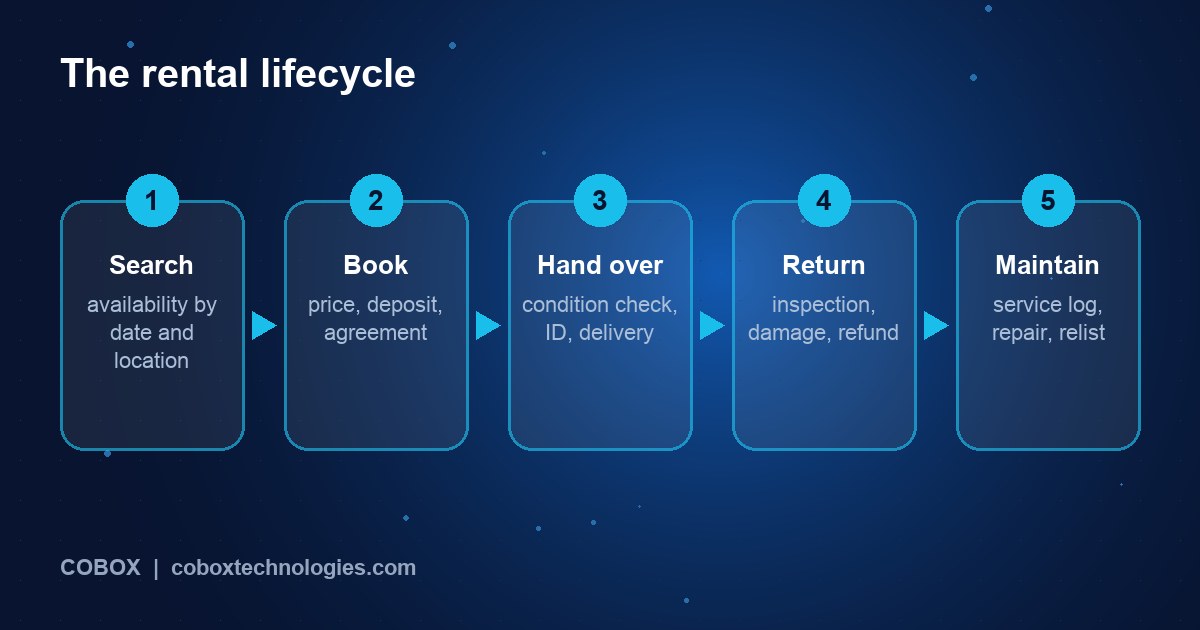
Consider a fictional marketplace, LendLens, in one city. A photographer searches for a 70-200 mm lens for Saturday and Sunday. The listing shows availability for those dates, the owner's rating, price per day (₹1,200), a refundable deposit (₹15,000), and condition photos. She books; the platform checks her identity and holds the deposit on her card or UPI mandate. At pickup, both parties complete a checklist with photos and the system records serial numbers. On return, the owner confirms the lens is undamaged, the deposit is released, and the owner is paid minus a 15 percent commission. If a scratch is found, the owner uploads photos and an estimate; the platform mediates within a fixed window using the pickup photos as evidence.
The value of the platform is trust and evidence, not the listing page. Anyone can list a lens on a classifieds site; few can hold deposits, confirm identity and resolve disputes.
Features that matter
| Area | MVP | Later |
|---|---|---|
| Catalogue | Items, categories, photos, specs, serial numbers, pricing per hour, day or week | Bundles, accessories suggestions, dynamic pricing |
| Availability | Date-range calendar, buffers for cleaning and transit, double-booking prevention | Multi-location stock, waitlists, reservations for projects |
| Booking and contracts | Rental terms, digital agreement, identity check | E-signature, corporate accounts, credit limits |
| Deposits and payments | Deposit hold or collection, rental payment, late fees, refunds | Instalments, invoicing, damage charge workflow |
| Handover and return | Condition checklist with photos, QR on assets, return inspection | IoT or GPS tracking, automated checklists |
| Maintenance | Service schedule by usage or date, repair log, availability blocks | Parts, vendor management, depreciation |
| Marketplace trust | Reviews, owner verification, dispute process, cover options | Insurance integration, fraud scoring |
| Reporting | Utilisation, revenue per asset, damage rate, late returns | Fleet planning, buy-or-sell recommendations |
For scope control see what to include in an MVP.
Availability logic needs care
A rental calendar is harder than a hotel calendar because items return late, need cleaning or repair, and travel between locations. Model the item's status (available, reserved, out, returned-pending-inspection, in-repair), and block the buffer time after each rental. Concurrency control matters: two customers must not both book the last item.
Deposits, damage and disputes
Decide how deposits are collected (card pre-authorisation, UPI collect, or a cash deposit for local shops), what counts as normal wear, how damage is priced, and how disputes are resolved. Whether you can hold funds on behalf of users in a marketplace is a regulated question; use a licensed payment provider and take advice. The ideas in building a financial services platform show why this deserves care.
Architecture in plain language
- Customer web or mobile web: search, availability, booking, payment. See mobile app vs web app.
- Owner and operator dashboard: inventory, calendar, handover checklists, payouts.
- Admin console: verification, disputes, finance.
- Backend: inventory, availability engine, bookings, payments, notifications, media storage.
- Integrations: payment gateway, identity verification, maps, WhatsApp, accounting, optional GPS devices. See API integrations.
Costs and timeline (illustrative)
| Build | Scope | Indicative cost | Indicative time |
|---|---|---|---|
| Rental shop booking system | Catalogue, availability, deposits, contracts, reports | ₹6-14 lakh | 10-14 weeks |
| Peer-to-peer marketplace v1 | Listings, search, payments, handover checklists, disputes, admin | ₹22-45 lakh | 5-8 months |
| B2B equipment platform | Fleet management, quotes, contracts, credit checks, logistics tracking | ₹25-55 lakh | 6-9 months |
Marketplace budgets must also include supply acquisition, insurance arrangements and support. Add 15-20 percent of build cost per year for maintenance; see software maintenance costs.
Worked economics: utilisation decides everything
An own-inventory rental business
Suppose a rental company (hypothetical) buys a mini excavator for ₹18 lakh and rents it for ₹6,000 a day.
- At 40 percent utilisation (146 days a year): revenue = 146 x ₹6,000 = ₹8,76,000
- Operating costs (maintenance, insurance, handling, delivery net of recovery) at ₹1,300 per rented day: ₹1,89,800
- Fixed costs (insurance, storage, finance allocation) of about ₹1,20,000 a year
- Annual contribution after fixed costs: ₹8,76,000 - ₹1,89,800 - ₹1,20,000 = ₹5,66,200
- Simple payback on ₹18 lakh: about 3.2 years, before depreciation, tax and financing cost
At 25 percent utilisation (91 days), revenue falls to ₹5,46,000, operating cost to ₹1,18,300, and contribution to ₹3,07,700; payback stretches to 5.8 years. At 55 percent (201 days), revenue is ₹12,06,000, operating cost ₹2,61,300, contribution ₹8,24,700, and payback about 2.2 years. The same machine and the same price move from marginal to attractive depending on utilisation, which is why booking software that fills gaps and reduces downtime pays off directly.
A peer-to-peer marketplace
For the lens booking: 2 days at ₹1,200 = ₹2,400 rental.
- Commission at 15 percent: ₹360 (revenue)
- Gateway cost at about 2 percent of ₹2,400: ₹48
- Verification and support allocation: ₹60
- Expected damage-mediation cost (say 3 percent of bookings cost ₹2,000 net to the platform): ₹60 per booking on average
- Contribution before marketing: ₹360 - ₹48 - ₹60 - ₹60 = ₹192
If acquiring a renter costs ₹500 and the average renter books three times a year, annual contribution is about ₹576, so payback is under a year. If most users rent once, it never pays back, so repeat usage, such as photographers and event crews, is the segment to target. Always distinguish revenue (₹360), gross profit after direct costs and contribution; see weekly dashboard numbers. Test supply and demand before building with the validation guide.
Growth levers
- Dense local supply: a renter should see several options within reach.
- Repeat professional users: photographers, event companies and contractors drive volume.
- Owner tools: inventory and calendar features keep owners listing.
- Seasonal campaigns: festivals, wedding seasons and construction seasons shift demand.
- Corporate accounts: credit terms and monthly invoicing.
Measure utilisation, revenue per asset, repeat rate, damage and dispute rates, and time to re-rent after return. See what to measure in the first 90 days.
Seven-phase launch plan
- Pick one category in one city, such as cameras, party equipment or compact construction tools.
- Test manually: list 20 items from friendly owners in a spreadsheet, take bookings by WhatsApp, and record every problem.
- Define terms: deposits, late fees, damage rules, cancellation policy.
- Build the MVP: catalogue, availability, booking, deposits, handover checklist.
- Pilot with 10-20 owners and a limited set of renters.
- Launch publicly with a local campaign.
- Add maintenance, insurance options and corporate accounts as usage grows.
Risks and compliance
- Theft and non-return: verify identity, hold deposits, track serial numbers, and consider insurance arrangements.
- Damage disputes: evidence at handover and return protects everyone; define standards clearly.
- Safety and liability: equipment that can injure (ladders, lifts, power tools) raises liability questions. Take legal advice on terms and insurance.
- Funds held: hold deposits only through compliant payment structures.
- Personal data: ID documents and addresses are sensitive under India's Digital Personal Data Protection Act, 2023; get advice on consent and retention. See our security page and security checklist.
- Licences: some equipment (vehicles, medical devices, drones) has specific licensing or operating rules; confirm what applies.
- Taxes: GST on rental income and commissions depends on structure; confirm with an accountant.
These are pointers for your advisers, not legal advice.
How COBOX can help
COBOX helps you pick a category, test demand and design the smallest platform that handles bookings, deposits and handovers well. We produce a Blueprint, build customer, owner and admin experiences, and integrate payments, identity and messaging. See MVP development, marketplace development and business process automation.
Frequently asked questions
Is it better to own inventory or run a marketplace?
Owning inventory gives control and needs capital. A marketplace needs less capital but more trust and supply work. Choose according to funding and your ability to recruit owners.
How much does a rental platform cost to build?
A rental shop system is often ₹6-14 lakh in India, and a marketplace ₹22-45 lakh or more, depending on payments and dispute features.
How do I prevent double bookings?
Use an availability engine with database-level locking and buffers, so two simultaneous bookings cannot both succeed.
How should I set deposits?
Base them on replacement value and risk, make them refundable, and explain release timing clearly.
Do I need GPS tracking?
Only for high-value mobile assets. For small items, serial numbers and photos are usually enough.
How do I handle damage claims fairly?
Use handover and return photos, a defined list of normal wear, and a time-limited mediation process.
What is a good utilisation level?
It depends on category and asset cost. Compute break-even utilisation from your own costs, as in the worked example.
Can I start without an app?
Yes. A responsive booking site with WhatsApp updates is enough to prove demand.
Turn your rental idea into a plan
Planning a rental business or marketplace? Start with a Business Blueprint covering customers, revenue model, MVP features, technology and launch roadmap. Paste something like this into the Blueprint tool:
I want to launch a [camera / event gear / construction equipment / tools] rental [business / marketplace] in [city]. I expect [number] items and about [number] bookings a month at ₹[price]. I need an MVP plan, a deposit and damage policy design, and a validation plan.
Or talk to us first, and read about the Business Blueprint.