 COBOX
COBOX
How to Start a Scrap and Recycling Business with Software: Pickup, Pricing and Traceability
India's informal scrap economy is vast, quiet and surprisingly efficient. Households sell newspapers, metal and appliances to a neighbourhood collector, who sells to a dealer, who sells to a recycler. Each step has a margin, but the weighing is often disputed, the prices opaque, and the final recycler cannot easily trace what it receives. Software cannot replace the collectors, but it can bring trust into the transaction, route pickups efficiently and create records that formal buyers need.
This guide is for founders and operators who want to start a scrap collection or recycling business using software, and for existing scrap dealers who want to digitise. We cover five business models, features, margin economics with worked numbers, compliance, costs and a launch plan. Scenarios are hypothetical and figures illustrative. Scrap prices move daily, so use your own current rates.
How the scrap value chain works
Understanding the chain is the first step:
- Sources: households, offices, shops, factories and construction sites.
- Collectors: neighbourhood kabadiwalas and small aggregators who collect and pay in cash.
- Aggregators and dealers: sort, bale and store materials such as paper, plastic, metal and e-waste.
- Recyclers and processors: pay by weight and quality, often in bulk and with paperwork.
Margins are earned from three things: buying right (accurate weighing and fair rates), sorting well (clean, separated material sells higher) and selling in bulk (better rates and fewer trips). Technology helps with all three.
Five business models
1. Doorstep scrap collection service
Customers book a pickup in an app; a collector arrives with a digital scale, shows current rates and pays instantly. Revenue is the spread between what you pay and what you sell for. Density of pickups determines whether a route is profitable.
2. B2B scrap aggregation for businesses
You collect scrap from offices, factories and retailers on contract, with documentation. Volumes are larger and relationships more stable. See digitising a manufacturing business, because factory scrap is a common source.
3. Scrap marketplace and dealer network
A platform where collectors, aggregators and recyclers trade lots with transparent rates and logistics. Revenue is commission or a trading margin. Trust, quality grading and payment terms are the hard parts; see building a two-sided marketplace and B2B wholesale ordering.
4. E-waste and special material recycling
Collection, refurbishment or dismantling of electronics and batteries. Margins can be higher, but regulation is stricter and handling is hazardous.
5. Software for scrap businesses (SaaS)
Weighing, inventory, rate management, invoicing and compliance records for dealers and recyclers. Revenue is a subscription. See building a SaaS product.
| Model | Revenue | Capital need | Main challenge |
|---|---|---|---|
| Doorstep collection | Buy-sell spread | Medium (vehicles, hub) | Pickup density, rate volatility |
| B2B aggregation | Spread and service fees | Medium | Contracts, documentation |
| Scrap marketplace | Commission, trading margin | Medium to high | Grading, payment terms, trust |
| E-waste recycling | Processing margin | High | Regulation, safety |
| Scrap SaaS | Subscription | Low | Informal sector adoption |
A hypothetical scenario: a Sunday morning route
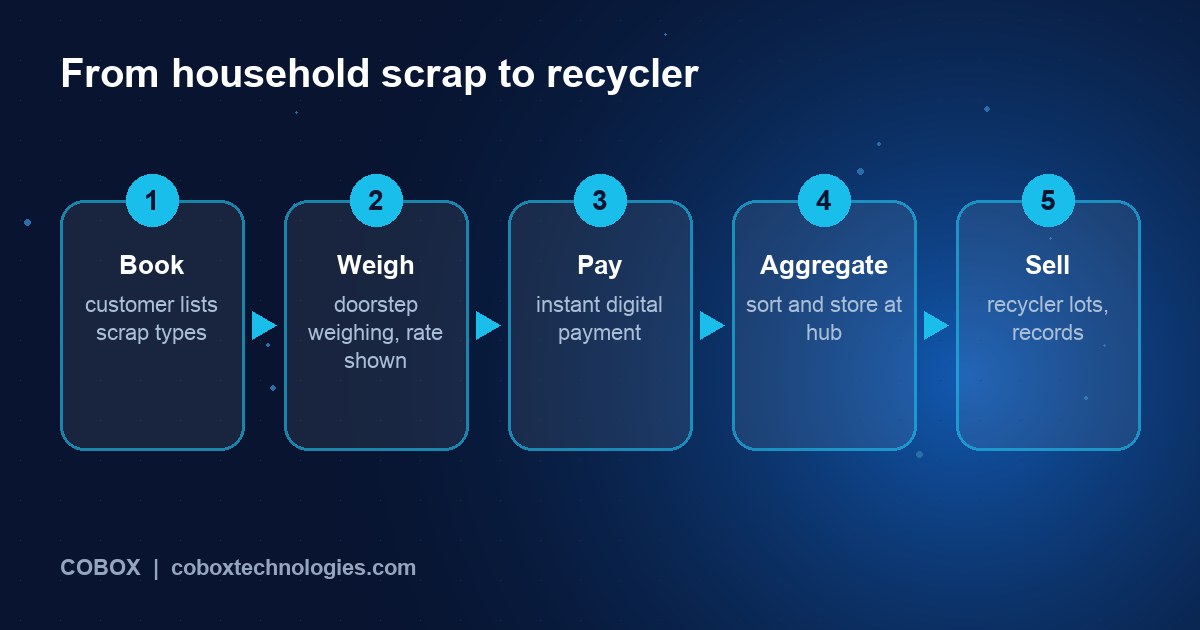
Consider a fictional company, ReLoop, operating in one city zone. A household books a pickup for Sunday between 10 and 12, selecting newspapers, cardboard, iron and old appliances. The app shows indicative rates for each material. At the doorstep the collector weighs each category on a calibrated digital scale connected to his phone, the customer sees the weight and the amount, and agrees. Payment goes to her UPI account before the collector leaves. The collector's route for the morning had 14 stops, sequenced to minimise travel. At the hub, material is sorted and weighed again; differences between doorstep and hub weights are recorded for each collector. By afternoon the aggregated lot of 380 kg of mixed paper is listed to a recycler with a quality grade, and a truck is booked. ReLoop's system keeps the record of source, weight, grade and destination.
Features that matter
| Area | MVP | Later |
|---|---|---|
| Customer booking | Pickup slots, material selection, indicative rates, address, reminders | Subscriptions for offices, loyalty, donation options |
| Collector app | Route list, doorstep weighing entry, rate card, instant payment, offline mode | Bluetooth scale integration, route optimisation, incentives |
| Rate management | Admin-controlled rate cards by material and area, change history | Dynamic rates from market data, buyer bids |
| Hub operations | Inbound weighing, sorting, inventory by grade, shrinkage tracking | Bale tracking with QR, storage optimisation |
| Sales to recyclers | Lots, grading, orders, delivery, invoices | Marketplace bidding, contracts, credit management |
| Payments | UPI payouts to customers, collector settlements, recycler invoices | Auto-reconciliation, wallets |
| Compliance and reporting | Transaction records, weight slips, certificates on request | Environmental reports, traceability dashboards |
For scope discipline see what to include in an MVP.
Trust at the doorstep
The biggest reason customers hesitate is the scale. Show weights on the customer's phone, use calibrated scales with periodic checks, and publish rate cards openly. Collector honesty is protected by transparency, not by supervision alone. Also record shrinkage: a collector whose doorstep weights are consistently 8 percent higher than hub weights is a risk worth investigating.
Architecture in plain language
- Customer web or mobile web: booking and payment; many users book via WhatsApp or a link.
- Collector mobile app (offline-first): routes, weights, payments. See mobile app development and mobile app vs web app.
- Hub console: inventory, grading, dispatch.
- Backend: pickups, routing, rates, ledger, traceability records.
- Integrations: maps and routing, payment gateway or UPI payouts, WhatsApp, accounting, optional weighing scales. See API integrations.
Logistics concepts overlap with digitising a logistics business.
Costs and timeline (illustrative)
| Build | Scope | Indicative cost | Indicative time |
|---|---|---|---|
| Pickup and hub MVP | Booking, collector app, rate cards, hub inventory, payments | ₹10-22 lakh | 3-5 months |
| B2B and recycler sales | Contracts, lots, grading, invoicing, traceability reports | ₹8-18 lakh extra | 2-4 months |
| Scrap marketplace or SaaS v1 | Multi-company accounts, bidding, logistics, compliance reports | ₹30-60 lakh | 6-9 months |
Operating costs (vehicles, scales, hub rent, staff) usually exceed software costs. Add 15-20 percent of build cost per year for maintenance; see software maintenance costs.
Worked economics: the pickup route
Assume ReLoop (hypothetical) collects a mixed household load. For clarity we use a single blended rate.
- Average pickup: 28 kg of mixed material
- Buying rate paid to the customer: ₹16 per kg, so ₹448
- Selling rate to the recycler after sorting: ₹21 per kg on 94 percent of the weight (6 percent is lost to moisture, contamination and weighing differences): 28 x 0.94 = 26.3 kg x ₹21 = ₹552
- Gross margin per pickup: ₹552 - ₹448 = ₹104
- Collector cost (paid per pickup) allocated: ₹60
- Vehicle fuel and hub handling allocation: ₹35
- Payment and app costs: ₹8
- Contribution per pickup: ₹104 - ₹60 - ₹35 - ₹8 = ₹1
That is essentially break-even, which is why household-only models struggle. Now see what changes the picture. If pickup size rises to 45 kg through bundling larger items and office waste, with the same percentage rates: buying ₹720, selling 45 x 0.94 x ₹21 = ₹888, gross margin ₹168; with collector cost ₹75, handling ₹50 and payment ₹10, contribution is ₹33. If shrinkage falls from 6 to 3 percent through better weighing, on the 28 kg load revenue rises to 28 x 0.97 x ₹21 = ₹570, adding ₹18. And a B2B contract of 800 kg a month paid at ₹17 and sold at ₹22 with 4 percent shrinkage yields: revenue 800 x 0.96 x ₹22 = ₹16,896; cost ₹13,600; gross margin ₹3,296, minus ₹1,200 transport and ₹300 handling, contribution about ₹1,800 per month from one stop. Per visit economics are much better with fewer, larger pickups.
The lessons: weight per stop, shrinkage and route density decide profit, and software moves each of them. Rate volatility is the other risk: if the selling rate falls by ₹2 per kg while you have already paid customers, margin disappears, so keep inventory short and rate cards updated. Keep revenue, gross margin and contribution distinct; see weekly dashboard numbers. Test willingness to book with the validation guide.
Growth levers
- Housing societies and offices: scheduled pickups with large, predictable volumes.
- Subscriptions: monthly pickups reduce acquisition cost per kilogram.
- Business contracts: retailers, restaurants and factories generate daily scrap.
- Sustainability reporting: companies increasingly want records of what they recycled; offer certificates.
- Collector partnerships: bring existing kabadiwalas onto the platform with tools that help them earn more, rather than replacing them.
Measure kilograms per pickup, shrinkage rate, cost per kilogram collected, pickups per route-hour and repeat rate. See what to measure in the first 90 days.
Seven-phase launch plan
- Map one zone: walk it with a collector and list sources, rates and buyers.
- Run it manually for a month with a phone number, a scale and a spreadsheet.
- Define standard rate cards and routes from real data.
- Build the MVP: booking, collector app and hub inventory first.
- Pilot with a few societies and shops.
- Add B2B contracts and recycler sales.
- Add compliance records and expand zones once margins hold.
Moving from phone calls and sheets to software is a familiar path; see Excel and WhatsApp: when to upgrade.
Risks and compliance
- Environmental rules: collecting and processing waste, especially e-waste, batteries and hazardous materials, is regulated under Indian environmental rules (for example e-waste and plastic waste rules) and often needs authorisations. Confirm what applies to your materials and scale.
- Handling safety: sharp, toxic and heavy materials create injury risk; provide training and protective equipment.
- Weighing and fairness: use calibrated scales and follow legal metrology requirements where applicable.
- Personal data: customer addresses and business records are personal data under India's Digital Personal Data Protection Act, 2023; see our security page.
- Cash and payments: digital payouts reduce theft and disputes; record cash payments carefully.
- Illegal or stolen material: require identity checks for larger sellers and keep records to deter handling stolen goods.
- Rate risk: commodity price swings can erase margin; hold limited inventory.
- Taxes: GST on scrap sales and purchases has specific rules; confirm with an accountant.
These are pointers for your advisers, not legal advice.
How COBOX can help
COBOX helps you test the pickup economics before heavy investment and then builds the platform: customer booking, offline-capable collector app, hub inventory, recycler sales and traceability records. We produce a Blueprint, integrate payments and messaging, and set up dashboards for shrinkage and route performance. See MVP development, business process automation and analytics dashboards.
Frequently asked questions
Is a scrap collection app profitable?
It can be, but household pickups alone are thin. Profit comes from larger loads, low shrinkage, dense routes and business contracts.
How much does it cost to build?
A pickup and hub MVP often costs ₹10-22 lakh in India, with marketplaces costing more. Vehicles and hubs are additional.
How do I gain customers' trust on weights?
Use calibrated scales, show weights and rates on the customer's phone and pay digitally on the spot.
Should I work with existing kabadiwalas?
Yes. They know the neighbourhood and have customer trust. Offer tools that increase their earnings instead of competing with them.
How do I handle rate changes?
Maintain admin-controlled rate cards, update them often and track margin by material daily.
Do I need special permissions?
For ordinary paper and metal, usually local trade rules; for e-waste, batteries and hazardous materials, specific authorisations apply. Confirm for your case.
Can this work for businesses only?
Yes. B2B contracts often have better economics than household pickups.
What should I measure first?
Kilograms per pickup, shrinkage, and cost per kilogram collected.
Turn your idea into a plan
Planning a scrap or recycling business? Start with a Business Blueprint covering customers, collectors, revenue model, MVP features, technology and launch roadmap. Paste something like this into the Blueprint tool:
I want to start a [doorstep scrap collection / B2B scrap aggregation / recycler marketplace] business in [city zone]. I expect [number] pickups a month averaging [number] kg at ₹[buy rate] per kg and a sale rate of ₹[sell rate]. I need an MVP plan, a collector app approach and a validation plan.
Or talk to us first, and read about the Business Blueprint.