 COBOX
COBOX
How to Start an Automotive Services and Marketplace Business: Garages, Used Cars and Parts

A car owner rarely wakes up wanting to visit a garage. They go because something is wrong, they feel unsure what it will cost, and they suspect they may be overcharged. Automotive services are a high-spend, low-trust category, which is exactly why transparency is worth money: the business that shows the problem, the price and the progress wins repeat customers in a market where most competitors leave customers guessing.
This guide is for founders building an automotive platform, and for garage, dealership and fleet owners moving from job-card books to software. We cover five business models, how each earns, the features that matter, worked unit economics, risks and a launch plan. All scenarios are hypothetical and figures are illustrative.
Why automotive is a good fit for software
Vehicles generate a long chain of recurring events: services every few months, insurance and pollution certificates yearly, tyres and batteries on a cycle, and eventual resale. Each event involves several parties (owner, workshop, parts supplier, insurer, buyer), usually coordinated by phone. Software helps in three ways:
- Transparency: photos of the fault, itemised estimates and approval before work starts.
- Utilisation: workshops earn from bay-hours, so filling and sequencing them matters.
- Retention: service history and reminders bring owners back to the same place.
Five business models
1. Garage and workshop management software
SaaS for independent workshops and chains: bookings, job cards, inventory, billing, customer records and reminders. Revenue is a monthly subscription. Garage owners are practical buyers, so the product must be quicker than a notebook on day one. See how to build a SaaS product.
2. Car service booking marketplace
Customers compare and book services at partner garages, with pickup and drop as an option. Revenue is commission or a margin on services. The central challenge is consistent quality across independent garages. Our marketplace guide covers supply and demand balance.
3. Used-car marketplace or dealer platform
Listings, inspection reports, financing and ownership transfer support. Revenue comes from listing fees, dealer subscriptions, or a margin on cars you own. Used cars are information-poor, so independent inspection reports and history are what buyers pay for.
4. Auto parts and accessories e-commerce
The hardest problem is fitment: the right part for the right make, model, year and variant. A fitment database is the moat. Compare with starting an e-commerce business and, for trade buyers, B2B wholesale ordering.
5. Fleet maintenance for businesses
Companies with delivery vans, cabs or staff vehicles need maintenance schedules, vendor management and cost control across many vehicles. Revenue is contracts or per-vehicle fees. Sales cycles are longer, retention is high. Related ideas appear in digitising a logistics business.
| Model | Revenue | Capital need | Main challenge |
|---|---|---|---|
| Garage software | Subscription | Low | Adoption by busy owners |
| Service marketplace | Commission, margin | Medium | Quality control of garages |
| Used-car platform | Fees, margin | Medium to high | Trust, inspection, financing |
| Parts e-commerce | Product margin | Medium (inventory) | Fitment accuracy, returns |
| Fleet maintenance | Contracts | Low to medium | Long sales cycles |
A hypothetical scenario: the 40,000 km service
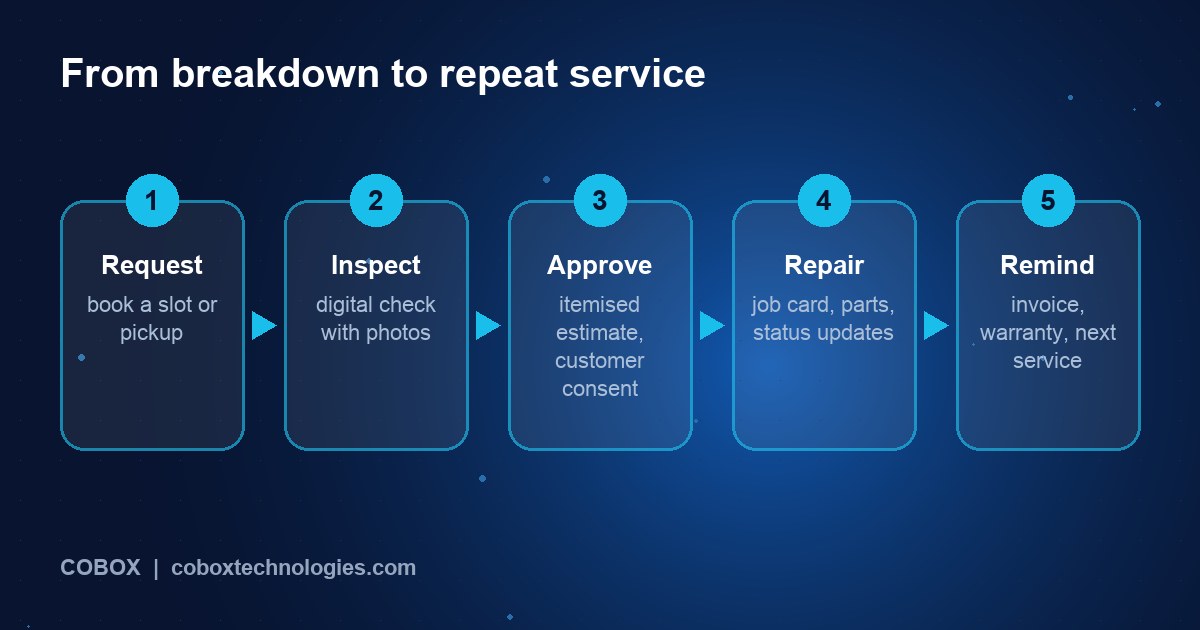
Consider a fictional platform, GaragePilot. Meera's hatchback is due for service. She books through a mobile page, picks a Saturday morning slot, and a driver collects the car. At the garage, the technician runs a digital inspection on a tablet: 30 checkpoints, with photos of worn brake pads and a leaking boot seal. The estimate arrives on Meera's phone: routine service ₹4,200, brake pads ₹2,800, seal ₹900. She approves two items and defers one. Progress updates arrive at each stage, the car returns by evening, and the invoice lists parts and labour with a warranty note. In five months, a reminder offers the next service and the tyre check.
The technology did not repair the car. It replaced a phone call and an unexplained bill with something the customer could see and approve, which is what builds repeat business.
Features that matter
Pick one model and one customer. For scope discipline see what to include in an MVP.
| Area | MVP | Later |
|---|---|---|
| Booking | Slots by bay capacity, pickup and drop, reminders | Subscription plans, roadside assistance |
| Job cards | Digital inspection, photos, itemised estimate, customer approval | Technician productivity, rework tracking |
| Parts and inventory | Stock, purchase orders, part costs on job cards | Supplier integrations, demand forecasting |
| Vehicle records | Service history, VIN or registration, documents | Warranty management, resale reports |
| Billing | GST invoices, payments, estimates vs actuals | Insurance claims workflow, financing |
| Customer engagement | Status updates, service and document reminders | Loyalty, campaigns, referral |
| Reporting | Revenue per bay-hour, repeat rate, estimate approval rate | Branch comparisons, margin by job type |
If you add a used-car marketplace, build inspection reports and listing quality controls early: a marketplace full of unverified cars loses trust quickly. For parts, invest in fitment data before UI polish.
Architecture in plain language
- Customer web or app: booking, approvals, history, payments. Many customers will arrive from search or a WhatsApp link, so a mobile web experience is a good start; see mobile app vs web app.
- Workshop tablet app: job cards, photos, checklists, status updates. It must work with weak Wi-Fi.
- Back office: inventory, billing, reports.
- Integrations: payment gateway, WhatsApp or SMS, vehicle data lookups where permitted, accounting. See API integrations and connecting CRM and accounting.
Costs and timeline (illustrative)
| Build | Scope | Indicative cost | Indicative time |
|---|---|---|---|
| Garage management MVP | Bookings, job cards, inventory, billing, reminders | ₹8-18 lakh | 3-4 months |
| Service marketplace v1 | Customer app, garage dashboard, payments, ratings, admin | ₹22-45 lakh | 5-8 months |
| Used-car or parts platform | Listings or catalogue, inspection or fitment, payments, dashboards | ₹25-55 lakh | 6-9 months |
Obtain quotes against a written scope; allow 15-20 percent of build cost per year for maintenance (see software maintenance costs) and compare with ready-made tools using custom vs ready-made software.
Worked economics: a service marketplace
Suppose GaragePilot (hypothetical) completes a booking worth ₹6,000 in service and parts, and takes a 12 percent commission.
- Gross booking value (GBV): ₹6,000
- Commission revenue: ₹720
- Pickup and drop cost: ₹250
- Payment gateway at about 2 percent: ₹120
- Support allocation: ₹60
- Contribution before marketing: ₹720 - ₹250 - ₹120 - ₹60 = ₹290
If customer acquisition costs ₹900 and the average customer books twice a year, annual contribution is about ₹580, and payback takes roughly 19 months at that rate. Raising repeat bookings to three a year gives ₹870, near break-even in the first year. Two levers matter more than features: reducing pickup cost through route batching, and lifting repeat rate through reminders. The same ₹6,000 job earns the garage perhaps 20 to 30 percent gross margin, so ask garages whether a 12 percent commission leaves them better off through extra volume; if not, the supply side will leave.
For garage SaaS the arithmetic is simpler. At ₹2,500 a month per garage and 5 percent monthly churn, expected lifetime is 20 months, so lifetime revenue is ₹50,000 per garage. If onboarding and sales cost ₹12,000 and support costs ₹300 a month (₹6,000 over the lifetime), contribution is about ₹32,000, a healthy return if the churn assumption holds. Test it on 20 pilot garages first. Keep revenue, gross profit and contribution separate in reporting; see weekly dashboard numbers, and test demand with our validation guide.
Growth levers
- Local SEO: pages like "car service in [locality]" with real prices and reviews.
- Digital service history: owners return where their records live.
- B2B partnerships: corporate fleets, dealerships, and insurers send steady volume.
- Estimate transparency: showing the part and price builds the trust that drives referrals.
Measure estimate approval rate, repeat rate within six months, bay utilisation and complaint rate. Attribution is covered in tracking marketing leads; launch metrics in the first 90 days.
Seven-phase launch plan
- Shadow garages: spend two days in workshops and map real workflows.
- Choose the model and a niche: two-wheelers, premium cars, EV, or fleets.
- Define the MVP: job card, estimate approval, reminders.
- Build and pilot with 3-5 garages, fixing friction weekly.
- Add customer booking once garage workflows are stable.
- Launch in one locality cluster to keep pickup costs low.
- Expand by adding services (tyres, detailing, insurance renewals).
Risks and compliance
- Quality and liability: bad repairs damage your brand; set service standards, warranties and complaint handling.
- Vehicle and owner data: registration numbers and addresses are personal data under India's Digital Personal Data Protection Act, 2023; take advice on consent and retention. See our security page.
- Used cars: ownership transfer, hypothecation checks and odometer fraud need verification processes, and the legal steps depend on the state.
- Parts authenticity: counterfeit parts are a risk; require supplier verification and return rules.
- Insurance and finance: selling or arranging them requires licensed partners; do not offer them yourself without proper authorisation.
- Pickup and drop safety: driver vetting, vehicle condition records and insurance cover.
- Taxes: GST on service, parts and commission differs; confirm with an accountant.
These are pointers for your advisers, not legal advice.
How COBOX can help
COBOX helps you decide whether to build software for garages, a marketplace or a parts business, and what to build first. We create a Blueprint, build the workshop, customer and admin experiences, and integrate payments, messaging and accounting. See MVP development, business process automation and mobile app development.
Frequently asked questions
Should I build garage software or a marketplace?
Software has a clearer customer and steadier revenue. A marketplace needs supply, demand and operations at the same time. Start with software if your capital is limited.
How much does an automotive platform cost?
A garage management MVP typically costs around ₹8-18 lakh in India. Marketplaces and parts platforms cost more.
How do I make sure parts fit?
Build a fitment database by make, model, year and variant, and validate it with returns data.
Do customers need an app?
Not initially. A mobile web page with WhatsApp updates handles most flows.
How do I build trust with estimates?
Include photos, itemised prices and a clear approve-or-defer choice for every item.
Can I use this for two-wheelers or EVs?
Yes. Job cards and reminders are similar; inspection checklists and parts catalogues differ.
How do I find the first garages?
Offer the software free for a pilot period in one locality, learn from their workflows, and ask them for referrals.
What should I measure first?
Estimate approval rate, repeat rate, bay utilisation and complaints.
Turn your automotive idea into a plan
Planning an automotive platform? Start with a Business Blueprint covering customers, revenue model, MVP features, technology and launch roadmap. Paste something like this into the Blueprint tool:
I want to build a [garage management software / car service marketplace / used-car platform / parts store] for [city and vehicle type]. I expect [number] garages or [number] monthly bookings at about ₹[price]. I need an MVP plan, integrations and a validation plan.
Or talk to us first, and read about the Business Blueprint.